With a 68% probability of an interest rate hike looming in the market, what changes have occurred in the trading logic for silver?
2026-09-02 18:40:03
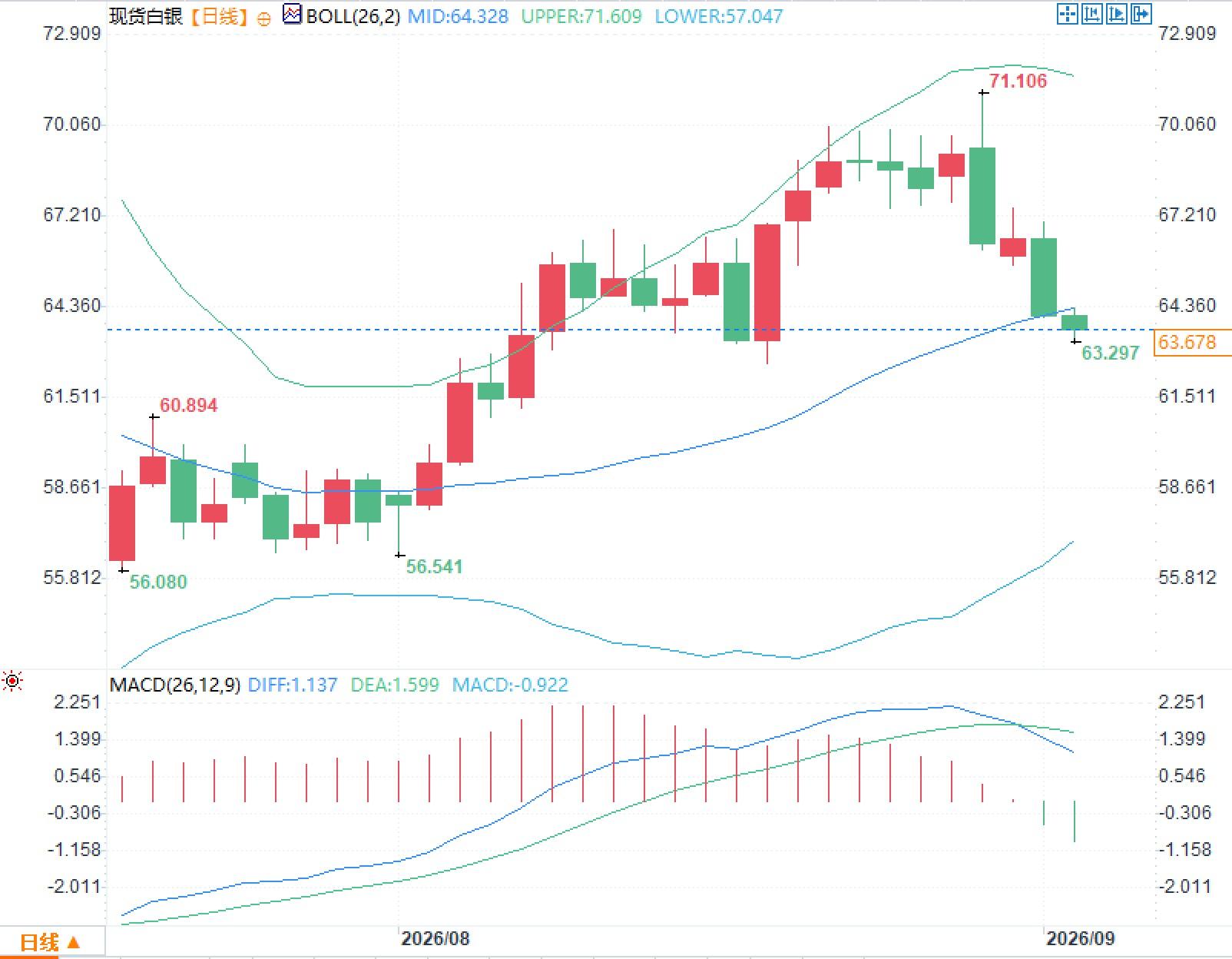
On Wednesday, September 2nd, spot silver continued its high volatility following the Jackson Hole meeting, currently trading around $63.70 per ounce. Compared to its intraday high above $71 per ounce on August 28th, it has seen a significant pullback in just a few trading days. Meanwhile, the implied probability of a 25 basis point rate hike at the Fed's September meeting has risen to approximately 68.1%, compared to only about 35.7% a week ago, making policy expectations the core variable in this round of precious metal repricing. 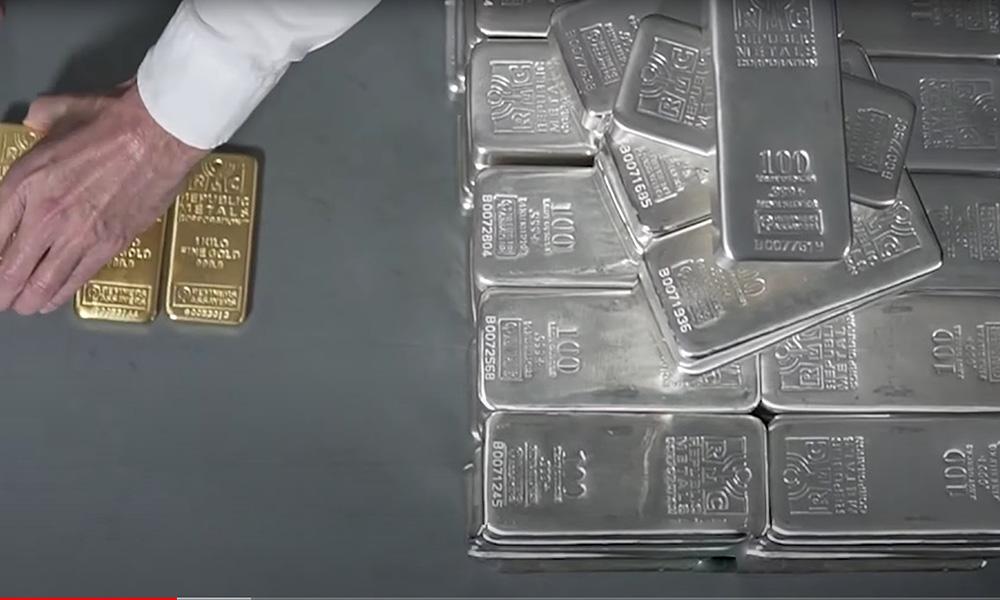
 The upcoming US data release schedule is particularly packed. The August jobs report will be released on September 4th, the August producer price index on September 10th, and the August consumer price index on September 11th, while the Federal Reserve meeting is scheduled for September 15th and 16th. Previously, non-farm payrolls decreased by 23,000 in July, and the unemployment rate was 4.1%. Employment and inflation data will jointly influence interest rate expectations within the same policy window.
Walsh's speech didn't just change a single sentence; it changed the market's reaction function.
In his speech on August 28, Federal Reserve Chairman Kevin Warsh explicitly stated that it is difficult to describe the current broad financial conditions as restrictive, and emphasized that inflation remains above the 2% target, with the current policy focus on price stability. He also pointed out that recent, relatively mild inflation readings are insufficient to prove that the underlying trend has substantially improved. The significance of these statements lies in redefining the market's previous assessment that "current interest rates are already tight enough." Recent data also clarifies this stance. In July, the U.S. Consumer Price Index (CPI) rose 3.4% year-on-year, with the core index rising 2.5%; the Personal Consumption Expenditures (PCE) price index, which the Fed pays closer attention to, rose 3.7% year-on-year in July, with the core index rising 3.3%. Warsh also specifically mentioned that among the 199 sub-items of the PCE price index, 54% of the items have increased by more than 3% over the past 12 months, indicating that policymakers are not focusing on single-month data, but rather on the breadth and stickiness of price increases. Therefore, the market is now trading not just on whether interest rates will be adjusted at a particular meeting, but on whether the Fed's tolerance for inflation has decreased. September interest rate futures currently correspond to a probability of about a 68.1% rate hike, while the probability of maintaining the current interest rate range is about 31.9%. This change means that the easing expectations previously reflected in the yield curve are being partially withdrawn.Why does silver react so dramatically to interest rate repricing?
For silver, macro pricing involves at least three synchronous variables: interest rates, the US dollar, and risk premiums. On September 2nd, the yield on the 10-year US Treasury note had risen to approximately 4.81%, while the US dollar index hovered around 99.8. Since silver itself does not generate interest income, rising bond yields increase the opportunity cost of holding non-interest-bearing assets; a stronger dollar alters the cross-market valuation environment for dollar-denominated commodities. When both change simultaneously, precious metals often exhibit higher price elasticity. This round of interest rate repricing is not driven by a single inflation data point. Energy prices, bond term premiums, and policy communication have all changed. On September 2nd, Brent crude oil briefly traded above $95 per barrel, with energy supply risks from the Middle East conflict re-entering inflation pricing. For the Federal Reserve, rising energy prices themselves may not directly determine policy, but if they further impact transportation costs, corporate input prices, and inflation expectations, it will reduce policymakers' confidence in a short-term decline in inflation. Therefore, the recent sharp correction in silver is more closely related to a simultaneous adjustment in macro discount rates and crowded positions, rather than a simple deterioration in silver's own fundamentals.Structural shortages persist, but short-term pricing power is temporarily in the hands of macroeconomic variables.
The biggest difference between silver and gold lies in the undeniable industrial attributes of silver. The latest annual industry survey projects global silver demand at approximately 1.11 billion ounces in 2026, with a potential structural gap of around 46.3 million ounces. Simultaneously, industrial demand is expected to decline by about 3%, primarily due to silver-saving technologies and material substitution in the photovoltaic sector, while demand for silver bars and coins is projected to grow by about 18%. This means the supply-demand structure is not a one-way change, but rather a coexistence of increased investment demand and cooling industrial demand. This structure explains why silver simultaneously exhibits both long-term supply constraints and short-term high volatility. Mine supply adjustments are relatively slow, and inventories can buffer the physical supply gap; however, financial markets are constantly recalculating real interest rates, the US dollar, term premiums, and policy probabilities. Therefore, during periods of rapid change in macroeconomic variables, the annual supply-demand gap does not mechanically translate into daily price performance. From an asset pricing perspective, the current focus should be on distinguishing between inventory logic and marginal funding logic. The former determines the medium- to long-term scarcity of silver, while the latter determines high-frequency volatility. When policy expectations lead to a repricing of more than 30 percentage points within a week, the impact on the funding side often temporarily overshadows the gradual changes on the industrial side.Technical structure reflects kinetic energy cooling, but is not equivalent to directional conclusions.
In the daily chart, silver previously surged to the upper Bollinger Band before retreating, and is now approaching the middle Bollinger Band again. The Bollinger Bands remain wide, indicating that the previously high volatility environment has not been fully digested. Meanwhile, the MACD indicator's DIF has fallen below the DEA, and the histogram has turned negative, suggesting a significant weakening of the short-term momentum generated by the previous price increase. The upcoming US data release schedule is particularly packed. The August jobs report will be released on September 4th, the August producer price index on September 10th, and the August consumer price index on September 11th, while the Federal Reserve meeting is scheduled for September 15th and 16th. Previously, non-farm payrolls decreased by 23,000 in July, and the unemployment rate was 4.1%. Employment and inflation data will jointly influence interest rate expectations within the same policy window.
- Risk Warning and Disclaimer
- The market involves risk, and trading may not be suitable for all investors. This article is for reference only and does not constitute personal investment advice, nor does it take into account certain users’ specific investment objectives, financial situation, or other needs. Any investment decisions made based on this information are at your own risk.