Gold prices rebounded to around $4,400 as US Treasury yields fell and the dollar weakened, awaiting the release of the non-farm payroll data.
2026-09-03 10:14:03
International gold prices rebounded from near a one-month low in early Asian trading on Thursday, with spot gold returning to around $4,400. Previously, gold prices had been under pressure, mainly due to a stronger dollar and a rapid rise in US long-term Treasury yields. As the dollar index and US Treasury yields retreated from recent highs, the actual cost of holding gold decreased, and some bargain hunters re-entered the market, providing short-term support for gold prices.  U.S. Treasury yields had previously risen to multi-year highs but subsequently retreated. John Williams, president of the New York Federal Reserve, stated that the recent rise in long-term Treasury yields was not primarily due to a renewed loss of control over inflation expectations, but rather reflected the continued resilience of the U.S. economy. Factors such as economic growth, investment demand, and geopolitical tensions could all drive up long-term interest rates, while the inflation trend itself is gradually cooling. This statement has a dual meaning for gold. If the rise in yields is mainly driven by economic growth expectations rather than worsening inflation expectations, then the demand for gold as an inflation hedge may be limited; however, on the other hand, if the market's concerns about further significant tightening by the Federal Reserve decrease as a result, the upside potential for real interest rates and the dollar may be constrained, thus providing some breathing room for gold. Another key variable in recent gold price movements comes from the situation in the Middle East. Following a new round of U.S. airstrikes against targets in Iran, Iran subsequently retaliated against U.S. targets in Bahrain, Kuwait, Jordan, and Iraq, reigniting market concerns about a further escalation of the regional conflict. Meanwhile, the security risks in the Strait of Hormuz continue to be a focus of the energy market. Rising energy prices are affecting gold through another pathway. Rising oil prices could reignite global inflationary pressures, prompting markets to reassess monetary policy paths for the coming months. While gold is generally considered a key asset for hedging against inflation, it doesn't generate interest income. Therefore, the opportunity cost of holding gold increases when market interest rates remain high. Investors currently estimate the probability of the Federal Reserve adjusting interest rates this month at approximately 62.3%, significantly higher than market pricing in at some previous stages. If this expectation continues to intensify, the dollar and US Treasury yields may regain upward momentum, putting downward pressure on gold. Conversely, if US employment data weakens significantly, and the market re-bets on a shift towards looser monetary policy, gold could receive a new catalyst for price increases. The US August non-farm payroll data will be one of the most important macroeconomic events in the near term. The performance of the labor market not only directly affects the Federal Reserve's assessment of economic resilience but also transmits to gold through three channels: the dollar, US Treasury yields, and real interest rates. If new job growth is significantly lower than market expectations, while the unemployment rate rises, investors may increase their bets on looser policies, potentially extending gold's rebound. Conversely, strong employment data could reinforce expectations of higher interest rates for a longer period, limiting gold's upside potential. Currently, the gold market is in a phase of highly concentrated macroeconomic variables. On the one hand, geopolitical risks continue to provide safe-haven demand; on the other hand, rising energy prices may push up inflation and compress the space for monetary policy easing. Meanwhile, Federal Reserve officials have emphasized that the US economy remains robust, meaning the market cannot simply interpret the current high yields as a precursor to a policy shift. From a daily chart perspective, spot gold rebounded near $4380 after a rapid decline in the previous period and is currently trading above the 100-day simple moving average, indicating that the overall medium-term structure has not yet been broken. However, the gold price is still below the Bollinger Band's middle line, suggesting that the bulls have not yet regained control of the trend in the short term. The 14-day RSI is around 50, indicating that market momentum is in neutral territory, meaning that the subsequent direction is highly dependent on macroeconomic data catalysts. The first resistance level to watch is the Bollinger Band middle line around $4450. A successful break above this level would target the upper Bollinger Band around $4685. On the downside, the key support level is the 100-day moving average around $4360. A break below this level could lead to a further pullback to the lower Bollinger Band around $4215. Looking at the 4-hour chart, gold has undergone a technical correction after a continuous decline, with short-term bearish momentum weakening. However, the current rebound lacks clear trend confirmation. Continued declines in the US dollar and US Treasury yields would favor a rebound towards $4450. A successful break above $4450 on the 4-hour chart could further improve the short-term technical structure. Conversely, if the price falls back below the $4380-$4360 support zone, it suggests that this rebound is more of an oversold correction, and there is still a possibility of retesting the $4300 or even $4215 area. Therefore, the key level for short-term gold price movement remains around $4360, while the key resistance level to watch is whether a successful break above $4450 can be achieved.
 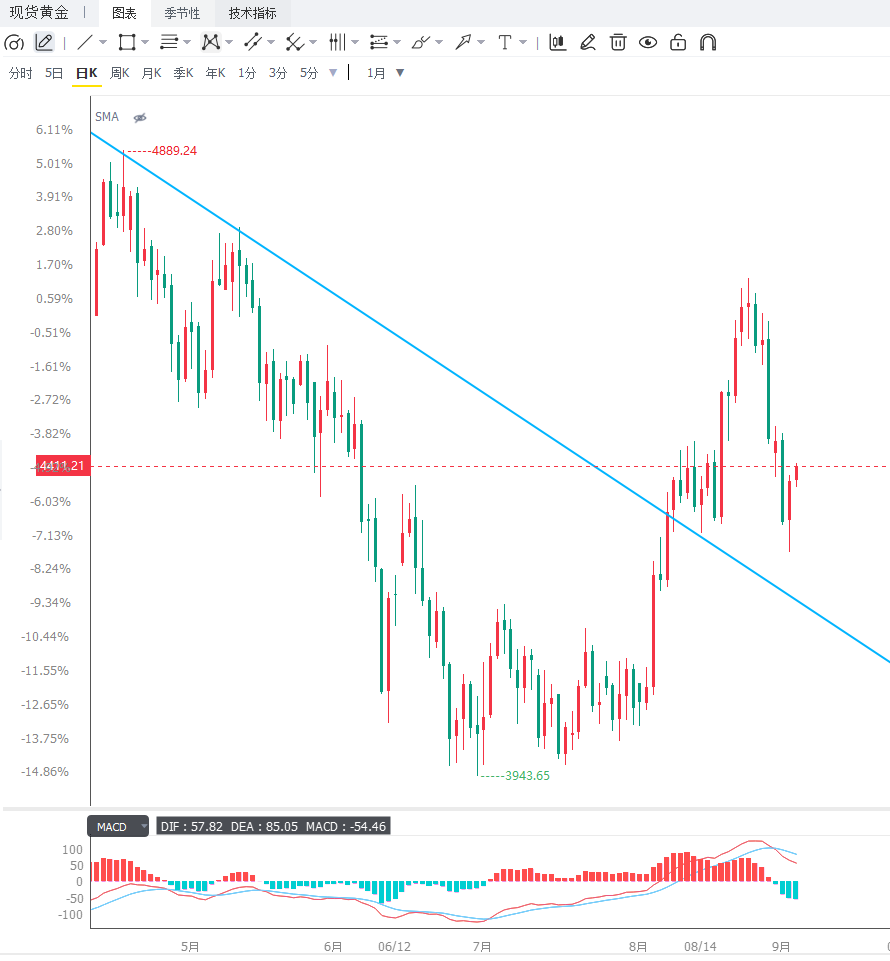 Editor's Summary: The current rebound in gold is largely a technical correction following the decline in the US dollar and US Treasury yields. While safe-haven demand from the Middle East situation remains, inflationary pressures from rising oil prices may limit the Federal Reserve's policy shift, making a sustained upward trend in gold unlikely in the short term. The market focus will now be on the US August non-farm payroll data and the correlation between the US dollar and US Treasury yields. If a slowdown in employment drives yields down, gold could retest $4450 and further open up upside potential; conversely, if employment remains strong and reinforces high-interest-rate expectations, gold prices may retest the $4360 support level. Before the release of macroeconomic data, gold is likely to remain volatile, and the price risk from rapid inverse movements of the US dollar and yields after the data release should be closely monitored.
U.S. Treasury yields had previously risen to multi-year highs but subsequently retreated. John Williams, president of the New York Federal Reserve, stated that the recent rise in long-term Treasury yields was not primarily due to a renewed loss of control over inflation expectations, but rather reflected the continued resilience of the U.S. economy. Factors such as economic growth, investment demand, and geopolitical tensions could all drive up long-term interest rates, while the inflation trend itself is gradually cooling. This statement has a dual meaning for gold. If the rise in yields is mainly driven by economic growth expectations rather than worsening inflation expectations, then the demand for gold as an inflation hedge may be limited; however, on the other hand, if the market's concerns about further significant tightening by the Federal Reserve decrease as a result, the upside potential for real interest rates and the dollar may be constrained, thus providing some breathing room for gold. Another key variable in recent gold price movements comes from the situation in the Middle East. Following a new round of U.S. airstrikes against targets in Iran, Iran subsequently retaliated against U.S. targets in Bahrain, Kuwait, Jordan, and Iraq, reigniting market concerns about a further escalation of the regional conflict. Meanwhile, the security risks in the Strait of Hormuz continue to be a focus of the energy market. Rising energy prices are affecting gold through another pathway. Rising oil prices could reignite global inflationary pressures, prompting markets to reassess monetary policy paths for the coming months. While gold is generally considered a key asset for hedging against inflation, it doesn't generate interest income. Therefore, the opportunity cost of holding gold increases when market interest rates remain high. Investors currently estimate the probability of the Federal Reserve adjusting interest rates this month at approximately 62.3%, significantly higher than market pricing in at some previous stages. If this expectation continues to intensify, the dollar and US Treasury yields may regain upward momentum, putting downward pressure on gold. Conversely, if US employment data weakens significantly, and the market re-bets on a shift towards looser monetary policy, gold could receive a new catalyst for price increases. The US August non-farm payroll data will be one of the most important macroeconomic events in the near term. The performance of the labor market not only directly affects the Federal Reserve's assessment of economic resilience but also transmits to gold through three channels: the dollar, US Treasury yields, and real interest rates. If new job growth is significantly lower than market expectations, while the unemployment rate rises, investors may increase their bets on looser policies, potentially extending gold's rebound. Conversely, strong employment data could reinforce expectations of higher interest rates for a longer period, limiting gold's upside potential. Currently, the gold market is in a phase of highly concentrated macroeconomic variables. On the one hand, geopolitical risks continue to provide safe-haven demand; on the other hand, rising energy prices may push up inflation and compress the space for monetary policy easing. Meanwhile, Federal Reserve officials have emphasized that the US economy remains robust, meaning the market cannot simply interpret the current high yields as a precursor to a policy shift. From a daily chart perspective, spot gold rebounded near $4380 after a rapid decline in the previous period and is currently trading above the 100-day simple moving average, indicating that the overall medium-term structure has not yet been broken. However, the gold price is still below the Bollinger Band's middle line, suggesting that the bulls have not yet regained control of the trend in the short term. The 14-day RSI is around 50, indicating that market momentum is in neutral territory, meaning that the subsequent direction is highly dependent on macroeconomic data catalysts. The first resistance level to watch is the Bollinger Band middle line around $4450. A successful break above this level would target the upper Bollinger Band around $4685. On the downside, the key support level is the 100-day moving average around $4360. A break below this level could lead to a further pullback to the lower Bollinger Band around $4215. Looking at the 4-hour chart, gold has undergone a technical correction after a continuous decline, with short-term bearish momentum weakening. However, the current rebound lacks clear trend confirmation. Continued declines in the US dollar and US Treasury yields would favor a rebound towards $4450. A successful break above $4450 on the 4-hour chart could further improve the short-term technical structure. Conversely, if the price falls back below the $4380-$4360 support zone, it suggests that this rebound is more of an oversold correction, and there is still a possibility of retesting the $4300 or even $4215 area. Therefore, the key level for short-term gold price movement remains around $4360, while the key resistance level to watch is whether a successful break above $4450 can be achieved. Editor's Summary: The current rebound in gold is largely a technical correction following the decline in the US dollar and US Treasury yields. While safe-haven demand from the Middle East situation remains, inflationary pressures from rising oil prices may limit the Federal Reserve's policy shift, making a sustained upward trend in gold unlikely in the short term. The market focus will now be on the US August non-farm payroll data and the correlation between the US dollar and US Treasury yields. If a slowdown in employment drives yields down, gold could retest $4450 and further open up upside potential; conversely, if employment remains strong and reinforces high-interest-rate expectations, gold prices may retest the $4360 support level. Before the release of macroeconomic data, gold is likely to remain volatile, and the price risk from rapid inverse movements of the US dollar and yields after the data release should be closely monitored.
- Risk Warning and Disclaimer
- The market involves risk, and trading may not be suitable for all investors. This article is for reference only and does not constitute personal investment advice, nor does it take into account certain users’ specific investment objectives, financial situation, or other needs. Any investment decisions made based on this information are at your own risk.