The slowdown in US employment weighed on the dollar, with the DXY falling back to around 99.40. The ISM and non-farm payroll data will be key indicators for a September rate hike.
2026-09-03 13:58:05
The US dollar index remained around 99.40 in early European trading on Thursday, experiencing some profit-taking after a continuous rebound. The decline in US Treasury yields from recent multi-year highs was a significant factor contributing to the short-term pressure on the dollar. Meanwhile, new signs of cooling in the US labor market have prompted investors to reassess the Federal Reserve's policy choices for September. Latest market data shows that the dollar index fell to around 99.41 on September 3, a daily decline of approximately 0.14%.  The US August ADP employment report became a significant catalyst for the current weakening of the US dollar. Data showed that the US private sector added only 38,000 jobs in August, lower than both the market expectation of 47,000 and the revised 46,000 in July, marking one of the weakest growth levels this year. The cooling job market suggests that US economic growth momentum may be weakening, increasing market concerns about weak non-farm payroll data on Friday. However, the dollar has not yet formed a clear one-sided downward trend. The hawkish signals previously released by Federal Reserve officials are still having an effect, and market pricing in a September rate hike has clearly intensified. Latest market information shows that investors currently expect a 25 basis point rate hike by the Fed in September with a probability of about 62% , a significant increase from before. At the same time, Fed officials continue to emphasize the importance of the inflation target, providing some interest rate support for the dollar despite the weak employment data. The hawkish remarks made by Fed Governor Warsh at the Jackson Hole conference reinforced this logic. He emphasized that the Fed still needs to pay close attention to the inflation target, thus increasing market expectations for continued high interest rates or even further tightening of policy. New York Fed President Williams pointed out that the recent rise in long-term Treasury yields reflects stronger economic fundamentals rather than being solely driven by inflation expectations. This policy stance implies that even if employment data cools, the Fed may not quickly shift to easing. Therefore, Thursday's ISM Services PMI will be a new short-term catalyst for the dollar. If service sector activity and the employment sub-index are strong, alleviating market concerns about a US economic slowdown, the dollar may regain buying interest and push the DXY back towards the 100 level. Conversely, if service sector data significantly falls short of expectations, while employment-related indicators continue to deteriorate, the market may further reduce its bets on Fed rate hikes, and the dollar index will face greater downward pressure. Friday's non-farm payroll report may determine whether this dollar rebound can continue. Currently, the market expects the US to add approximately 58,000 non-farm jobs in August, with the unemployment rate expected to remain at 4.1% . Since ADP employment was already significantly weaker than expected, a significantly lower-than-expected non-farm payroll report could trigger a rapid cooling of Fed rate hike expectations. Conversely, if non-farm payrolls are significantly stronger than expected, the dollar and Treasury yields may rebound in tandem. The market generally believes that employment data will directly influence policy decisions in September. However, even if non-farm payroll data is stronger than expected, the upside potential of the US dollar may be limited. Market analysts believe that even a hawkish employment report may not be enough to completely change the Fed's policy path. In other words, the dollar currently needs more than just better-than-expected employment figures; it also needs wage, unemployment rate, and subsequent inflation data to support a rate hike logic. Furthermore, the renewed rise in oil prices above $90 has created a more complex macroeconomic environment for the dollar. The situation in the Middle East and risks in the Strait of Hormuz are pushing up energy prices, potentially increasing global inflationary pressures and limiting the Fed's future rate cut options. At the same time, high oil prices may also negatively impact economic growth by suppressing consumption, thus the dollar faces two opposing forces: "inflation support" and "growth concerns." The market is closely watching this policy contradiction. Looking at broader market performance, the dollar is currently in a consolidation phase after its recent rebound. The dollar index fell continuously in August, but with renewed hawkish expectations from the Fed, the index quickly recovered from around 98.55 to above 99.60. The latest trends show that the dollar's rebound momentum is beginning to slow, and the market is awaiting new economic data to confirm its next direction. On the daily chart, the DXY is currently around 99.40 , with the price still below the 20-day Bollinger Band middle line and the 100-day simple moving average, indicating that the previous rebound has not yet fully transformed into a new upward trend. The 14-day RSI is around 45 , in the neutral-to-weak zone, not yet in oversold territory, suggesting that the index still has room for further correction. The first resistance level to watch is the Bollinger Band middle line around 99.42 . If this level is broken, the next resistance is the 100-day moving average around 99.75 ; a further break above this level would see the upper Bollinger Band around 100.15 become a more significant medium-term resistance. On the downside, the lower Bollinger Band around 98.65 is a key level to watch. If this level is breached, the dollar index may retest 98.50 or even lower. On the 4-hour chart, the DXY previously rebounded rapidly from around 98.55 to the 99.60 level, but is currently consolidating at a high level around 99.40, with the short-term rebound momentum clearly slowing down. Technical analysis indicates that the 99.40-99.60 area is a key battleground for short-term bulls and bears. If the index can regain a foothold above 99.60 , there is a chance for a further rebound towards the 99.75 and 100.00 levels. However, if it continues to be resisted in the 99.40-99.60 area and breaks below the short-term support near 99.00 , this rebound may be coming to an end, and the probability of retesting 98.65 will significantly increase. Currently, the MACD momentum is weakening, and the RSI is in the neutral zone, indicating that the market is more inclined to wait for ISM and non-farm payroll data to confirm the direction.
 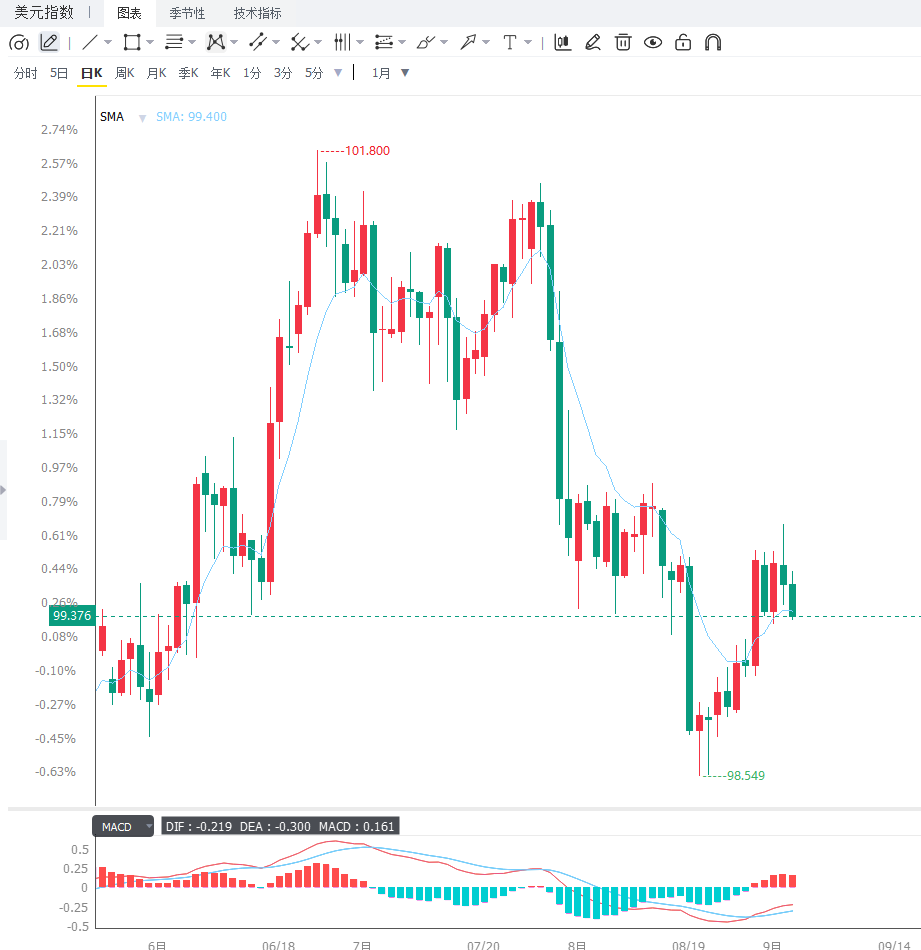 Editor's Summary: The US dollar index is currently caught in a dual struggle between hawkish expectations from the Federal Reserve and a cooling US employment situation. The significantly lower-than-expected ADP employment data weakened the dollar's short-term momentum, but the approximately 62% probability of a September rate hike and hawkish statements from Fed officials still provide support. Key short-term resistance levels to watch are 99.42 and 99.75, while the key support level is 98.65. If the ISM services and non-farm payroll data continue to show weakness in the job market, the DXY may weaken again; if the data is significantly stronger than expected, the dollar is expected to rebound towards the 100 level. The current market direction is highly dependent on US employment data, and volatility may increase significantly around the time of the non-farm payroll release.
The US August ADP employment report became a significant catalyst for the current weakening of the US dollar. Data showed that the US private sector added only 38,000 jobs in August, lower than both the market expectation of 47,000 and the revised 46,000 in July, marking one of the weakest growth levels this year. The cooling job market suggests that US economic growth momentum may be weakening, increasing market concerns about weak non-farm payroll data on Friday. However, the dollar has not yet formed a clear one-sided downward trend. The hawkish signals previously released by Federal Reserve officials are still having an effect, and market pricing in a September rate hike has clearly intensified. Latest market information shows that investors currently expect a 25 basis point rate hike by the Fed in September with a probability of about 62% , a significant increase from before. At the same time, Fed officials continue to emphasize the importance of the inflation target, providing some interest rate support for the dollar despite the weak employment data. The hawkish remarks made by Fed Governor Warsh at the Jackson Hole conference reinforced this logic. He emphasized that the Fed still needs to pay close attention to the inflation target, thus increasing market expectations for continued high interest rates or even further tightening of policy. New York Fed President Williams pointed out that the recent rise in long-term Treasury yields reflects stronger economic fundamentals rather than being solely driven by inflation expectations. This policy stance implies that even if employment data cools, the Fed may not quickly shift to easing. Therefore, Thursday's ISM Services PMI will be a new short-term catalyst for the dollar. If service sector activity and the employment sub-index are strong, alleviating market concerns about a US economic slowdown, the dollar may regain buying interest and push the DXY back towards the 100 level. Conversely, if service sector data significantly falls short of expectations, while employment-related indicators continue to deteriorate, the market may further reduce its bets on Fed rate hikes, and the dollar index will face greater downward pressure. Friday's non-farm payroll report may determine whether this dollar rebound can continue. Currently, the market expects the US to add approximately 58,000 non-farm jobs in August, with the unemployment rate expected to remain at 4.1% . Since ADP employment was already significantly weaker than expected, a significantly lower-than-expected non-farm payroll report could trigger a rapid cooling of Fed rate hike expectations. Conversely, if non-farm payrolls are significantly stronger than expected, the dollar and Treasury yields may rebound in tandem. The market generally believes that employment data will directly influence policy decisions in September. However, even if non-farm payroll data is stronger than expected, the upside potential of the US dollar may be limited. Market analysts believe that even a hawkish employment report may not be enough to completely change the Fed's policy path. In other words, the dollar currently needs more than just better-than-expected employment figures; it also needs wage, unemployment rate, and subsequent inflation data to support a rate hike logic. Furthermore, the renewed rise in oil prices above $90 has created a more complex macroeconomic environment for the dollar. The situation in the Middle East and risks in the Strait of Hormuz are pushing up energy prices, potentially increasing global inflationary pressures and limiting the Fed's future rate cut options. At the same time, high oil prices may also negatively impact economic growth by suppressing consumption, thus the dollar faces two opposing forces: "inflation support" and "growth concerns." The market is closely watching this policy contradiction. Looking at broader market performance, the dollar is currently in a consolidation phase after its recent rebound. The dollar index fell continuously in August, but with renewed hawkish expectations from the Fed, the index quickly recovered from around 98.55 to above 99.60. The latest trends show that the dollar's rebound momentum is beginning to slow, and the market is awaiting new economic data to confirm its next direction. On the daily chart, the DXY is currently around 99.40 , with the price still below the 20-day Bollinger Band middle line and the 100-day simple moving average, indicating that the previous rebound has not yet fully transformed into a new upward trend. The 14-day RSI is around 45 , in the neutral-to-weak zone, not yet in oversold territory, suggesting that the index still has room for further correction. The first resistance level to watch is the Bollinger Band middle line around 99.42 . If this level is broken, the next resistance is the 100-day moving average around 99.75 ; a further break above this level would see the upper Bollinger Band around 100.15 become a more significant medium-term resistance. On the downside, the lower Bollinger Band around 98.65 is a key level to watch. If this level is breached, the dollar index may retest 98.50 or even lower. On the 4-hour chart, the DXY previously rebounded rapidly from around 98.55 to the 99.60 level, but is currently consolidating at a high level around 99.40, with the short-term rebound momentum clearly slowing down. Technical analysis indicates that the 99.40-99.60 area is a key battleground for short-term bulls and bears. If the index can regain a foothold above 99.60 , there is a chance for a further rebound towards the 99.75 and 100.00 levels. However, if it continues to be resisted in the 99.40-99.60 area and breaks below the short-term support near 99.00 , this rebound may be coming to an end, and the probability of retesting 98.65 will significantly increase. Currently, the MACD momentum is weakening, and the RSI is in the neutral zone, indicating that the market is more inclined to wait for ISM and non-farm payroll data to confirm the direction. Editor's Summary: The US dollar index is currently caught in a dual struggle between hawkish expectations from the Federal Reserve and a cooling US employment situation. The significantly lower-than-expected ADP employment data weakened the dollar's short-term momentum, but the approximately 62% probability of a September rate hike and hawkish statements from Fed officials still provide support. Key short-term resistance levels to watch are 99.42 and 99.75, while the key support level is 98.65. If the ISM services and non-farm payroll data continue to show weakness in the job market, the DXY may weaken again; if the data is significantly stronger than expected, the dollar is expected to rebound towards the 100 level. The current market direction is highly dependent on US employment data, and volatility may increase significantly around the time of the non-farm payroll release.
- Risk Warning and Disclaimer
- The market involves risk, and trading may not be suitable for all investors. This article is for reference only and does not constitute personal investment advice, nor does it take into account certain users’ specific investment objectives, financial situation, or other needs. Any investment decisions made based on this information are at your own risk.