Will the US's combination of hard and soft tactics, coupled with Iran's mutually destructive actions, reverse the trend in oil prices?
2026-09-03 16:14:07
On Thursday (September 3), during the Asian and European sessions, international oil prices saw a slight pullback but remained in a strong bullish zone. WTI crude oil futures traded at 90.16, down 0.94%. In response to rising oil prices, the US took three actions: bombing Iran, violently escorting ships, and then unusually stating that the war should not be expected to drag on for long, that armed conflict is not in the interest of either side, and that peaceful dialogue is the best way to resolve differences. The overall goal remained to appease oil prices through a combination of soft and hard tactics. The details involve the largest exchange of fire between the US and Iran since July in the Strait of Hormuz. The US military launched airstrikes against Iranian military targets in the south, including air defenses, radar, mine-laying facilities at sea, and communications. In retaliation, Iran used missiles and drones to strike US military facilities in Bahrain, Jordan, Kuwait, and Iraq, and issued a strong statement indicating it would launch a more powerful counterattack. At the same time, the US military launched a propaganda war and adjusted its strategy toward Iraq, using escorting ships, military strikes, and maritime blockades as the core means of exerting pressure. It set a wartime record of escorting 40 oil tankers in a single day and made every effort to protect the oil transport route through the Strait of Hormuz. However, the continued standoff still makes the international energy shipping market full of uncertainty, and the conflict is unlikely to be resolved in the short term. 
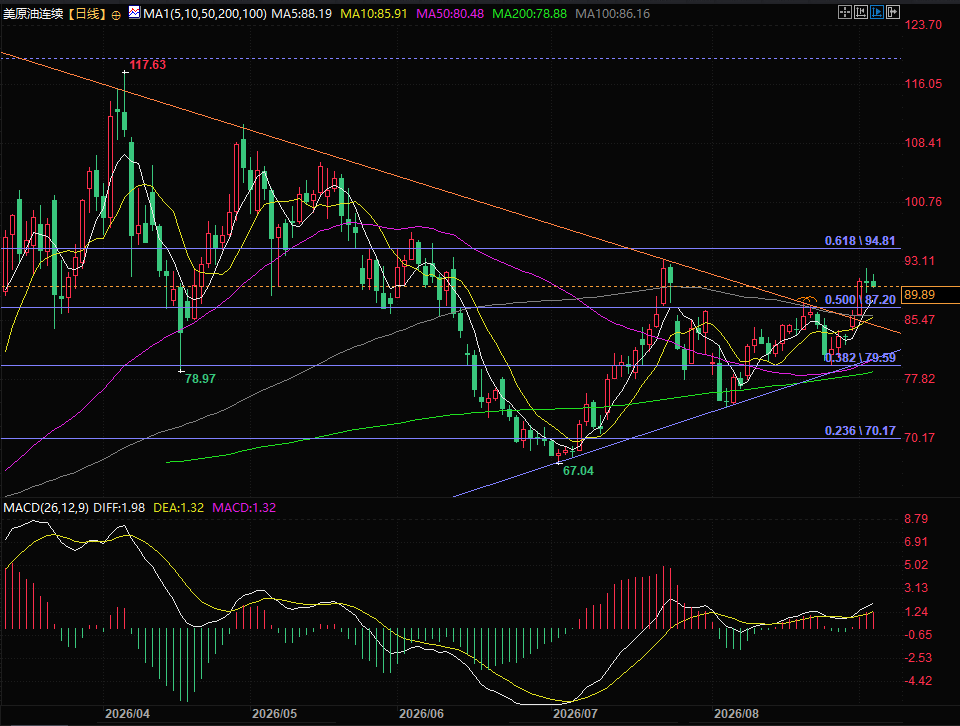 (WTI crude oil futures daily chart, source: EasyTrade) At 16:08 Beijing time, WTI crude oil futures were trading at $98.70 per barrel.
Key information warfare event: The US refuted the accusation that an Iranian oil tanker had struck a landmine.
In the early hours of August 31, the US military struck a mine-laying facility on Iran's Larak Island, weakening Iran's ability to blockade shipping lanes. Subsequently, the Iranian Revolutionary Guard claimed that a supertanker had struck a mine and caught fire in the southern part of the Strait of Hormuz, forcing it to halt its voyage. This claim is highly questionable, as Iran has not released information about the tanker, the location of the incident, or any verifiable evidence. That afternoon, the US Central Command directly refuted the claim, stating that no vessel had struck a mine and accusing Iran of spreading disinformation, creating shipping panic, and attempting to compensate for its own disadvantage in the strategic game.The essence of the game: Iran's maritime deterrence is declining, and the blockade of shipping lanes is failing.
An analysis by the Institute for International War Studies (ISW) suggests that Iran's laying of mines and fabricating reports of tanker attacks were intended to exaggerate the risks to shipping lanes, deter merchant ships, and attempt to regain control of the routes. However, actual shipping data contradicts this: tanker traffic through the Strait of Hormuz continues to recover, and merchant ships still prioritize the southern core route. The US strikes on Iranian radar facilities further reduce its maritime jamming capabilities. ISW points out that Iran's only weakness lies in its control of maritime routes; its regime is not at risk of collapse.Current state of the US-Iran standoff: The US is actively applying pressure, while Iran is passively retaliating to preserve its bargaining chips.
The current power struggle presents a US-led offensive and Iranian defensive posture: Iran's military facilities have been damaged, its economy disrupted, and its ability to blockade the Strait of Hormuz continues to decline. This round of US strikes precisely targeted Iran's core maritime military facilities, including air defense, radar, mine-laying, and communications systems, covering multiple strategic coastal points. To maintain its bargaining power, Iran has launched multi-dimensional countermeasures: continued attacks on merchant ships in the Strait (most of which were intercepted by the US military), strikes against US-related facilities in multiple countries, and blacklisting more oil tankers transiting the Strait. Although its maritime influence has waned, Iran's domestic security control remains stable. High-ranking US officials have stated that they are abandoning negotiations, exaggerating the Iranian regime crisis, and that the US policy towards Iran has completely shifted, no longer seeking negotiation or de-escalation. Trump claimed that the US has almost complete control over the Strait of Hormuz, that Iran's economy is on the verge of collapse, and did not rule out supporting domestic protests in Iran, openly inciting internal conflict. US Treasury Secretary Bessenter stated that Iran is caught in a "death spiral," predicting three possible outcomes: internal division within the Guard, popular resistance, or the resumption of negotiations, and emphasized that regime change is not an official US objective.Institutional assessment: No risk of regime collapse in Iran in the short term
Compared to the radical statements from the US, professional institutions are taking a more rational approach. Currently, Iran shows no signs of regime collapse, such as large-scale protests, defections within the Guard, elite divisions, or cities spiraling out of control. The probability of its collapse within six months is extremely low; external pressure will only fuel long-term social unrest. Influenced by the US congressional elections in November, the US is deliberately controlling the scale of the conflict and has not yet achieved its four strategic goals of dismantling Iran's nuclear forces, ballistic missiles, navy, and regional proxy system, thus its pressure on Iran has significant limitations.Current status of crude oil shipping: shipping routes are being rapidly repaired, and supply resilience is increasing.
Thanks to the US military's mine-clearing, escort, and precision strikes against harassing facilities, navigation capacity in the Strait of Hormuz has been significantly restored. On August 31, the strait's daily crude oil throughput reached 17 million barrels, a new high since the start of the current conflict. Meanwhile, Iraqi crude oil exports rebounded strongly, with daily exports rising from 1.35 million barrels in July to 2.34 million barrels in August. Benefiting from Iran's release of oil tankers and Iraqi crude oil discounts, the market expects its exports to continue rising in September, further enhancing the resilience of global crude oil supply.Situation Summary: Control of the shipping lanes has changed hands, but geopolitical risks remain.
Oil prices are still rising, and the US will likely take action, such as launching attacks or violent escorts. However, armed conflict is not in the interest of either side; peaceful dialogue is the best way to resolve differences. This is essentially a carrot-and-stick intervention during the oil price surge, hoping to bring prices down. Iran's fabrication of tanker attacks is a low-cost game strategy under pressure, both deterring the shipping market and avoiding direct conflict with the US military. Currently, both sides are suffering losses. The core of the current situation remains a tug-of-war and attrition. Iran has lost absolute control of the Strait of Hormuz, creating a new balance of power between the US and Iran. Iran's maritime deterrent power has weakened, but its domestic stability and retaliatory capabilities remain. In the short term, the US seems to have the upper hand, and the large outflow of crude oil has alleviated the pressure of a short-term price surge. However, compared to the US's control of the Strait through escorts, Iran still has an asymmetric advantage in its ability to strike the Strait of Hormuz. Technically, oil prices remain in a strong range, recently testing support around 88.50. Theoretically, they should rise directly, but given US intervention, whether this will lead to a pullback and a double top pattern on the daily chart remains to be seen. (WTI crude oil futures daily chart, source: EasyTrade) At 16:08 Beijing time, WTI crude oil futures were trading at $98.70 per barrel.
- Risk Warning and Disclaimer
- The market involves risk, and trading may not be suitable for all investors. This article is for reference only and does not constitute personal investment advice, nor does it take into account certain users’ specific investment objectives, financial situation, or other needs. Any investment decisions made based on this information are at your own risk.