The yen's unusual movements are not just due to intervention expectations: three pricing chains are changing simultaneously.
2026-09-03 16:00:05
On Thursday, September 3, the USD/JPY exchange rate saw significantly increased volatility, briefly approaching 156.3 and currently fluctuating around 157. Meanwhile, the yield on 10-year Japanese government bonds fell back to approximately 2.965% after hitting 3.000% on September 1, while the weighted average yield on the latest auction of 30-year government bonds rose to 4.079%. Current pricing in the foreign exchange market is no longer solely driven by "intervention trading," but rather is the result of the combined effects of the Bank of Japan's policy pace, the term premium of long-term government bonds, and the global interest rate environment. 
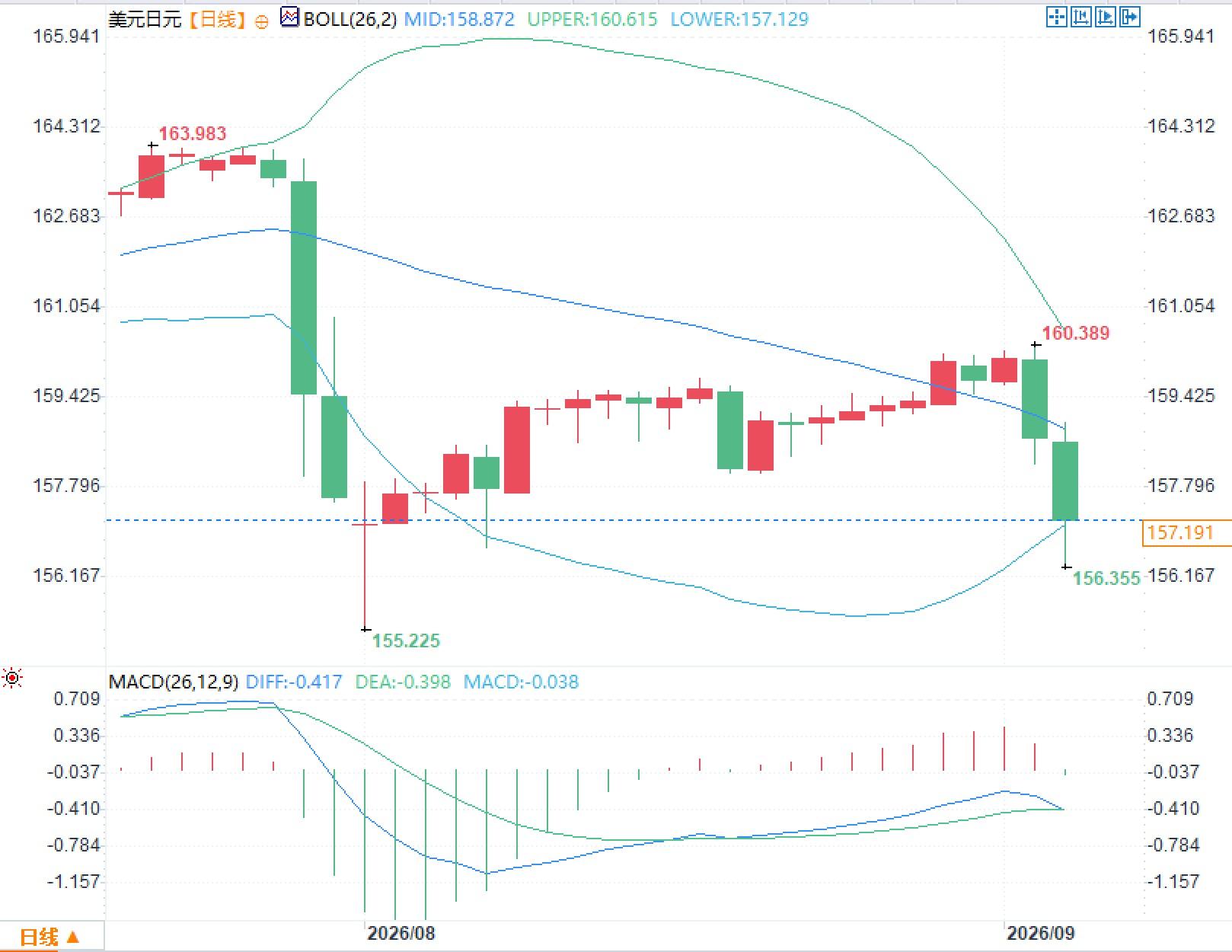 Regarding the MACD, the DIFF is -0.417, the DEA is -0.398, and the histogram is -0.038. Both lines are below the zero axis and the distance between them is small, reflecting that the previous recovery momentum has weakened, but it is not enough to define the subsequent trend on its own.
The core of the yen's sharp rise is the repricing of policy expectations.
The Bank of Japan's current policy rate is 1.0%, while the Federal Reserve's target range for the federal funds rate remains at 3.50% to 3.75%, resulting in a nominal policy rate spread of approximately 2.50 to 2.75 percentage points. This spread remains substantial, but market focus has shifted from "how large is the spread" to "how quickly the spread changes." On September 2nd, Bank of Japan policy board member Hajime Takada stated that 2026 marks the beginning of a new policy phase, emphasizing that "interest rate hikes will not proceed at a fixed pace," and that policy needs to be flexibly adjusted based on economic, price, and financial conditions. The July meeting summary also explicitly stated the need for more agile adjustments to the policy rate and discussion of the magnitude of rate hikes, rather than mechanically following a predetermined cycle. The Bank of Japan's July outlook projects a core consumer price index increase of +2.5% in fiscal year 2026, +2.4% in fiscal year 2027, and a return to +2.0% in fiscal year 2028. This implies that the foreign exchange market is remapping inflation stickiness onto the policy path, rather than simply waiting for administrative exchange rate actions.The 30-year Treasury bond auction exposed the pressure of term premium.
The September 3rd auction of 30-year Japanese government bonds showed a coupon rate of 4.0%, with competitive bids totaling 1.7281 trillion yen and winning bids of 456.2 billion yen. The weighted average yield was 4.079%, with the highest winning yield at 4.100%. Based on the competitive bids and winning bids, the bid-to-cover ratio was approximately 3.79 times, lower than the approximately 3.86 times on August 6th. Simultaneously, the weighted average yield was 14.2 basis points higher than the previous 3.937%. This result is not a demand failure, but rather investors demanding higher maturity compensation. For exchange rates, the significance of long-term yields lies not only in bond prices but also in their potential to alter the asset allocation margins of large institutions such as life insurance companies, banks, and pension funds. When domestic long-term bond yields rise, the relative attractiveness of overseas assets, foreign exchange hedging costs, and the willingness to repatriate funds are all recalculated. Therefore, the government bond yield curve is becoming a crucial variable in yen pricing and can no longer be considered a secondary indicator in foreign exchange analysis.Technical structure signal
Looking at the daily chart for USD/JPY, the Bollinger Bands have a middle band at 158.872, an upper band at 160.615, and a lower band at 157.129. The latest candlestick touched a low of 156.355, briefly crossing the lower band. Compared to the previous wide-range phase, the overall width of the Bollinger Bands has narrowed significantly, but the simultaneous enlargement of the body and shadows on the day indicates a misalignment between the static fluctuation bands and event-driven price movements. Regarding the MACD, the DIFF is -0.417, the DEA is -0.398, and the histogram is -0.038. Both lines are below the zero axis and the distance between them is small, reflecting that the previous recovery momentum has weakened, but it is not enough to define the subsequent trend on its own.What the market really needs to focus on are the three transmission chains.
The first is the policy interest rate chain. The Bank of Japan's policy rate has risen to 1.0%, while the Federal Reserve maintains its target range of 3.50% to 3.75%. Changes in expectations at either end will alter the funding costs of the carry trade structure. The second is the inflation chain. The Bank of Japan's latest outlook indicates that core inflation will remain significantly above 2% in fiscal year 2026, meaning policy discussions will be difficult to deviate from price stickiness. Furthermore, changes in energy prices will affect inflation expectations through import costs and real income. The third is the term premium chain. The 10-year yield has touched 3.000%, and the average yield on 30-year tenders has risen to 4.079%, indicating that fiscal supply, institutional allocation, and duration risk are being transmitted to the exchange rate market.Frequently Asked Questions
Question 1: Does the rapid strengthening of the yen in a short period mean that the authorities have intervened again? Answer: This cannot be confirmed. Foreign exchange intervention usually requires subsequent verification from official capital flow data. Policy expectation repricing, expected changes in interest rate differentials, and position covering can also cause similar rapid fluctuations. Therefore, market behavior itself is not sufficient evidence. Question 2: Why does the 30-year Japanese government bond auction affect the yen? Answer: Long-term government bond yields determine the relative return for domestic institutions holding long-term yen assets, and also affect foreign exchange hedging costs and overseas asset allocation. When the term premium rises, life insurance companies, banks, and pension funds adjust their asset allocation models accordingly, thereby changing cross-border capital flows.- Risk Warning and Disclaimer
- The market involves risk, and trading may not be suitable for all investors. This article is for reference only and does not constitute personal investment advice, nor does it take into account certain users’ specific investment objectives, financial situation, or other needs. Any investment decisions made based on this information are at your own risk.