The Beige Book shows that the US economy is relying heavily on AI infrastructure to stay afloat; can the interest rate paradox boost gold prices?
2026-09-03 18:10:03
On September 2, 2026, the Federal Reserve released its latest Beige Book, summarizing frontline economic survey data from 12 regional Federal Reserve banks as of August 24. The report presents a comprehensive picture of the core characteristics of the US economy: "weak recovery, strong divergence, and strong ties to AI." Released just before the Fed's September 15-16 policy meeting, and coupled with Fed Chairman Warsh's hawkish remarks at the Jackson Hole symposium, the report clearly reveals the true state of US growth, inflation, and employment. It further highlights the dual reshaping effect of the AI data center infrastructure boom on the US macroeconomy, creating numerous contradictions with current market hawkish expectations. Simultaneously, facing domestic inflation in the US, Bessant called on other central banks to actively raise interest rates to absorb excess liquidity in the market, suppress global inflation, and stabilize domestic currencies such as Japan's to prevent countries from selling US Treasury bonds in response to currency devaluation.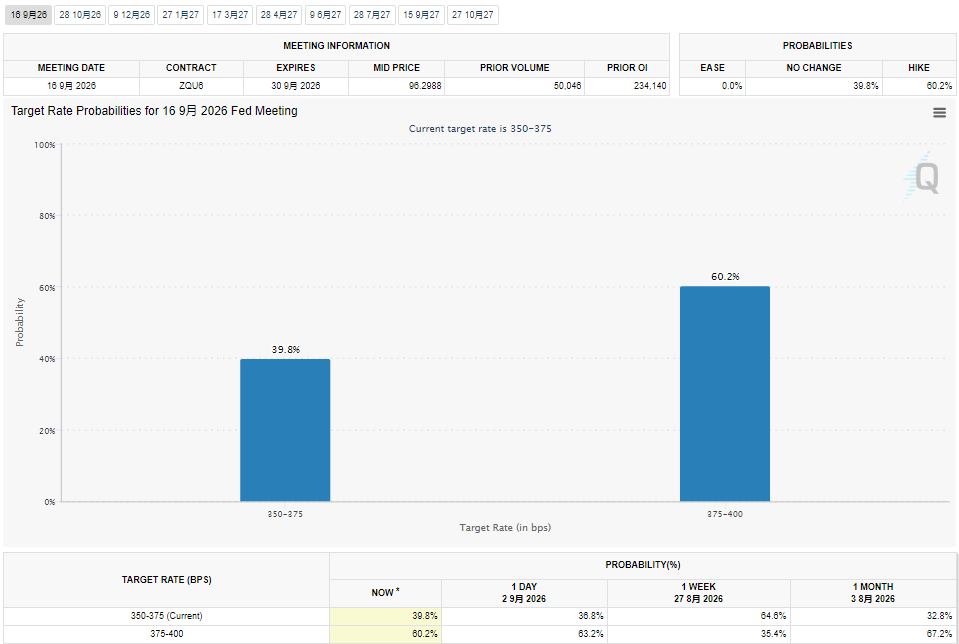 (FedWatch interest rate futures, source: CME Group)
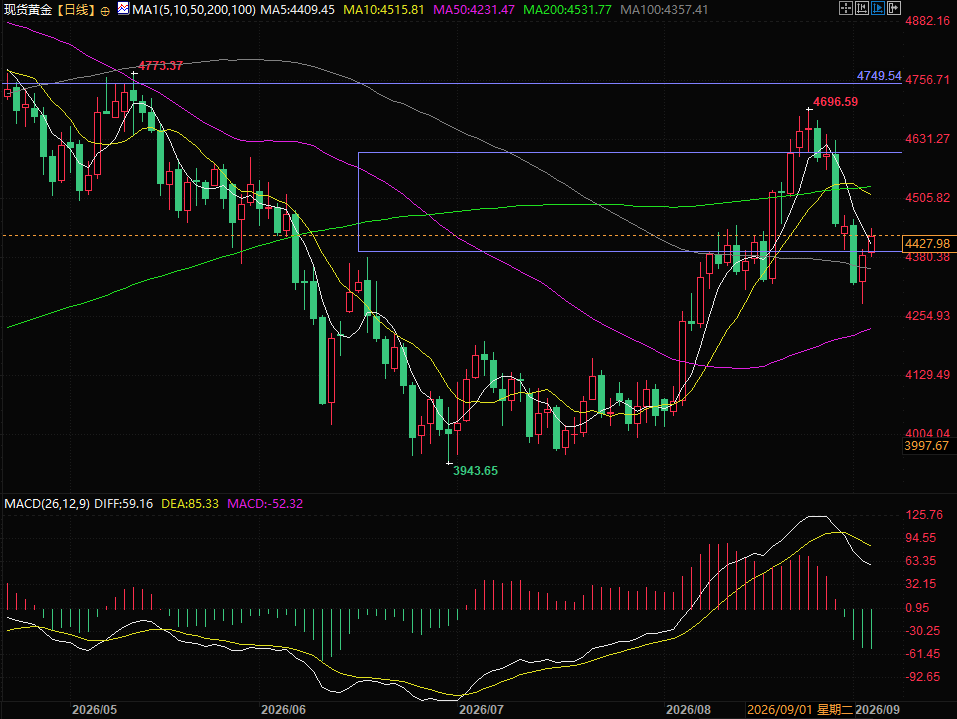 (Spot gold daily chart, source: EasyTrade) At 18:06 Beijing time, spot gold is currently trading at $4429 per ounce.
Overall Economy: Slight Expansion Across the Entire Country, Growth Highly Dependent on AI Computing Infrastructure
Beige Book data shows that as of the end of August, overall economic activity in the United States only saw a slight increase, with most traditional industries continuing to experience slowing growth, indicating a generally weak economic recovery. In stark contrast to the weakness in traditional industries, investments in data centers and AI infrastructure, spearheaded by tech giants like Amazon and Microsoft, have become the core pillar supporting US aggregate demand and bolstering the manufacturing and construction sectors. This has evolved from a single-technology trend into a core variable influencing the overall macroeconomic trajectory of the US. The current structural dependence of US economic growth is extremely prominent, with significant regional and industry differentiation. While overall end-user demand in areas like Cleveland continues to weaken, local manufacturing is booming against the trend, benefiting from orders generated by data center construction. Regions like Minneapolis have also seen a recovery in employment and industrial demand driven by the implementation of computing infrastructure. Conversely, after removing data center-related investments, economic growth in many regions has declined sharply. Non-residential construction activity in St. Louis has cooled significantly, and the Chicago Federal Reserve has even stated bluntly that without data centers, the US construction industry will fall into recession. This phenomenon signifies that the resilience of the US real economy's recovery is highly tied to the computing capital expenditures of global tech giants, highlighting the vulnerability of its singular growth structure. In terms of long-term investment scale, this wave of AI infrastructure construction is unprecedented. PwC predicts that global cumulative capital expenditure on AI infrastructure will reach $31.6 trillion from 2026 to 2050, with annual data center investment climbing from $800 billion in 2026 to $1.8 trillion in 2050. The United States accounts for $15.1 trillion of this investment, followed closely by the Asia-Pacific region with $8.2 trillion. Morgan Stanley further estimates that global data center construction costs will reach $2.9 trillion from 2026 to 2028, with AI-related investments alone contributing 25% to US GDP growth in 2026, becoming the core growth engine of the US economy. Meanwhile, capital expenditures by tech giants continue to expand, projected to increase from $805 billion in 2026 to $1.1 trillion in 2027, continuously supporting the economy.Inflation Situation: Rising prices across the board, multiple pressures drive up expectations of policy tightening.
This round of the Beige Book strongly confirms Federal Reserve Chairman Warsh's core assessment: the primary risk to the current US economy is inflation, not unemployment, and combating inflation has become the Fed's primary policy objective. Data shows that prices rose across all 12 Federal Reserve districts, with most districts experiencing moderate inflation, while some saw significant increases, indicating widespread inflationary pressure. The core drivers of rising inflation are clear and persistent, primarily falling into three categories. First, geopolitical conflicts continue to disrupt energy prices; the protracted situation in Iran exacerbates global energy supply uncertainty, pushing up fuel and electricity costs across the US, becoming the main source of cost pressure for businesses and residents. Second, tariffs, raw materials, and logistics costs continue to rise, directly squeezing profits in the manufacturing and construction industries, with imported price increases particularly pronounced in upstream sectors such as metals, petrochemicals, and transportation. Third, the rigid increase in insurance and healthcare service costs creates persistent service-related inflationary pressure, further solidifying inflation stickiness. It is worth noting that the current inflation transmission exhibits differentiated characteristics. While most enterprises face upward cost pressures, the price sensitivity of the end-consumer market has significantly increased. Many enterprises are choosing to compress profit margins and postpone price increases to avoid losing customers. This means that inflationary pressures are temporarily hidden on the production side, and the risk of future price rebounds remains. Meanwhile, the data center infrastructure boom is further exacerbating inflationary contradictions: large-scale computing power construction continues to compete for electricity, industrial raw materials, equipment, and capital, pushing up input costs in the construction and manufacturing industries and becoming a significant source of new inflationary pressure.The job market is generally resilient and stable, but structural shortages and differentiation coexist.
Compared to high inflationary pressures, the US job market has remained robust overall, avoiding widespread unemployment and recession, thus serving as a cornerstone of economic stability. Surveys show that employment saw slight growth in seven districts and remained flat in five, with overall employment showing a marginal increase and the market entering a stable phase of "low hiring, low layoffs." However, the job market exhibits significant structural differentiation, with uneven performance across industries and regions. On one hand, districts like Richmond, where data centers are concentrated, are experiencing severe shortages of skilled workers in construction and high-end manufacturing. The boom in computing infrastructure continues to attract high-quality labor, leading companies to significantly raise salaries to retain talent. One construction company in Maryland, for example, increased wages by 35% to address the labor shortage. Demand for labor is strong in manufacturing and computing infrastructure-related services, with wages steadily rising. On the other hand, the higher education sector continues to see layoffs, with some universities freezing hiring. Employment in sectors such as finance and healthcare is stagnating, and job opportunities in areas like Minneapolis have contracted. From an employment structure perspective, the AI industry continues to exert a dual influence on the workforce: creating numerous infrastructure and technology-related jobs while simultaneously replacing traditional positions. The employment environment for recent college graduates has improved slightly compared to last year, but job supply remains far less than the number of job seekers, and youth employment pressure persists. Overall, corporate hiring expectations for the next six months are cautiously optimistic, and the job market is expected to remain stable but tight.Consumption and Industry: K-shaped divergence intensifies, economic uncertainty continues to rise.
The US consumer market saw a slight overall increase, but structural gaps continued to widen, exhibiting a typical K-shaped divergence pattern. High-end consumption remained resilient, with luxury goods and high-end services consumption remaining robust in areas like New York. However, low- and middle-income groups were squeezed by rising oil prices and energy costs, resulting in shrinking disposable income and a widespread trend of "consumption downgrading and pursuing value for money." Several districts, including Atlanta, Chicago, and New York, observed consumers actively abandoning high-end consumption and turning to affordable goods and services. Regional consumption differences were also significant. Boston benefited from the World Cup and festivals, leading to a surge in restaurant and retail sales in July and August, while consumption declined slightly in Cape Cod due to high temperatures and rising accommodation costs. Overall consumption declined in districts such as Cleveland, Richmond, and St. Louis. Businesses are generally concerned that if geopolitical conflicts in the Middle East continue, rising energy costs during the winter heating season will further suppress residents' spending power. On the industrial side, manufacturing saw a slight overall recovery, with data center and defense-related orders being the core drivers. However, demand for some end-consumer goods remained weak, and tariff uncertainties dampened the willingness of some companies to expand production. Non-financial services revenue saw a slight increase, with professional services performing strongly, but the higher education sector continued to contract. Bank lending expanded slightly, with loan demand diverging. Credit standards remained generally stable but tightened in some areas, as financial institutions were generally concerned about the impact of inflation, high interest rates, and tariffs on household and corporate borrowing behavior. Multiple factors combined to fuel market expectations of interest rate hikes. CME FedWatch data showed that the probability of a rate hike at the Fed's September meeting had slightly decreased to 60.2%, while the probability of maintaining the current rate had risen to 40%. (FedWatch interest rate futures, source: CME Group)Key takeaways: AI infrastructure is a double-edged sword; interest rate decisions impact growth across the US and globally.
This Beige Book fully outlines the complex state of the US economy: traditional economic drivers are weak and recovery is sluggish, relying entirely on AI data center infrastructure to support the manufacturing and construction sectors, stabilizing overall growth. However, the surge in computing power investment is not a simple boon; it has exacerbated supply and demand tensions in energy, labor, capital, and raw materials, further increasing inflation stickiness and creating a dual situation where "growth depends on AI, and inflation stems from AI." The Federal Reserve's policy is currently in a critical balancing point: a rate hike in September would be a crude tool for suppressing aggregate demand, proving ineffective against this "supply-side/structural inflation" driven by the technological revolution. Rate hikes will not stop tech giants from buying chips or increase shipping capacity in the Strait of Hormuz, but they will cause the financial costs of the entire AI supply chain to soar, ultimately leading to a situation where "giants stubbornly continue to pour money in, while traditional industries and debt-ridden infrastructure suffer collateral damage from the rate hike," making it difficult for small and medium-sized enterprises to obtain financing. In the end, before inflation can be controlled, many traditional industries will collapse. Therefore, considering Bessant's recent call for global central banks to raise interest rates, the US may not ultimately raise rates. We are closely monitoring subsequent non-farm payroll and CPI data. In terms of trading, these data will have a significant impact on gold prices, as they essentially represent the Fed's direction. If the Fed's rate hike expectations are affected and weakened, gold will likely rise again. (Spot gold daily chart, source: EasyTrade) At 18:06 Beijing time, spot gold is currently trading at $4429 per ounce.- Risk Warning and Disclaimer
- The market involves risk, and trading may not be suitable for all investors. This article is for reference only and does not constitute personal investment advice, nor does it take into account certain users’ specific investment objectives, financial situation, or other needs. Any investment decisions made based on this information are at your own risk.