One chart: The Baltic Dry Index surged, hitting a near five-year high.
2026-09-03 22:38:03
The latest data shows that the Baltic Dry Index (BDI) reached 3488 points on September 3, 2026, a new high since October 29, 2021, up 4.71% month-on-month, marking the second consecutive day of increase (including zero growth). Looking at the short-term charts, the recent 11 BDI data points show: 9 positive increases, 2 negative increases, and 0 zero increases. Specifically, the Panamax Freight Index (BPI) was 2457 points, up 1.15% from the previous value; the Capesize Freight Index (BCI) was 6042 points, up 7.09%; and the Supramax Freight Index (BSI) was 1668 points, up 0.66%. For detailed 720-day and 10-year trend charts of the Baltic Dry Index and its three main sub-indices, please refer to the charts specially created by FX678. 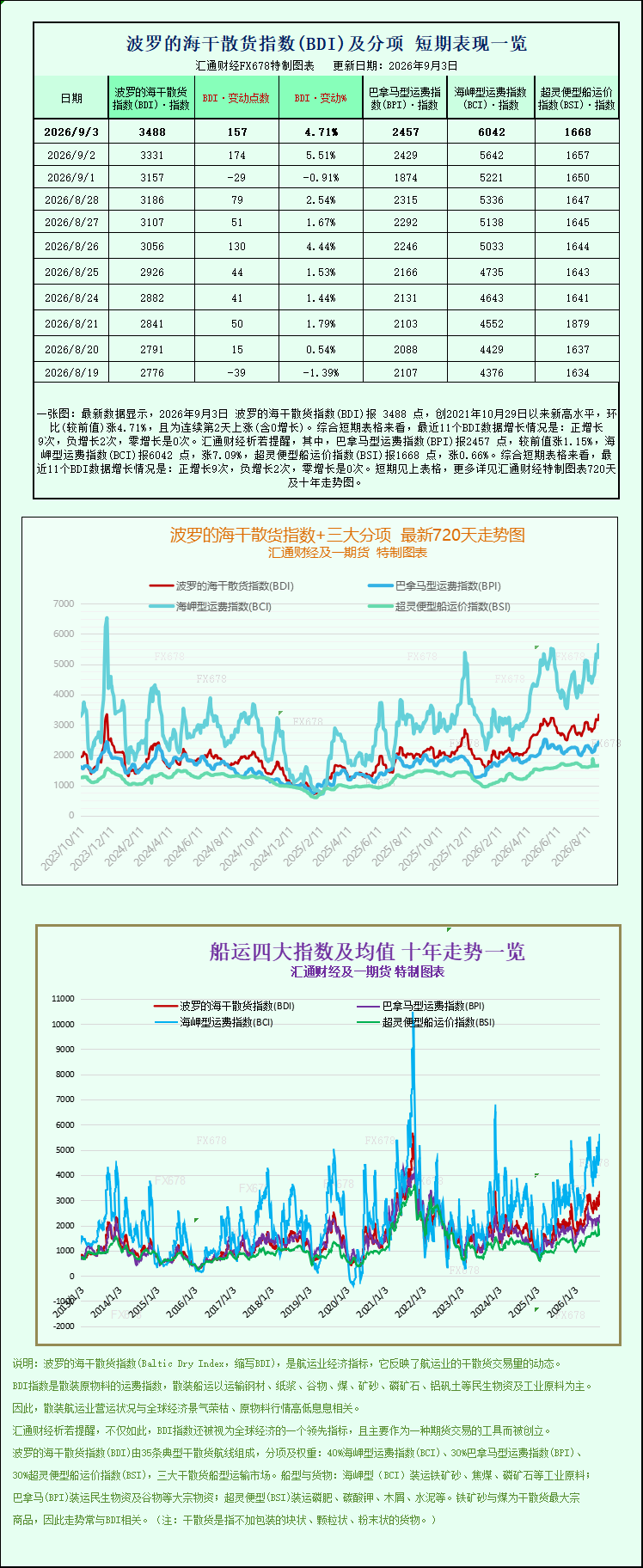 As a core indicator of the global dry bulk shipping market, the Baltic Dry Index (BADI) continued its strong upward trend on Thursday, climbing to its highest level since October 2021. Freight rates across all sectors strengthened, reflecting a significant recovery in global demand for commodity shipping. Data shows that the Baltic Dry Index, which comprehensively reflects the freight rates of Capesize, Panamax, and Supramax vessels, surged 157 points, or 4.7%, to close at 3488 points. This level represents a near five-year peak, indicating that the international dry bulk shipping market has emerged from its previous sluggish period and that industry activity has significantly improved. The Baltic Dry Index is considered a leading indicator of the global industrial economy; its rise directly reflects the expansion of transoceanic demand for basic commodities such as iron ore, coal, and grains, and also indirectly reflects changing trends in global industrial production and trade activities. Looking at different vessel types, Capesize vessels, the largest in size and primarily responsible for transporting iron ore and long-distance coal, were the core force driving the index's rise in this round of market activity. The Capesize freight rate index rose 400 points in a single day, an increase of 7.1%, closing at 6042 points, a new high since the end of 2023. In terms of actual trading revenue, the average daily charter income for a standard 150,000-ton Capesize vessel surged by $3,632 to $51,298. Capesize vessels mainly travel between mineral exporting countries such as Australia and Brazil and Asian industrial consumption markets, with iron ore being their primary cargo. The surge in revenue for this vessel type fully demonstrates the rapid release of demand for seaborne iron ore. Behind the market, both spot and futures prices for iron ore strengthened simultaneously. The tight supply of coking coal eased, blast furnace operating rates rebounded in various regions, and steel companies' production demand improved, directly leading to an increase in iron ore procurement. Meanwhile, rising ocean freight rates and improved overseas exports of steel products further supported iron ore prices. Both supply and demand factors drove up ocean freight orders for ore, pushing up freight rates for large vessels. The Panamax vessel index, a major medium-sized vessel type, also saw a recovery in freight rates. The Panamax index rose 28 points, or 1.2%, to 2457 points, a new high since May 2026. Panamax vessels typically have a deadweight tonnage of 60,000-70,000 tons and are mainly used for long-distance transport of coal and grain. They are compatible with the Panama Canal's navigation standards and are the main carriers for global grain and thermal coal trade. The average daily charter rate for this vessel type rose by $248 to $22,113, with expectations of a peak grain export season and global thermal power plant restocking demand jointly supporting higher freight rates in this sector. The Supramax bulk carrier, smaller in size and adaptable to a wider range of ports, maintained a steady upward trend. The Supramax index rose 11 points, or 0.6%, to close at 1668 points. This vessel type can carry fertilizers, cement, and small-batch grains and ores, with routes covering more small and medium-sized ports. The moderate rise in the index indicates that small- and medium-batch dry bulk trade is also recovering in tandem, rather than a localized market driven by a single cargo type. Considering the performance of various vessel types, this round of Baltic Dry Index (BDI) increases shows a broad-based rise across the entire sector, rather than a pulse-like increase in a single vessel type. This is significantly different from past periods where the market was driven solely by Capesize vessels. On the one hand, the recovery of the steel industry has led to an expansion in iron ore shipments; on the other hand, seasonal stockpiling demand for coal and grains has gradually started, with multiple categories of bulk cargo trade releasing shipments simultaneously, jointly driving up market competition for bulk carriers. However, industry insiders also caution that the dry bulk shipping market naturally possesses strong cyclicality. The current sharp rise in freight rates, besides being due to a genuine recovery in demand, is also influenced by factors such as short-term capacity allocation, port turnover efficiency, and long-distance detours. Going forward, changes in iron ore supply, the sustainability of steel industry operations, actual global grain exports during the harvest season, and the pace of new ship capacity release will all determine how long this round of high freight rates can last. Market participants need to be wary that if downstream demand falls short of expectations, there is also a risk of a rapid correction in high freight rates.
As a core indicator of the global dry bulk shipping market, the Baltic Dry Index (BADI) continued its strong upward trend on Thursday, climbing to its highest level since October 2021. Freight rates across all sectors strengthened, reflecting a significant recovery in global demand for commodity shipping. Data shows that the Baltic Dry Index, which comprehensively reflects the freight rates of Capesize, Panamax, and Supramax vessels, surged 157 points, or 4.7%, to close at 3488 points. This level represents a near five-year peak, indicating that the international dry bulk shipping market has emerged from its previous sluggish period and that industry activity has significantly improved. The Baltic Dry Index is considered a leading indicator of the global industrial economy; its rise directly reflects the expansion of transoceanic demand for basic commodities such as iron ore, coal, and grains, and also indirectly reflects changing trends in global industrial production and trade activities. Looking at different vessel types, Capesize vessels, the largest in size and primarily responsible for transporting iron ore and long-distance coal, were the core force driving the index's rise in this round of market activity. The Capesize freight rate index rose 400 points in a single day, an increase of 7.1%, closing at 6042 points, a new high since the end of 2023. In terms of actual trading revenue, the average daily charter income for a standard 150,000-ton Capesize vessel surged by $3,632 to $51,298. Capesize vessels mainly travel between mineral exporting countries such as Australia and Brazil and Asian industrial consumption markets, with iron ore being their primary cargo. The surge in revenue for this vessel type fully demonstrates the rapid release of demand for seaborne iron ore. Behind the market, both spot and futures prices for iron ore strengthened simultaneously. The tight supply of coking coal eased, blast furnace operating rates rebounded in various regions, and steel companies' production demand improved, directly leading to an increase in iron ore procurement. Meanwhile, rising ocean freight rates and improved overseas exports of steel products further supported iron ore prices. Both supply and demand factors drove up ocean freight orders for ore, pushing up freight rates for large vessels. The Panamax vessel index, a major medium-sized vessel type, also saw a recovery in freight rates. The Panamax index rose 28 points, or 1.2%, to 2457 points, a new high since May 2026. Panamax vessels typically have a deadweight tonnage of 60,000-70,000 tons and are mainly used for long-distance transport of coal and grain. They are compatible with the Panama Canal's navigation standards and are the main carriers for global grain and thermal coal trade. The average daily charter rate for this vessel type rose by $248 to $22,113, with expectations of a peak grain export season and global thermal power plant restocking demand jointly supporting higher freight rates in this sector. The Supramax bulk carrier, smaller in size and adaptable to a wider range of ports, maintained a steady upward trend. The Supramax index rose 11 points, or 0.6%, to close at 1668 points. This vessel type can carry fertilizers, cement, and small-batch grains and ores, with routes covering more small and medium-sized ports. The moderate rise in the index indicates that small- and medium-batch dry bulk trade is also recovering in tandem, rather than a localized market driven by a single cargo type. Considering the performance of various vessel types, this round of Baltic Dry Index (BDI) increases shows a broad-based rise across the entire sector, rather than a pulse-like increase in a single vessel type. This is significantly different from past periods where the market was driven solely by Capesize vessels. On the one hand, the recovery of the steel industry has led to an expansion in iron ore shipments; on the other hand, seasonal stockpiling demand for coal and grains has gradually started, with multiple categories of bulk cargo trade releasing shipments simultaneously, jointly driving up market competition for bulk carriers. However, industry insiders also caution that the dry bulk shipping market naturally possesses strong cyclicality. The current sharp rise in freight rates, besides being due to a genuine recovery in demand, is also influenced by factors such as short-term capacity allocation, port turnover efficiency, and long-distance detours. Going forward, changes in iron ore supply, the sustainability of steel industry operations, actual global grain exports during the harvest season, and the pace of new ship capacity release will all determine how long this round of high freight rates can last. Market participants need to be wary that if downstream demand falls short of expectations, there is also a risk of a rapid correction in high freight rates.
- Risk Warning and Disclaimer
- The market involves risk, and trading may not be suitable for all investors. This article is for reference only and does not constitute personal investment advice, nor does it take into account certain users’ specific investment objectives, financial situation, or other needs. Any investment decisions made based on this information are at your own risk.