A seasoned fund manager reveals the Federal Reserve's "secret," stating that investors are facing a second opportunity to buy gold.
2026-09-04 13:28:04
The gold market is shrouded in a fog of stagnant inflation and rising interest rates, with dramatic fluctuations leaving countless investors hesitant and even disoriented. When the market focuses excessively on short-term interest rate swings, it often overlooks the core logic driving asset value. At this critical juncture, the insightful observations of veteran fund manager Eric Strand offer a glimpse into the market's blind spots, revealing that behind this volatility lies a long-term opportunity that has been misjudged.
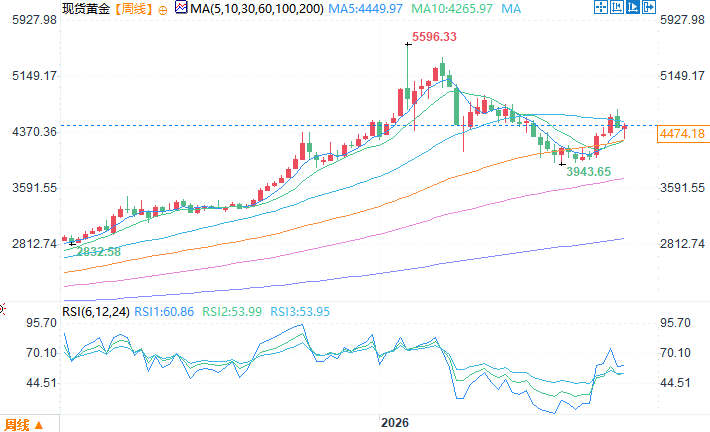 Spot gold weekly chart source: FX678. As of 13:26 Beijing time on September 4th, spot gold was trading at $4470.18 per ounce.
Misjudging the nature of inflation: Why interest rate hikes fail to shake the foundation of gold prices
Gold investors are facing dramatic volatility stemming from the interplay of persistent inflation and rising interest rate expectations. However, according to Eric Strand, founder of the AuAg fund, the market's focus is fundamentally misaligned. Strand states bluntly that it's only a matter of time before gold resumes its long-term upward trend, as investors will eventually realize that simply raising interest rates cannot address the core drivers of inflation. He points out that the market has already positioned itself for higher interest rates, which has supported the dollar in the short term and created headwinds for gold prices. However, this market reaction is based on a misinterpretation of inflation. He emphasizes that current inflation is not due to excessive consumer demand, but rather driven by the continued rise in commodity prices and imported costs—a classic example of cost-push inflation. Strand explicitly states that in a cost-push inflation environment, raising interest rates is not only ineffective but also adds to the economic burden. He explains that this is different from consumers needing to cool down after overspending; raising interest rates is equivalent to adding another layer of cost on top of already high costs, which cannot effectively curb inflation. Once the market recognizes this logic, the pessimistic positions previously based on rising interest rate expectations will instead become fuel for the next round of gold price increases.Seeing Through the Surface of Policy: The Inevitability of the Fed's "Much ado About Nothing"
In a volatile market, Strand's strategy appears calm and resolute: patience and waiting for the market to correct its mistakes. He frankly states that prices will naturally return to normal once the market finally awakens. At the same time, he expresses skepticism about the Federal Reserve's ability to implement its hawkish rhetoric, describing its stance as essentially "all talk and no action." He analyzes that even if the Fed adopts a stance of combating inflation to maintain its credibility, its policy space is extremely limited in the face of the heavy economic and fiscal realities. The core variable truly constraining the Fed is the ever-increasing massive debt burden of the US government. With federal debt surpassing the $40 trillion mark, the government urgently needs to lower long-term borrowing costs to maintain controllable debt interest payments. This debt pressure creates an irreconcilable contradiction with interest rate hikes. Strand asserts that to lower long-term interest rates, the Fed will ultimately have to restart quantitative easing, regardless of its nominal form. Furthermore, the government's goal of resolving the debt problem through economic growth also runs counter to a tight monetary policy. To stimulate the economy, it is necessary not to suppress consumption through interest rate hikes, but to accelerate growth. Therefore, Strand argues that inflation itself could even become a "tool" for solving the debt problem, as it can dilute the real value of debt by boosting nominal economic activity, ultimately forcing the Federal Reserve to bow to reality.Strong structural support: Supply-demand imbalance creates new opportunities for gold
Strand emphasizes that investors should not be led astray by short-term inflation data and interest rate expectations, but should focus on structural forces that monetary policy cannot address: high commodity costs, surging metal demand, massive government debt, and the urgency to control borrowing costs. These factors collectively form a solid foundation for a long-term bullish outlook on gold. He specifically points out that deteriorating demand for US government debt will force policymakers to suppress long-term yields, and this policy shift will be a catalyst for a gold price surge . The approximately 10% rebound in gold prices in August was merely a prelude to a larger market move. Strand predicts that once the market confirms the Fed's "talk is cheap," gold prices could easily rise by 20% to 30% this year. For investors who missed the first wave of the rally, Strand sees the recent pullback as a rare "second chance." If they don't get on board now, they risk being left behind again. In terms of sector allocation, he is particularly optimistic about precious metal miners. Despite the recent strong performance of mining stocks, their valuations remain attractive relative to underlying commodity prices. Years of high prices have significantly improved mining companies' balance sheets and reduced financial risk. More importantly, insufficient exploration and limited new mine development will lead to continued supply constraints in the future, while demand for metals in the fields of artificial intelligence, defense and infrastructure is surging. This supply-demand imbalance creates an excellent investment opportunity.Conclusion
Ultimately, gold's price movement is no longer simply determined by the Federal Reserve's short-term interest rate moves, but is rooted in the deeper logic of the dollar's credibility, debt size, and physical supply and demand. Strand believes that a weakening dollar and debt monetization are inevitable trends, while the rigid constraints on metal supply and the structural expansion of demand together create an irreversible bullish backdrop. The market needs to recognize that interest rate hikes cannot fundamentally cure inflation and debt; when this consensus forms, it will be the day gold begins a new and magnificent upward trend. Spot gold weekly chart source: FX678. As of 13:26 Beijing time on September 4th, spot gold was trading at $4470.18 per ounce.
- Risk Warning and Disclaimer
- The market involves risk, and trading may not be suitable for all investors. This article is for reference only and does not constitute personal investment advice, nor does it take into account certain users’ specific investment objectives, financial situation, or other needs. Any investment decisions made based on this information are at your own risk.