Fed rate hike expectations have diverged, and the dollar index has fallen for three consecutive days, awaiting guidance from non-farm payroll data.
2026-09-04 14:00:05
The US dollar index continued its weakness in Asian trading on Friday, trading around 99.00, marking its third consecutive day of decline. Recently, the dollar has been pressured again by multiple factors, including changing expectations for monetary policy, falling US Treasury yields, and a stronger yen. Market sentiment regarding the Federal Reserve's policy path in September is showing clear divergence.  Federal Reserve Governor Christopher Waller's latest remarks have become a significant trigger for the dollar's weakness. Waller stated that if the upcoming inflation data does not contain any major surprises, he is inclined to maintain the current interest rate level at the September policy meeting. This statement contrasts with the relatively hawkish stance previously adopted by Fed Chairman Kevin Warsh, prompting investors to reassess the short-term interest rate path. From the perspective of interest rate market pricing, the change in policy expectations is already quite evident. Data from the CME Group's FedWatch tool shows that the probability of a Fed rate hike in September has fallen from 63.2% to 50.2%, a single-day drop of 13 percentage points. This means that the market has shifted from a previous bias towards a rate hike to a near 50/50 situation. The dollar's previous interest rate advantage has therefore been weakened. Next, the US August jobs report will be a crucial event influencing the dollar's short-term trend. The market currently expects US non-farm payrolls to increase by approximately 56,000 in August, with the unemployment rate remaining around 4.1%. If employment data is significantly weaker than expected, it will further reinforce market expectations that the Federal Reserve will maintain interest rates or even shift to a more accommodative stance, potentially putting continued pressure on the dollar. Conversely, if the employment market performs significantly better than expected, it could reignite the probability of a September rate hike and provide the dollar with a temporary rebound. Besides expectations regarding Fed policy, the rapid appreciation of the yen has also amplified downward pressure on the dollar index. The recent continuous decline in the USD/JPY exchange rate has fueled discussions about potential government action to stabilize the exchange rate. Simultaneously, investors are reassessing the possibility of further tightening by the Bank of Japan this year. The yen's recent appreciation has widened significantly, with the USD/JPY exchange rate experiencing substantial daily declines. The gradual normalization of Japanese monetary policy and the cooling of US interest rate expectations have combined to compress carry trades in the USD/JPY exchange rate. From a broader market perspective, the core issue facing the dollar is not simply economic data, but rather the marginal changes in interest rate expectations. Previously, the market worried that sticky US inflation might force the Fed to maintain a tight policy, while Waller's latest comments have re-emphasized "data dependence." Against this backdrop, unless subsequent inflation and employment data significantly exceed expectations, policy support for the dollar may continue to weaken. However, the US dollar is not entirely without the conditions for a rebound. US inflation data remains relatively high, and if the job market shows renewed resilience, market expectations for the Federal Reserve to maintain high interest rates or even further tighten policy this year may resurface. Furthermore, global risk aversion and the US economy's growth advantage relative to other major economies may also provide support for the dollar at key junctures. Therefore, the dollar market will enter a data-driven phase in the short term. Investors should not only focus on the August non-farm payroll data but also consider the unemployment rate, average hourly earnings, and subsequent inflation indicators for a comprehensive assessment. Especially with the probability of a September rate hike having fallen to around 50%, any unexpected data could cause a rapid readjustment of interest rate pricing and amplify the intraday volatility of the dollar index. From a daily chart perspective, the dollar index is currently trading around 99.00, with a short-term bearish trend still dominating. The index continues to trade below the 9-period and 50-period exponential moving averages, currently around 99.26 and 99.79 respectively, providing significant resistance to a dollar rebound. The 14-day RSI is near 40 and below the 50 midline, indicating that market momentum remains bearish. However, the indicator has not yet entered severely oversold territory, so the US dollar still has room to fall further. In the short term, the first resistance level to watch is around 99.26. If it fails to regain this level, the US dollar index may continue to test the 98.80 and 98.30 areas. If it unexpectedly breaks through 99.26, further observation is needed regarding the resistance around 99.79. Only by regaining the 50-period moving average can the short-term bearish structure be significantly alleviated. Looking at the 4-hour chart, the US dollar index remains in a downward channel after continuous weakening, and the rebound is currently insufficient to reverse the short-term trend. The 99.00 level is both a psychological level and a crucial area of contention between bulls and bears. If the price breaks below 98.80, the downside potential in the short term may open further, seeking support at 98.50 or even 98.30. If the non-farm payroll data drives a rapid rebound in the US dollar, 99.26 will become the first key resistance level, with further breakthroughs leading to targets in the 99.50 and 99.79 areas. Overall, until the US dollar regains its footing above 99.26, the 4-hour chart should still be viewed primarily as a rebound with downward pressure.
 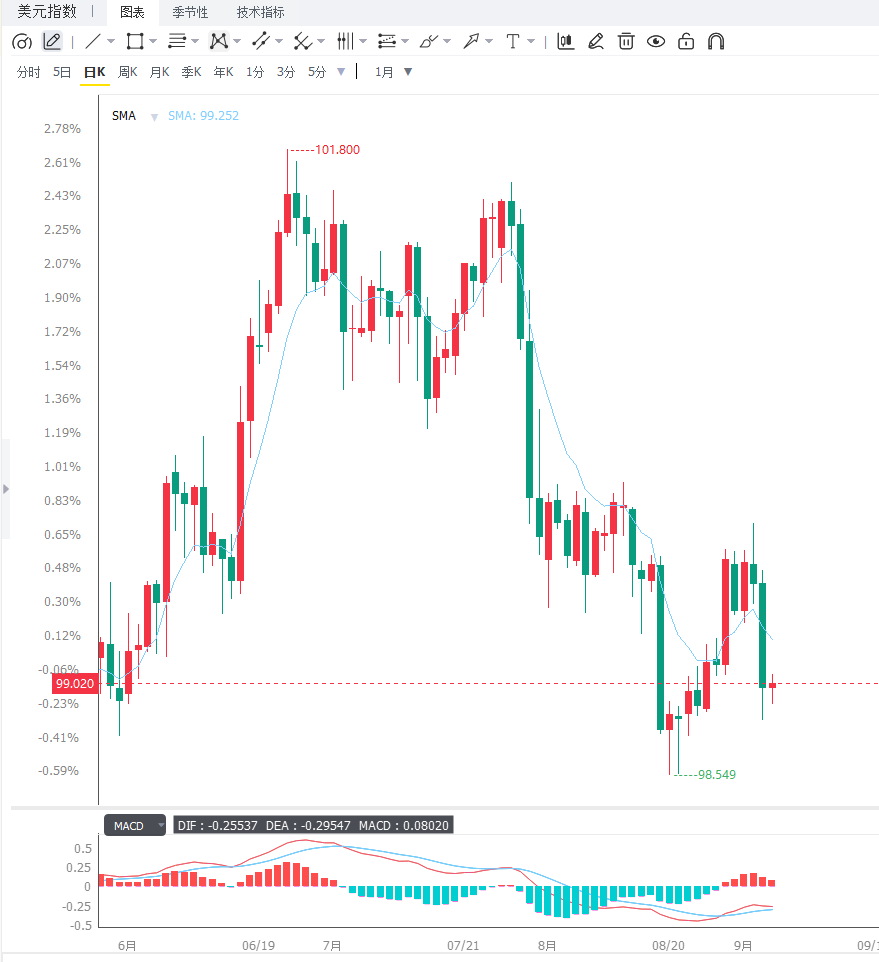 Editor's Summary: The continued weakening of the US dollar index is a result of the rapid repricing of expectations regarding Federal Reserve policy and the strong appreciation of the Japanese yen. Waller's dovish remarks have reduced the probability of a September rate hike back to 50.2%, significantly weakening short-term policy support for the dollar. The upcoming US non-farm payroll data will be a crucial catalyst in determining market direction. If the employment data is weak, the dollar index may decline further; if employment significantly exceeds expectations, the market may re-bet on rate hikes, driving a rapid recovery in the dollar. In the short term, 99.26 and 99.79 are key resistance levels for the continuation of the dollar's rebound, while 98.80 and 98.30 are key support areas to watch during the downtrend.
Federal Reserve Governor Christopher Waller's latest remarks have become a significant trigger for the dollar's weakness. Waller stated that if the upcoming inflation data does not contain any major surprises, he is inclined to maintain the current interest rate level at the September policy meeting. This statement contrasts with the relatively hawkish stance previously adopted by Fed Chairman Kevin Warsh, prompting investors to reassess the short-term interest rate path. From the perspective of interest rate market pricing, the change in policy expectations is already quite evident. Data from the CME Group's FedWatch tool shows that the probability of a Fed rate hike in September has fallen from 63.2% to 50.2%, a single-day drop of 13 percentage points. This means that the market has shifted from a previous bias towards a rate hike to a near 50/50 situation. The dollar's previous interest rate advantage has therefore been weakened. Next, the US August jobs report will be a crucial event influencing the dollar's short-term trend. The market currently expects US non-farm payrolls to increase by approximately 56,000 in August, with the unemployment rate remaining around 4.1%. If employment data is significantly weaker than expected, it will further reinforce market expectations that the Federal Reserve will maintain interest rates or even shift to a more accommodative stance, potentially putting continued pressure on the dollar. Conversely, if the employment market performs significantly better than expected, it could reignite the probability of a September rate hike and provide the dollar with a temporary rebound. Besides expectations regarding Fed policy, the rapid appreciation of the yen has also amplified downward pressure on the dollar index. The recent continuous decline in the USD/JPY exchange rate has fueled discussions about potential government action to stabilize the exchange rate. Simultaneously, investors are reassessing the possibility of further tightening by the Bank of Japan this year. The yen's recent appreciation has widened significantly, with the USD/JPY exchange rate experiencing substantial daily declines. The gradual normalization of Japanese monetary policy and the cooling of US interest rate expectations have combined to compress carry trades in the USD/JPY exchange rate. From a broader market perspective, the core issue facing the dollar is not simply economic data, but rather the marginal changes in interest rate expectations. Previously, the market worried that sticky US inflation might force the Fed to maintain a tight policy, while Waller's latest comments have re-emphasized "data dependence." Against this backdrop, unless subsequent inflation and employment data significantly exceed expectations, policy support for the dollar may continue to weaken. However, the US dollar is not entirely without the conditions for a rebound. US inflation data remains relatively high, and if the job market shows renewed resilience, market expectations for the Federal Reserve to maintain high interest rates or even further tighten policy this year may resurface. Furthermore, global risk aversion and the US economy's growth advantage relative to other major economies may also provide support for the dollar at key junctures. Therefore, the dollar market will enter a data-driven phase in the short term. Investors should not only focus on the August non-farm payroll data but also consider the unemployment rate, average hourly earnings, and subsequent inflation indicators for a comprehensive assessment. Especially with the probability of a September rate hike having fallen to around 50%, any unexpected data could cause a rapid readjustment of interest rate pricing and amplify the intraday volatility of the dollar index. From a daily chart perspective, the dollar index is currently trading around 99.00, with a short-term bearish trend still dominating. The index continues to trade below the 9-period and 50-period exponential moving averages, currently around 99.26 and 99.79 respectively, providing significant resistance to a dollar rebound. The 14-day RSI is near 40 and below the 50 midline, indicating that market momentum remains bearish. However, the indicator has not yet entered severely oversold territory, so the US dollar still has room to fall further. In the short term, the first resistance level to watch is around 99.26. If it fails to regain this level, the US dollar index may continue to test the 98.80 and 98.30 areas. If it unexpectedly breaks through 99.26, further observation is needed regarding the resistance around 99.79. Only by regaining the 50-period moving average can the short-term bearish structure be significantly alleviated. Looking at the 4-hour chart, the US dollar index remains in a downward channel after continuous weakening, and the rebound is currently insufficient to reverse the short-term trend. The 99.00 level is both a psychological level and a crucial area of contention between bulls and bears. If the price breaks below 98.80, the downside potential in the short term may open further, seeking support at 98.50 or even 98.30. If the non-farm payroll data drives a rapid rebound in the US dollar, 99.26 will become the first key resistance level, with further breakthroughs leading to targets in the 99.50 and 99.79 areas. Overall, until the US dollar regains its footing above 99.26, the 4-hour chart should still be viewed primarily as a rebound with downward pressure. Editor's Summary: The continued weakening of the US dollar index is a result of the rapid repricing of expectations regarding Federal Reserve policy and the strong appreciation of the Japanese yen. Waller's dovish remarks have reduced the probability of a September rate hike back to 50.2%, significantly weakening short-term policy support for the dollar. The upcoming US non-farm payroll data will be a crucial catalyst in determining market direction. If the employment data is weak, the dollar index may decline further; if employment significantly exceeds expectations, the market may re-bet on rate hikes, driving a rapid recovery in the dollar. In the short term, 99.26 and 99.79 are key resistance levels for the continuation of the dollar's rebound, while 98.80 and 98.30 are key support areas to watch during the downtrend.
- Risk Warning and Disclaimer
- The market involves risk, and trading may not be suitable for all investors. This article is for reference only and does not constitute personal investment advice, nor does it take into account certain users’ specific investment objectives, financial situation, or other needs. Any investment decisions made based on this information are at your own risk.