With oil prices remaining high and the US dollar weakening, the USD/CAD pair has fallen below the 1.3800 level; caution is advised against a potential acceleration of the downward move.
2026-09-04 13:58:05
The USD/CAD pair remained weak and volatile during Friday's Asian trading session, hovering below the 1.3800 level, not far from the near two-week low reached in the previous session. After a week of continuous correction, the exchange rate has clearly moved away from the previous high near 1.3940, and a significant weekly decline is expected. The current fundamental environment also continues to support further correction in the USD/CAD pair.  The recent strength in oil prices is a key factor supporting the Canadian dollar. Crude oil prices remain near their highest levels since July 24th, and the geopolitical risk premium in the Middle East has not yet subsided significantly. The situation surrounding the Strait of Hormuz continues to impact global energy supply expectations. Given the Canadian dollar's strong commodity currency characteristics, higher oil prices typically benefit the Canadian dollar and exert downward pressure on the USD/CAD exchange rate. Meanwhile, the hawkish signals released by the Bank of Canada at its September policy meeting further strengthened the Canadian dollar's relative interest rate advantage. With high oil prices and expectations of tighter monetary policy in Canada, the market remains relatively optimistic about the Canadian dollar's future performance, thus putting further downward pressure on the USD/CAD exchange rate. The weakening of the US dollar itself further amplifies this trend. The US dollar index fell to a more than one-week low on Thursday, mainly due to a significant reduction in market bets on a September rate hike by the Federal Reserve. Federal Reserve Governor Christopher Waller stated that US inflation has shown signs of slowing to some extent, and barring any major surprises, the Fed is likely to maintain its current policy in September. This statement quickly impacted the interest rate market. US Treasury yields subsequently fell, suppressing the dollar's upward momentum. For the USD/CAD pair, this means the exchange rate is under dual pressure from both the US dollar and the Canadian dollar: on the one hand, declining expectations of a Fed rate hike weaken the dollar's interest rate advantage; on the other hand, rising oil prices and the Bank of Canada's hawkish stance strengthen demand for the Canadian dollar. However, the market is not currently fully betting on a sustained one-sided decline in USD/CAD. Investors are awaiting clearer macroeconomic signals, especially the US non-farm payroll report and Canada's monthly employment data. Both employment data will be released at the same time, and their relative strength or weakness could directly impact interest rate expectations in both countries and the short-term direction of USD/CAD. The market currently expects US non-farm payrolls to increase by approximately 56,000 in August, with the unemployment rate remaining around 4.1%. If US employment data is significantly weaker than expected, while Canadian employment remains resilient, the market may further reduce the probability of a Fed rate hike, and USD/CAD is likely to continue seeking support downwards. Conversely, if US non-farm payroll data is significantly stronger than expected, while the Canadian job market shows a clear cooling, USD/CAD may experience a technical rebound. However, strong employment data alone is not enough to completely determine the Fed's policy path. The market will continue to focus on subsequent inflation data, as the necessity for a Fed rate hike in September remains limited if employment improvement fails to be accompanied by a resurgence in inflation. Therefore, future US inflation data may be more important than a single employment indicator. Even with strong non-farm payroll data, the Fed may choose to maintain interest rates as long as inflation continues to cool, limiting the dollar's upside and providing fundamental support for USD/CAD bears. Furthermore, the Middle East situation remains a significant external variable for the exchange rate. If risks related to the Strait of Hormuz continue to push up oil prices, the Canadian dollar may receive additional support, increasing downward pressure on USD/CAD. Conversely, if geopolitical risks ease significantly and the oil risk premium declines rapidly, the Canadian dollar's commodity advantage may weaken, creating a potential for a short-term rebound in USD/CAD. Currently, USD/CAD has fallen rapidly from around 1.3940, and the market is testing lower technical support levels. As long as the exchange rate cannot regain its footing above key moving averages and Fibonacci resistance levels, the short-term trading logic still favors shorting opportunities on rallies. From a daily chart perspective, the USD/CAD pair failed to hold above the 100-day simple moving average this week and subsequently broke below the 61.8% Fibonacci retracement level, indicating a significant weakening of the overall technical structure. The 61.8% retracement level around 1.3819 has become the first short-term resistance. If the price rebounds but fails to hold above this area, it means the previous failed breakout may continue to evolve into a trend correction. Further upside targets are the 50% retracement level around 1.3901 and the 100-day moving average around 1.3920, with 1.3983 and 1.4084 forming higher-level resistance. On the downside, the 78.6% retracement level around 1.3702 is the first important support level. A break below this level could lead to a further test of the previous full retracement level around 1.3554. Overall, until the price recovers above 1.3920, the daily chart remains bearish. From a 4-hour chart perspective, the USD/CAD pair has formed a clear downward trend after a rapid decline from around 1.3940, with short-term rebounds still facing resistance from dense resistance levels. The 1.3800 level is currently a crucial psychological battleground between bulls and bears. If the price continues to trade below this level and further breaks below 1.3702, short-term bearish momentum may strengthen again, with the next targets around 1.3600 and the 1.3554 area. If non-farm payrolls or Canadian employment data drive a rapid rebound, the first level to watch is 1.3819, followed by the 1.3901 and 1.3920 areas. Only if the price re-establishes itself above 1.3920 and further breaks through 1.3983 will the current daily bearish structure show significant signs of correction.
 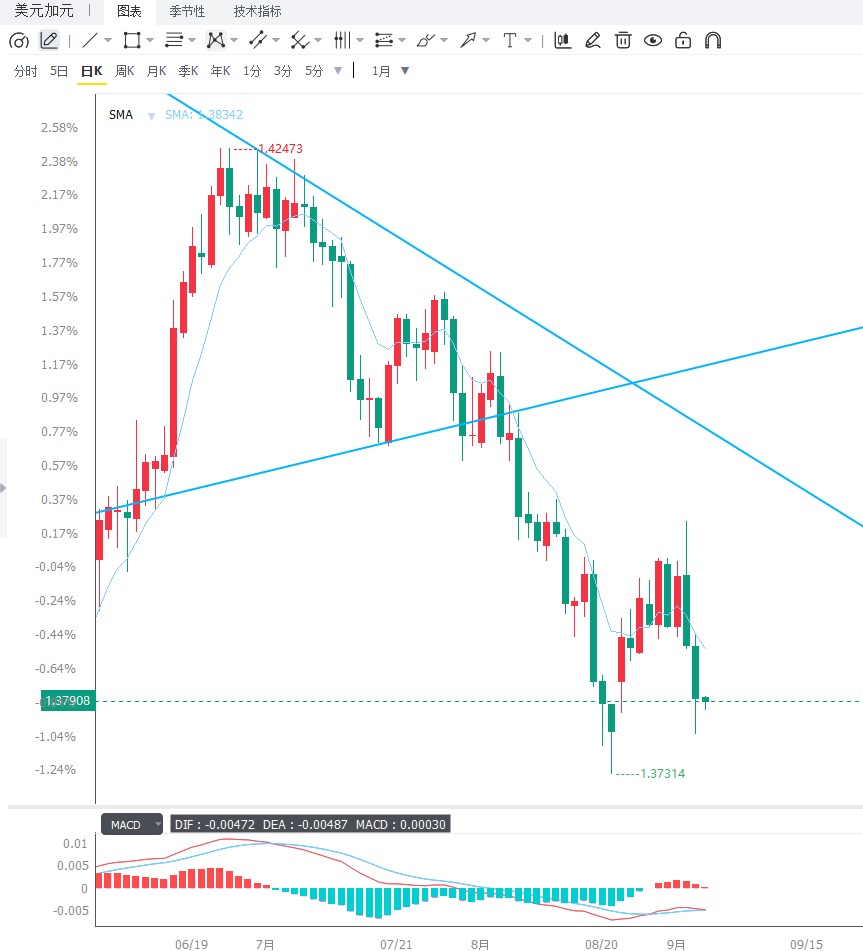 Editor's Summary: The current decline in USD/CAD is not solely driven by a weakening US dollar, but rather by a combination of factors including high oil prices, a hawkish stance from the Bank of Canada, and a cooling of expectations for a Federal Reserve rate hike. In the short term, 1.3819 is the first key resistance level for the pair's rebound, while 1.3702 is a crucial support level that the bears need to break through in the next phase. US non-farm payrolls and Canadian employment data will directly impact monetary policy expectations in both countries, while the situation in the Middle East and oil prices may amplify exchange rate volatility through the Canadian dollar. If US employment data cools and oil prices remain high, USD/CAD has further downside potential; conversely, if US data is significantly strong and pushes the US dollar back up, a rapid correction in the exchange rate should be anticipated.
The recent strength in oil prices is a key factor supporting the Canadian dollar. Crude oil prices remain near their highest levels since July 24th, and the geopolitical risk premium in the Middle East has not yet subsided significantly. The situation surrounding the Strait of Hormuz continues to impact global energy supply expectations. Given the Canadian dollar's strong commodity currency characteristics, higher oil prices typically benefit the Canadian dollar and exert downward pressure on the USD/CAD exchange rate. Meanwhile, the hawkish signals released by the Bank of Canada at its September policy meeting further strengthened the Canadian dollar's relative interest rate advantage. With high oil prices and expectations of tighter monetary policy in Canada, the market remains relatively optimistic about the Canadian dollar's future performance, thus putting further downward pressure on the USD/CAD exchange rate. The weakening of the US dollar itself further amplifies this trend. The US dollar index fell to a more than one-week low on Thursday, mainly due to a significant reduction in market bets on a September rate hike by the Federal Reserve. Federal Reserve Governor Christopher Waller stated that US inflation has shown signs of slowing to some extent, and barring any major surprises, the Fed is likely to maintain its current policy in September. This statement quickly impacted the interest rate market. US Treasury yields subsequently fell, suppressing the dollar's upward momentum. For the USD/CAD pair, this means the exchange rate is under dual pressure from both the US dollar and the Canadian dollar: on the one hand, declining expectations of a Fed rate hike weaken the dollar's interest rate advantage; on the other hand, rising oil prices and the Bank of Canada's hawkish stance strengthen demand for the Canadian dollar. However, the market is not currently fully betting on a sustained one-sided decline in USD/CAD. Investors are awaiting clearer macroeconomic signals, especially the US non-farm payroll report and Canada's monthly employment data. Both employment data will be released at the same time, and their relative strength or weakness could directly impact interest rate expectations in both countries and the short-term direction of USD/CAD. The market currently expects US non-farm payrolls to increase by approximately 56,000 in August, with the unemployment rate remaining around 4.1%. If US employment data is significantly weaker than expected, while Canadian employment remains resilient, the market may further reduce the probability of a Fed rate hike, and USD/CAD is likely to continue seeking support downwards. Conversely, if US non-farm payroll data is significantly stronger than expected, while the Canadian job market shows a clear cooling, USD/CAD may experience a technical rebound. However, strong employment data alone is not enough to completely determine the Fed's policy path. The market will continue to focus on subsequent inflation data, as the necessity for a Fed rate hike in September remains limited if employment improvement fails to be accompanied by a resurgence in inflation. Therefore, future US inflation data may be more important than a single employment indicator. Even with strong non-farm payroll data, the Fed may choose to maintain interest rates as long as inflation continues to cool, limiting the dollar's upside and providing fundamental support for USD/CAD bears. Furthermore, the Middle East situation remains a significant external variable for the exchange rate. If risks related to the Strait of Hormuz continue to push up oil prices, the Canadian dollar may receive additional support, increasing downward pressure on USD/CAD. Conversely, if geopolitical risks ease significantly and the oil risk premium declines rapidly, the Canadian dollar's commodity advantage may weaken, creating a potential for a short-term rebound in USD/CAD. Currently, USD/CAD has fallen rapidly from around 1.3940, and the market is testing lower technical support levels. As long as the exchange rate cannot regain its footing above key moving averages and Fibonacci resistance levels, the short-term trading logic still favors shorting opportunities on rallies. From a daily chart perspective, the USD/CAD pair failed to hold above the 100-day simple moving average this week and subsequently broke below the 61.8% Fibonacci retracement level, indicating a significant weakening of the overall technical structure. The 61.8% retracement level around 1.3819 has become the first short-term resistance. If the price rebounds but fails to hold above this area, it means the previous failed breakout may continue to evolve into a trend correction. Further upside targets are the 50% retracement level around 1.3901 and the 100-day moving average around 1.3920, with 1.3983 and 1.4084 forming higher-level resistance. On the downside, the 78.6% retracement level around 1.3702 is the first important support level. A break below this level could lead to a further test of the previous full retracement level around 1.3554. Overall, until the price recovers above 1.3920, the daily chart remains bearish. From a 4-hour chart perspective, the USD/CAD pair has formed a clear downward trend after a rapid decline from around 1.3940, with short-term rebounds still facing resistance from dense resistance levels. The 1.3800 level is currently a crucial psychological battleground between bulls and bears. If the price continues to trade below this level and further breaks below 1.3702, short-term bearish momentum may strengthen again, with the next targets around 1.3600 and the 1.3554 area. If non-farm payrolls or Canadian employment data drive a rapid rebound, the first level to watch is 1.3819, followed by the 1.3901 and 1.3920 areas. Only if the price re-establishes itself above 1.3920 and further breaks through 1.3983 will the current daily bearish structure show significant signs of correction. Editor's Summary: The current decline in USD/CAD is not solely driven by a weakening US dollar, but rather by a combination of factors including high oil prices, a hawkish stance from the Bank of Canada, and a cooling of expectations for a Federal Reserve rate hike. In the short term, 1.3819 is the first key resistance level for the pair's rebound, while 1.3702 is a crucial support level that the bears need to break through in the next phase. US non-farm payrolls and Canadian employment data will directly impact monetary policy expectations in both countries, while the situation in the Middle East and oil prices may amplify exchange rate volatility through the Canadian dollar. If US employment data cools and oil prices remain high, USD/CAD has further downside potential; conversely, if US data is significantly strong and pushes the US dollar back up, a rapid correction in the exchange rate should be anticipated.
- Risk Warning and Disclaimer
- The market involves risk, and trading may not be suitable for all investors. This article is for reference only and does not constitute personal investment advice, nor does it take into account certain users’ specific investment objectives, financial situation, or other needs. Any investment decisions made based on this information are at your own risk.