Trump may reduce oil price intervention; can oil prices withstand upward pressure?
2026-09-04 16:40:05
On Friday (September 4th) during the Asian and European sessions, international oil prices fell slightly, with WTI crude oil down 0.57% to trade at $90.79. Oil prices above $90 are a thorn in the side for the US, prompting Trump to continue advocating for higher oil prices. He stated last night that 30 to 40 ships transit the Strait of Hormuz every night, and the previous trading day that armed conflict is not in the interest of either side, and that peaceful dialogue is the best way to resolve differences. The logic of the US-Iran game still revolves around oil prices; oil prices above $90 indicate that the US is more anxious, and the market believes Iran has the upper hand. Currently, the US-Iran conflict has entered its seventh month, with no signs of easing negotiations. To curb Iran's nuclear ambitions and eliminate shipping interference in the Strait of Hormuz, the US has established a long-term operational strategy, launching a triple pressure strategy of military strikes, comprehensive sanctions, and a maritime blockade. Simultaneously, the conflict in Yemen has intensified, and geopolitical risks in the Middle East have spread comprehensively. Despite the ongoing combat operations depleting some of the US military's weapons stockpiles, the US has initiated increased military production to ensure ammunition supply. Trump even claimed that the US military's ammunition reserves for the war against Iran are almost "unlimited," sufficient to support long-term military operations, and also hinted at his hope that Iran would take the initiative to back down. 
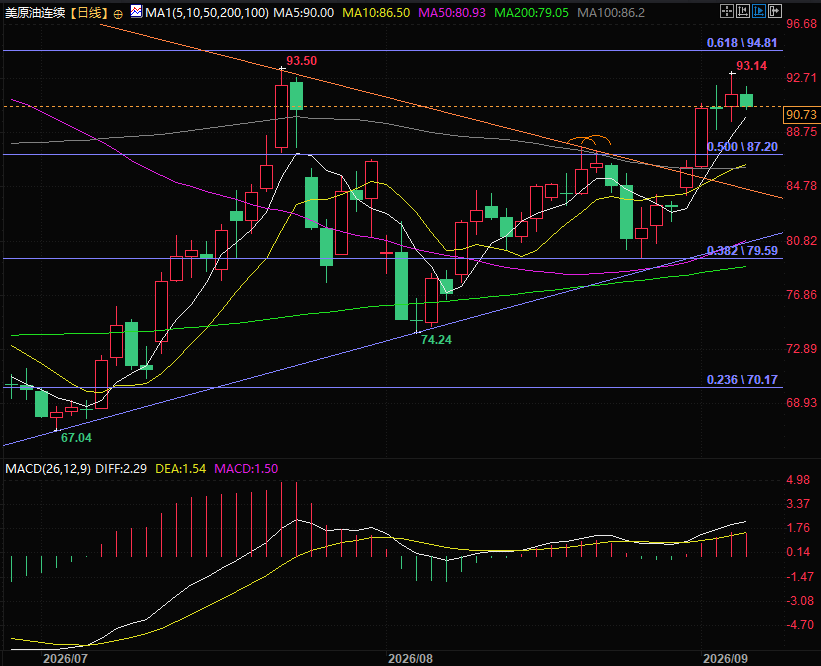 (WTI crude oil futures daily chart, source: EasyTrade) At 16:33 Beijing time, WTI crude oil futures were trading at $90.68 per barrel.
With escalating land and sea blockades, Iran's economy is in dire straits.
Compared to conventional sanctions that can be circumvented through trade transshipment and shadow transactions, the targeted maritime blockade by the US military has dealt a devastating blow to Iran, causing its economic defenses to collapse completely. As of September 2, the US blockade had forced 86 merchant ships associated with Iran to leave Iranian ports, three ships were rendered unable to navigate, and two were subject to inspection, with the blockade intensifying since the end of August. Simultaneously, US Secretary of State Rubio issued sanctions threats, imposing secondary sanctions on all third-party countries that assist Iran in circumventing sanctions, completely blocking Iran's external revenue-generating channels. As a result, Iran's imports and exports declined by 35%, domestic inflation approached 70%, and the rial exchange rate hit a record low; core crude oil exports plummeted from 1.7 million barrels per day to around 260,000 barrels per day. The hedging model relying on shadow fleets and ship-to-ship transshipment became completely ineffective, foreign exchange earnings dried up, and the domestic economy became unsustainable. The US military continued to send strong signals of a hardline stance, with Trump publicly declaring that the US has virtually "unlimited" ammunition reserves against Iran, sufficient to support a prolonged military operation. Despite the ongoing high-intensity conflict depleting some of the US military's weapons inventory, the Pentagon has urgently launched a production increase plan to ensure the supply of subsequent combat materials. The US's strategic objectives in this round of actions against Iran are clear: to curb Iran's nuclear ambitions and completely end Iran's interference with shipping in the Strait of Hormuz. To this end, the US is implementing a three-pronged strategy of military strikes, comprehensive sanctions, and a maritime blockade to comprehensively compress Iran's living space.The chaotic information warfare on the battlefield has led to a significant reduction in navigation data across the Taiwan Strait.
The current conflict is characterized by highly distorted battlefield information and intense competition, significantly increasing market uncertainty. Iran has repeatedly claimed responsibility for attacks on US military bases and ships, and for orchestrating tanker attacks, all of which have been completely denied by the US. Even with the escalating standoff, the US continues to ensure basic shipping in the Strait of Hormuz, escorting 40 merchant ships carrying a total of 18 million barrels of crude oil safely through on September 1st alone. The stark contrast between the two sides' reports continues to disrupt market sentiment. Latest shipping data directly reflects the risks in the strait: on Thursday, only four commodity vessels passed through the Strait of Hormuz, including two medium-range oil tankers, one Kamsarmax bulk carrier, and one Handysize bulk carrier, far below the nine vessels of the previous day and the daily average of 15 vessels over the past ten days. Coupled with some vessels turning off their transponders, the actual traffic activity may be further revised downwards, and the global core energy transport corridor continues to tighten. Compared to economic sanctions that can be circumvented through trade transshipment and shadow transactions, the US-imposed maritime blockade has dealt a fatal blow to Iran, causing a complete collapse of Iran's economic defenses. Data shows that Iran's import and export trade volume declined by about 35% year-on-year, the domestic inflation rate approached 70%, and the rial exchange rate fell to a historic low. Crude oil exports, a core pillar of the Iranian economy, suffered a precipitous drop, plummeting from 1.7 million barrels per day to around 260,000 barrels per day, nearly depleting foreign exchange earnings. For a long time, Iran relied on shadow fleets, ship-to-ship transshipment, and the Chinese market to absorb crude oil, circumventing US sanctions. However, the maritime blockade completely severed its logistical channels, leaving Iran unable to support import trade, stabilize its exchange rate, or maintain domestic economic operations.The conflict in Yemen is escalating, and risks in the Red Sea and the Persian Gulf are resonating.
The geopolitical risks in the Middle East are exhibiting a multi-faceted interconnectedness. The escalation of the conflict in Yemen and the situation in the Strait of Hormuz are strongly resonating, further amplifying the risks to oil supply. Recently, the fiercest fighting since 2022 erupted in Taiz province, Yemen, with the Houthi rebels launching a ground offensive using missiles and drones, advancing their lines, triggering a large-scale refugee exodus, and attempting to cut off key routes from Taiz to the Red Sea coast, seize the port of Moha, and gain control of Red Sea shipping. This conflict is not an isolated incident but a regional strategic deployment by the Iranian camp: Iran, relying on proxy forces such as the Houthis, has established a foothold in the Red Sea, echoing the situation in the Strait of Hormuz and counterbalancing the power of the US and the West. Currently, both sides in Yemen are continuously increasing troop deployments and casualties are rising. The conflict risks dragging Saudi Arabia into the fray. If Red Sea shipping is disrupted, it will have a cumulative effect with the tightening of shipping lanes in the Persian Gulf, although there are currently no reports of such disruptions.Summary and Technical Analysis:
Overall, while the two major energy shipping routes in the Middle East remain shrouded in risk, crude oil transport capacity has not been completely blocked, and oil-producing countries are trying to sell more oil . Because the US urgently wants oil prices to fall (Trump has been making daily statements to suppress oil prices since prices exceeded 90), Iran, as its counterpart, is more willing to see oil prices rise, thus forcing the US to ease sanctions. Therefore, the core contest regarding oil prices currently revolves around whether Iran can exert reasonable (and Iran also needs to focus on international diplomacy) control over oil prices, and whether the US can provide more oil supply and stabilize prices. The most direct analytical tool is likely the oil price itself; higher oil prices indicate stronger Iranian control, making it easier for prices to rise. Therefore, technical analysis and trend judgment are particularly important. Of course, traditional fundamental analysis such as crude oil transportation, Iranian crude oil storage, and domestic inflation is also important, but there is currently a lot of misinformation in the market. We will select more reliable information and combine it with market analysis. Meanwhile, the US has been announcing daily positive news about ample oil supply, acting as an additional force to intervene in oil prices. Recent online rumors suggest Trump is unwell; if the US reduces its propaganda campaign regarding oil prices, prices may become uncontrollable and break upwards. Why do I emphasize and analyze oil price trends daily? Because in the face of the global debt crisis and the Federal Reserve's indecisiveness, oil prices, along with the underlying geopolitical and inflationary factors, are the key to understanding and analyzing the entire process of rising interest rates. Understanding oil prices means grasping the decision-making direction of global central banks. Technically: The recent three trading days have shown a double-top pattern on the daily candlestick chart, similar to that of August 20th and 21st, while oil prices have begun to pull back. Here, we should pay attention to the support level of the 5-day moving average. If oil prices cannot retrace to the 5-day moving average, be wary of a reversal and continued strength, potentially targeting the 0.618 Fibonacci retracement level of 94.81. (WTI crude oil futures daily chart, source: EasyTrade) At 16:33 Beijing time, WTI crude oil futures were trading at $90.68 per barrel.
- Risk Warning and Disclaimer
- The market involves risk, and trading may not be suitable for all investors. This article is for reference only and does not constitute personal investment advice, nor does it take into account certain users’ specific investment objectives, financial situation, or other needs. Any investment decisions made based on this information are at your own risk.