Rising expectations of a Bank of Japan interest rate hike supported the yen, while the USD/JPY pair faced increased downward pressure after falling below the 156 level.
2026-09-07 09:54:07
The USD/JPY pair weakened in Asian trading on Monday, falling back to around the 156.00 level after its previous rebound failed to hold. Last Friday, the pair found some support near its early August lows and rebounded modestly, but the rally was limited. As the new week begins, market attention is shifting back to the Bank of Japan's policy path and changes in US interest rate expectations.  One of the core factors supporting the yen is the significantly increased market expectation of further monetary tightening by the Bank of Japan (BOJ). Traders have largely priced in the possibility of a 25 basis point rate hike at the BOJ's September 17-18 meeting, and the market is also beginning to discuss the potential for further policy adjustments in December. If the BOJ releases a clearer signal of policy tightening in the future, the expected interest rate differential between the US dollar and the Japanese yen may narrow further, thus putting sustained pressure on USD/JPY. Domestic inflation in Japan remains a crucial variable influencing policy expectations. Previously, core price increases in Japan remained at a relatively high level, and price indicators in the Tokyo area also showed that inflationary pressures have not completely subsided. Under these circumstances, the policy environment faced by the BOJ has changed significantly from the past period of maintaining ultra-loose policies for a long time. As long as the domestic price and wage environment in Japan continues to remain resilient, market expectations for further BOJ rate hikes are unlikely to dissipate quickly. At the same time, market concerns about possible measures by the Japanese government to stabilize the exchange rate have also increased the risks during the upward movement of USD/JPY. If USD/JPY rapidly approaches 160 again, investors may reassess the risk of official intervention, making some long positions more cautious at higher levels. For the foreign exchange market, policy expectations and intervention risks have combined to provide some protection for the yen during its weak phase. However, the dollar is not entirely passive. The latest US non-farm payroll report was better than market expectations, prompting investors to reassess the policy path of the Federal Reserve's September meeting. If the job market remains resilient, and inflationary pressures from rising energy prices reappear, the Fed may maintain higher interest rates for longer than previously expected. Theoretically, rising US interest rate expectations would benefit the dollar and could limit the downside for USD/JPY. However, dollar bulls have not significantly increased their positions, mainly due to the upcoming US inflation data this week. The market will focus on the Producer Price Index (PPI) and Consumer Price Index (CPI) to determine whether recent energy price increases are transmitting to broader goods and services prices. If inflation data is higher than expected, expectations of a Fed rate cut may cool further, potentially providing new support for the dollar; conversely, if price pressures ease again, the market may bet again that the Fed will maintain or even gradually shift to a more accommodative policy stance, potentially putting greater downward pressure on USD/JPY. Meanwhile, tensions between the US and Iran, as well as changes in the Strait of Hormuz, have also provided some safe-haven support for the dollar. The recent surge in crude oil prices has increased global investor concerns about energy supply and financial market volatility. In an environment of declining risk appetite, the US dollar, as a traditional safe-haven currency, may see inflows. This factor has, to some extent, offset the pressure on USD/JPY caused by rising expectations of a Bank of Japan policy shift. Furthermore, the US Labor Day holiday has resulted in relatively low market liquidity, making price fluctuations during Asian and European sessions more susceptible to short-term capital flows. In this environment, a mere break below 156 USD/JPY does not necessarily indicate a confirmed trend. The market is currently more focused on whether the 155.30-155.20 area can be effectively broken. A breach of this area would further confirm the previous downtrend; conversely, if the price finds support in this area and returns above 156, short-term bearish momentum may ease. From a market sentiment perspective, USD/JPY is currently caught in a tug-of-war between two forces. On one hand, expectations of a Bank of Japan rate hike and the risk of potential intervention are driving funds to buy the yen; on the other hand, the resilience of the US job market, inflation concerns stemming from energy prices, and geopolitical risks are limiting further dollar weakness. Therefore, the market is likely to remain cautious ahead of the release of US inflation data, and short-term exchange rate volatility may be significantly amplified. Technically, the USD/JPY pair maintains a short-term bearish bias on the daily chart. The pair is currently trading below the important 200-day simple moving average at 158.46, indicating that the medium-term trend has not yet reversed to bullish. As long as the price cannot stabilize above 158.46, the recent downtrend from its more than one-month high remains valid. On the downside, the first support level to watch is 155.30-155.25, which is currently a key support level. A decisive break below this level on the daily chart could open up further downside potential. If bearish momentum strengthens, the 155 level and the 153.80-154.00 area will become potential targets. On the upside, the first resistance level to watch is 156.80-157.20, with further resistance around 158.00 and the 200-day moving average area at 158.46. From a 4-hour chart perspective, USD/JPY remains in a weak rebound structure within a downtrend, with the 156 level becoming a key battleground between bulls and bears in the short term. If the price rebound fails to regain a foothold in the 156.80-157.20 area, short-term moving averages may continue to exert downward pressure, and the MACD momentum may also expand downwards again. A decisive break below the 155.30-155.20 area could accelerate the downtrend on the 4-hour chart, potentially leading to a further test of the 154 level. Conversely, if the price finds significant support at 155.20 and breaks above 157, the short-term bearish structure will weaken, and the price may rebound towards the 158 area. The most crucial technical signals to watch are whether the 155.30-155.20 support level can be effectively broken, and whether a sustained selling pressure can form after the 156 level is breached.
 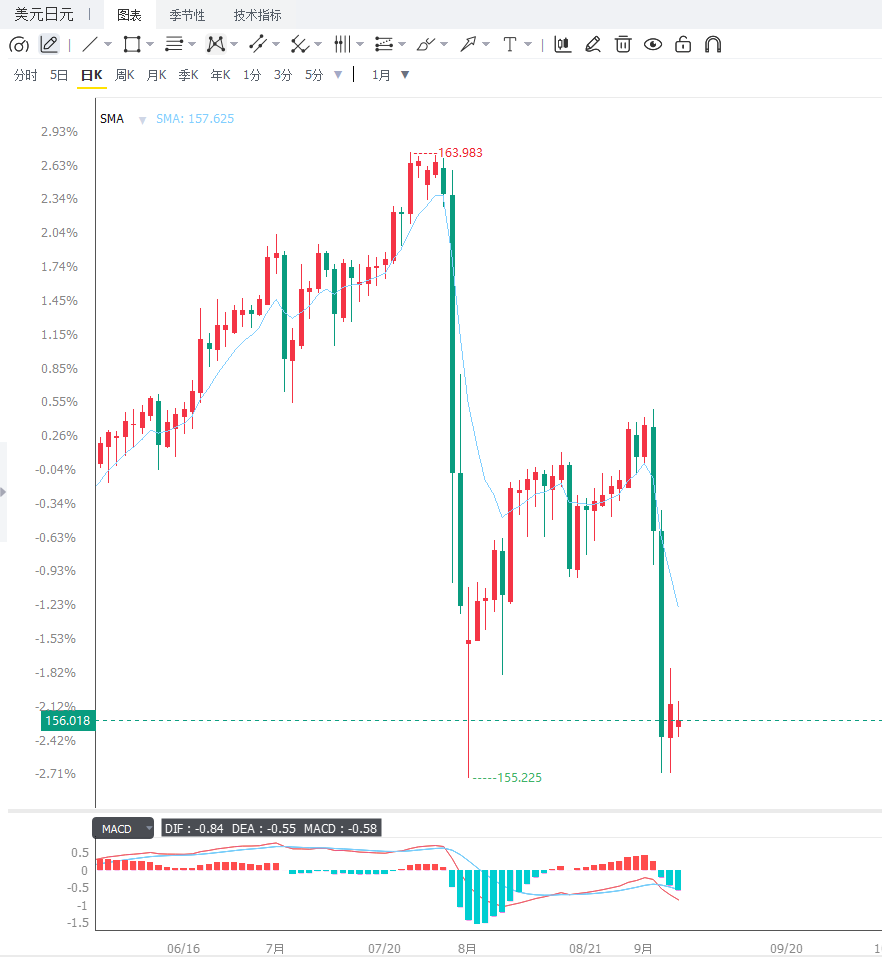 Editor's Summary: The USD/JPY pair is currently caught in a dual struggle between expectations of a Bank of Japan (BOJ) rate hike and renewed expectations of US interest rates. In the short term, expectations of a September BOJ rate hike, potential currency intervention risks, and the overall weakness of the US dollar remain key factors suppressing the exchange rate. Meanwhile, resilient US employment data, rising energy prices, and safe-haven demand provide support for the dollar. In the coming trading days, US inflation data will be a crucial catalyst for determining the dollar's direction. If inflation data remains high, the dollar may gain upward momentum, and USD/JPY may fluctuate within the 155-158 range. If inflation cools and further strengthens market expectations of a Fed policy shift, while the BOJ releases more hawkish signals, then a breach of the 155.30-155.20 support level would significantly increase the probability of further declines in USD/JPY. Therefore, the market should not rely solely on a single economic data point to determine the trend. It is necessary to simultaneously observe the USD/JPY interest rate differential, BOJ policy expectations, US inflation performance, and the potential risk of official intervention around 160. In the short term, the USD/JPY pair remains predominantly bearish, but volatility may intensify significantly ahead of key data releases.
One of the core factors supporting the yen is the significantly increased market expectation of further monetary tightening by the Bank of Japan (BOJ). Traders have largely priced in the possibility of a 25 basis point rate hike at the BOJ's September 17-18 meeting, and the market is also beginning to discuss the potential for further policy adjustments in December. If the BOJ releases a clearer signal of policy tightening in the future, the expected interest rate differential between the US dollar and the Japanese yen may narrow further, thus putting sustained pressure on USD/JPY. Domestic inflation in Japan remains a crucial variable influencing policy expectations. Previously, core price increases in Japan remained at a relatively high level, and price indicators in the Tokyo area also showed that inflationary pressures have not completely subsided. Under these circumstances, the policy environment faced by the BOJ has changed significantly from the past period of maintaining ultra-loose policies for a long time. As long as the domestic price and wage environment in Japan continues to remain resilient, market expectations for further BOJ rate hikes are unlikely to dissipate quickly. At the same time, market concerns about possible measures by the Japanese government to stabilize the exchange rate have also increased the risks during the upward movement of USD/JPY. If USD/JPY rapidly approaches 160 again, investors may reassess the risk of official intervention, making some long positions more cautious at higher levels. For the foreign exchange market, policy expectations and intervention risks have combined to provide some protection for the yen during its weak phase. However, the dollar is not entirely passive. The latest US non-farm payroll report was better than market expectations, prompting investors to reassess the policy path of the Federal Reserve's September meeting. If the job market remains resilient, and inflationary pressures from rising energy prices reappear, the Fed may maintain higher interest rates for longer than previously expected. Theoretically, rising US interest rate expectations would benefit the dollar and could limit the downside for USD/JPY. However, dollar bulls have not significantly increased their positions, mainly due to the upcoming US inflation data this week. The market will focus on the Producer Price Index (PPI) and Consumer Price Index (CPI) to determine whether recent energy price increases are transmitting to broader goods and services prices. If inflation data is higher than expected, expectations of a Fed rate cut may cool further, potentially providing new support for the dollar; conversely, if price pressures ease again, the market may bet again that the Fed will maintain or even gradually shift to a more accommodative policy stance, potentially putting greater downward pressure on USD/JPY. Meanwhile, tensions between the US and Iran, as well as changes in the Strait of Hormuz, have also provided some safe-haven support for the dollar. The recent surge in crude oil prices has increased global investor concerns about energy supply and financial market volatility. In an environment of declining risk appetite, the US dollar, as a traditional safe-haven currency, may see inflows. This factor has, to some extent, offset the pressure on USD/JPY caused by rising expectations of a Bank of Japan policy shift. Furthermore, the US Labor Day holiday has resulted in relatively low market liquidity, making price fluctuations during Asian and European sessions more susceptible to short-term capital flows. In this environment, a mere break below 156 USD/JPY does not necessarily indicate a confirmed trend. The market is currently more focused on whether the 155.30-155.20 area can be effectively broken. A breach of this area would further confirm the previous downtrend; conversely, if the price finds support in this area and returns above 156, short-term bearish momentum may ease. From a market sentiment perspective, USD/JPY is currently caught in a tug-of-war between two forces. On one hand, expectations of a Bank of Japan rate hike and the risk of potential intervention are driving funds to buy the yen; on the other hand, the resilience of the US job market, inflation concerns stemming from energy prices, and geopolitical risks are limiting further dollar weakness. Therefore, the market is likely to remain cautious ahead of the release of US inflation data, and short-term exchange rate volatility may be significantly amplified. Technically, the USD/JPY pair maintains a short-term bearish bias on the daily chart. The pair is currently trading below the important 200-day simple moving average at 158.46, indicating that the medium-term trend has not yet reversed to bullish. As long as the price cannot stabilize above 158.46, the recent downtrend from its more than one-month high remains valid. On the downside, the first support level to watch is 155.30-155.25, which is currently a key support level. A decisive break below this level on the daily chart could open up further downside potential. If bearish momentum strengthens, the 155 level and the 153.80-154.00 area will become potential targets. On the upside, the first resistance level to watch is 156.80-157.20, with further resistance around 158.00 and the 200-day moving average area at 158.46. From a 4-hour chart perspective, USD/JPY remains in a weak rebound structure within a downtrend, with the 156 level becoming a key battleground between bulls and bears in the short term. If the price rebound fails to regain a foothold in the 156.80-157.20 area, short-term moving averages may continue to exert downward pressure, and the MACD momentum may also expand downwards again. A decisive break below the 155.30-155.20 area could accelerate the downtrend on the 4-hour chart, potentially leading to a further test of the 154 level. Conversely, if the price finds significant support at 155.20 and breaks above 157, the short-term bearish structure will weaken, and the price may rebound towards the 158 area. The most crucial technical signals to watch are whether the 155.30-155.20 support level can be effectively broken, and whether a sustained selling pressure can form after the 156 level is breached. Editor's Summary: The USD/JPY pair is currently caught in a dual struggle between expectations of a Bank of Japan (BOJ) rate hike and renewed expectations of US interest rates. In the short term, expectations of a September BOJ rate hike, potential currency intervention risks, and the overall weakness of the US dollar remain key factors suppressing the exchange rate. Meanwhile, resilient US employment data, rising energy prices, and safe-haven demand provide support for the dollar. In the coming trading days, US inflation data will be a crucial catalyst for determining the dollar's direction. If inflation data remains high, the dollar may gain upward momentum, and USD/JPY may fluctuate within the 155-158 range. If inflation cools and further strengthens market expectations of a Fed policy shift, while the BOJ releases more hawkish signals, then a breach of the 155.30-155.20 support level would significantly increase the probability of further declines in USD/JPY. Therefore, the market should not rely solely on a single economic data point to determine the trend. It is necessary to simultaneously observe the USD/JPY interest rate differential, BOJ policy expectations, US inflation performance, and the potential risk of official intervention around 160. In the short term, the USD/JPY pair remains predominantly bearish, but volatility may intensify significantly ahead of key data releases.
- Risk Warning and Disclaimer
- The market involves risk, and trading may not be suitable for all investors. This article is for reference only and does not constitute personal investment advice, nor does it take into account certain users’ specific investment objectives, financial situation, or other needs. Any investment decisions made based on this information are at your own risk.