The Federal Reserve's attempt to downplay the fact that global official gold reserves exceeded the value of US Treasury bonds last year indicates that a strategic shift by global central banks is now a certainty.
2026-09-07 10:28:07
As the saying goes, the more something is tried to conceal, the more significant it becomes. When the Federal Reserve recently released a rare research note attempting to provide context for the momentous milestone of gold surpassing US Treasury bonds, it precisely confirmed the immense impact of this event on the existing financial order. This historic turning point, occurring in 2025, was first observed by Tavi Costa, founder of Azuria Capital LLC, and quickly gained recognition from authoritative institutions such as the International Monetary Fund. In the current context of dramatic changes in the global financial landscape, attempting to downplay this fact only highlights the irreversibility of gold's rising status, and a revolution in the definition of reserve assets is quietly unfolding.

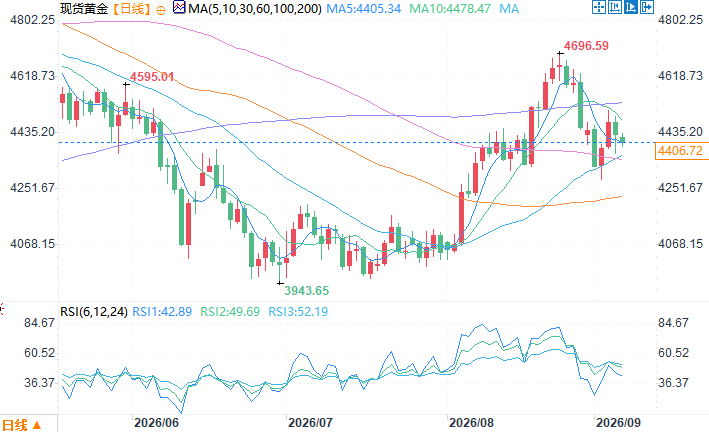 Spot gold daily chart source: FX678. At 10:27 AM Beijing time on September 7th, spot gold was trading at $4407.72 per ounce.
The Federal Reserve's justifications and unintentional evidence of reality
The timing of the Federal Reserve's release of this research note is quite delicate, coinciding with the US Treasury's announcement that it would double its purchases of long-term Treasury bonds through a repurchase program. While the official definition is not yield curve control, the underlying motivation is self-evident. If the long-term US Treasury market has sufficient private and institutional demand, the government would have no need to intervene and inject liquidity. This move, in turn, indirectly confirms the market's lack of confidence in long-term bonds, contrasting sharply with the high demand for gold. Faced with the fact that gold reserves surpass US Treasury bonds, the Federal Reserve offered two seemingly reasonable technical explanations: firstly, the surge in gold value is mainly due to price increases, not an explosive increase in central bank purchases; secondly, global gold reserves include a huge historical holding inherited from the Bretton Woods system. These technical explanations do point out statistical details, but they cannot obscure the core fact: even excluding US-held gold, by the end of 2025, the value of global sovereign gold reserves would still reach $4 trillion, slightly higher than the $3.9 trillion in US Treasury bonds held by foreign officials. This comparison of hard power cannot be concealed by simple price fluctuations.Central banks vote with their actions: Gold's strategic position is unshakeable.
While the numerical superiority can perhaps be attributed to price factors, the actual actions of central banks cannot be ignored; they are endorsing gold's strategic position through sustained purchases. Data from the World Gold Council's "2026 Central Bank Gold Reserves Survey" shows that over the past four years, global central banks have purchased an average of approximately 1,000 tons of gold annually, double the average rate of the previous decade. This clearly demonstrates that central bank gold purchases are not short-term speculation, but rather the execution of a long-term strategy. Even more noteworthy are market expectations. The survey shows a record 45% of surveyed central banks expect to increase their gold reserves in the next 12 months, and a staggering 89% believe that global central bank gold holdings will continue to rise. Looking further ahead, 84% of respondents expect gold's share of global reserves to further expand in five years, while 74% believe the dollar's share will decline. These figures are not nostalgic for the Bretton Woods system, but rather a forward-looking strategic deployment based on future risk assessments by major global financial institutions, clearly conveying a firm confidence in gold.Beyond the Currency Dispute: Reshaping the Global Financial Asset Landscape
Of course, it must be clearly recognized that the surpassing of gold's reserve value does not mean that the US dollar is about to lose its dominant position as a reserve currency, nor does it mean that US Treasury bonds have suddenly lost their value as the world's deepest and most liquid financial market asset. The fundamental position of the US Treasury market remains solid in the short term, but this is not the focus of the debate. The core significance of this transformation lies not in gold's simple substitution of the dollar, but in the fundamental shift in the asset allocation concepts of global central banks. Central banks are increasingly viewing gold as a strategic monetary asset that runs parallel to, and even gradually replaces, traditional dollar reserves in certain marginal areas. The Federal Reserve may be able to downplay the psychological impact of this milestone through technical analysis, but it cannot deny the deeper logic behind this trend: against the backdrop of increasing global uncertainty, gold is no longer merely a safe-haven asset, but has become an indispensable key monetary asset in the global financial market.Conclusion
In conclusion, the Federal Reserve's attempt to explain gold's milestone of surpassing US Treasury bonds with technical reasons appears weak and unconvincing. While the dollar's reserve currency status is unlikely to be shaken in the short term, the continued trend of global central banks increasing their gold holdings signifies a shift in reserve asset allocation from a sole reliance on the dollar to a diversified strategy. Gold's status as a strategic monetary asset is established, and its equal importance, or even marginal substitution, for dollar reserves has become an irreversible trend. This game of value and trust will ultimately reshape the future landscape of global finance. Spot gold daily chart source: FX678. At 10:27 AM Beijing time on September 7th, spot gold was trading at $4407.72 per ounce.
- Risk Warning and Disclaimer
- The market involves risk, and trading may not be suitable for all investors. This article is for reference only and does not constitute personal investment advice, nor does it take into account certain users’ specific investment objectives, financial situation, or other needs. Any investment decisions made based on this information are at your own risk.