The much stronger-than-expected US non-farm payrolls data put pressure on gold prices, but the medium-term bullish structure for gold remains valid, awaiting stabilization.
2026-09-07 10:34:05
International gold prices weakened slightly in early Asian trading on Monday, with spot gold trading around $4,400 per ounce, continuing its previous downward trend. The direct catalyst for this decline in gold prices came from the latest US employment data. Data released by the US Bureau of Labor Statistics showed that non-farm payrolls increased by 162,000 in August, significantly higher than the market expectation of 56,000 and also markedly higher than the increase of approximately 21,000 in July. The strong employment performance changed the market's judgment on the short-term policy path of the Federal Reserve, thus putting significant pressure on gold.  For gold, US interest rate expectations are currently one of the most important pricing factors. Gold itself does not generate interest income; when the market expects US interest rates to remain high or even rise further, the opportunity cost of holding gold relative to dollar assets increases. Therefore, after the release of the non-farm payroll data, investors quickly increased their bets on a tightening of the Federal Reserve's policy in September, leading to short-term profit-taking and capital outflows in gold. The probability of a 25 basis point rate hike at the Fed's September meeting has risen to approximately 58.3%, higher than the approximately 50.2% level before the data release. Changes in market expectations are directly reflected in precious metal prices. Independent analyst Ty Wong believes that the strong jobs report significantly increases the likelihood of a September rate hike, and unless the upcoming US consumer price data is weak, gold may still face pressure in the short term. However, the market cannot yet determine the Fed's future policy path based solely on a single jobs report. This week, US PPI and CPI will become new key variables. If producer prices and consumer prices accelerate again, the market may further bet on the Fed maintaining or even strengthening its tightening stance, which could continue to support the dollar and US Treasury yields, while gold may undergo further adjustments. Conversely, if US inflation data falls short of expectations, particularly if core prices continue to cool, the interest rate hike expectations driven by employment data could reverse. At that point, the market will reassess whether the Federal Reserve truly needs to take more aggressive policy action in September. Therefore, the current decline around $4395 is more of a short-term adjustment following the repricing of interest rate expectations than a fundamental change in the long-term upward logic of gold. Meanwhile, Middle East energy transportation risks further complicate gold's trajectory. Recent tensions in the region have brought commercial shipping in the Strait of Hormuz under intense market scrutiny. If energy transportation continues to be affected, international oil prices may remain high, transmitting to global inflation through energy costs. Typically, escalating geopolitical risks can support gold through safe-haven demand, but the current situation presents a unique challenge: if energy prices continue to rise sharply, prompting renewed market concerns about US inflation, the Federal Reserve may find it more difficult to quickly shift to an easing policy. In this case, the safe-haven benefit of geopolitical risks for gold may be partially offset by the negative chain of "rising oil prices → rising inflation expectations → high interest rates." This is a key reason why recent gold price performance differs from traditional safe-haven logic. Investors are not only focused on the military risks themselves, but also on whether these risks will further impact energy supply, inflation, and the policy paths of major central banks. If oil prices continue to rise but US inflation data weakens simultaneously, gold may regain support from both safe-haven demand and expectations of further easing; conversely, if rising oil prices simultaneously fuel renewed US inflation, gold may continue to face downward pressure in the short term. From a funding perspective, gold has already accumulated some profit-taking after its recent significant rise. Better-than-expected non-farm payroll data became a key factor triggering profit-taking. Until expectations for Fed policy stabilize, gold may continue to experience high volatility. The market currently needs to focus on whether the $4395-$4405 area can provide effective support, and whether the price can rebound and reclaim the $4465 level. Previously, Commerzbank believed that the recent gold rebound was driven by increasingly apparent market divergence, with some investors beginning to doubt whether the Fed would actually continue tightening policy in September. Fed Governor Christopher Waller's previously cautious policy statements also prompted the market to reassess the probability of further interest rate hikes. This means that there is currently no one-sided bearish logic in the gold market, and subsequent market movements will still heavily depend on US inflation data and speeches by Federal Reserve officials. From a global asset allocation perspective, gold still has certain strategic allocation value. On the one hand, global geopolitical risks and energy supply uncertainties have not disappeared; on the other hand, there are still disagreements in the market regarding the long-term outlook for US fiscal policy, interest rates, and the dollar's trajectory. Even if gold is pressured in the short term by strong employment data, as long as there is no significant withdrawal of medium- to long-term funds, its pullback may still attract new bargain hunters. The daily chart for gold still shows some resilience. Spot gold is currently still above the 100-day simple moving average of approximately $4,350, so the medium-term bullish structure has not been broken. However, the price has fallen below the 20-day Bollinger Band middle line of approximately $4,465, indicating that after the previous rapid rise, it has entered a clear consolidation phase. The 14-day RSI is approximately 51, having fallen from a previously high level to near neutral, meaning that the overheated bullish state has been released, but the market has not yet formed clear oversold conditions. The first resistance level to watch is around $4465. If this level is reclaimed, the next resistance level to watch is around $4675. On the downside, the first support level to watch is the $4405-$4395 area. If this area is breached, it may test the 100-day moving average around $4350, and further down, the lower Bollinger Band around $4260. From the 4-hour chart, gold remains in a weak structure after a short-term pullback, with the $4395 area becoming a crucial battleground between bulls and bears. If the price can find support around $4400 and break back into the $4435-$4465 area, the 4-hour momentum may gradually recover, with a potential rebound target around $4500. Conversely, if the price continues to trade below $4465 and breaks below $4395, the bears may continue to dominate in the short term, and $4350 will become the next important level to watch. Short-term momentum indicators such as MACD need to be closely monitored to see if bottoming signals appear. Whether $4,395 can be held will directly affect whether the short-term adjustment of gold is a normal pullback or a further weakening trend.
 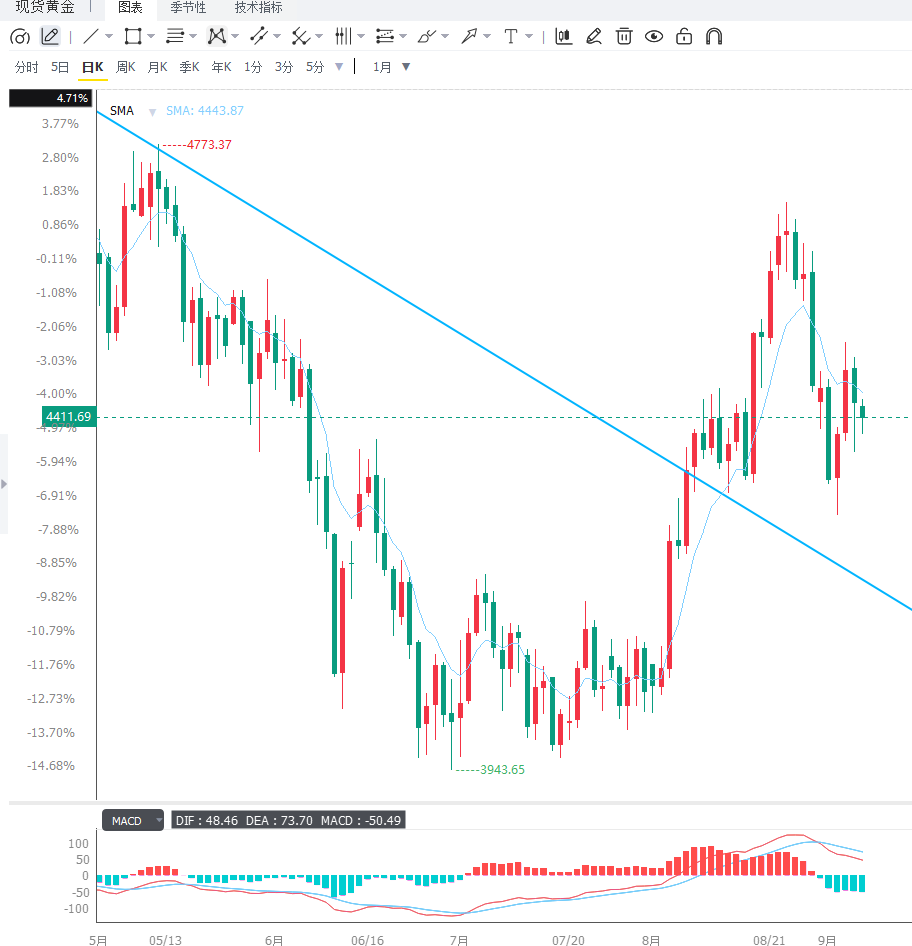 Editor's Summary: The significantly stronger-than-expected US non-farm payroll data for August has significantly increased expectations of a Fed rate hike in September, which is the main reason for the recent rapid correction in gold prices. In the short term, the dollar and interest rate expectations may continue to put downward pressure on gold prices, while the inflationary risks brought by rising energy prices have also increased uncertainty in the gold market. However, this is not yet sufficient to conclude that the medium-term upward structure of gold has ended. The $4395-$4350 range constitutes a relatively important defensive zone. As long as this area can effectively absorb selling pressure, gold still has the potential to recover upwards. The key to determining the future direction of the market will be whether US PPI and CPI can validate market expectations of further tightening by the Fed. If US inflation rises again, gold may continue to seek support at $4350 or even $4260; if inflation data cools significantly, and the Fed weakens expectations of further rate hikes, gold may retest $4465 and recover towards $4675. The core contradiction in the current gold market has shifted from simple safe-haven demand to a rebalancing between "geopolitical risk support" and "high interest rates and strong dollar suppression." Therefore, short-term volatility may increase further, but in the medium to long term, it is still necessary to focus on real interest rates, the trend of the US dollar, central bank gold purchases, and changes in global risk asset allocation.
For gold, US interest rate expectations are currently one of the most important pricing factors. Gold itself does not generate interest income; when the market expects US interest rates to remain high or even rise further, the opportunity cost of holding gold relative to dollar assets increases. Therefore, after the release of the non-farm payroll data, investors quickly increased their bets on a tightening of the Federal Reserve's policy in September, leading to short-term profit-taking and capital outflows in gold. The probability of a 25 basis point rate hike at the Fed's September meeting has risen to approximately 58.3%, higher than the approximately 50.2% level before the data release. Changes in market expectations are directly reflected in precious metal prices. Independent analyst Ty Wong believes that the strong jobs report significantly increases the likelihood of a September rate hike, and unless the upcoming US consumer price data is weak, gold may still face pressure in the short term. However, the market cannot yet determine the Fed's future policy path based solely on a single jobs report. This week, US PPI and CPI will become new key variables. If producer prices and consumer prices accelerate again, the market may further bet on the Fed maintaining or even strengthening its tightening stance, which could continue to support the dollar and US Treasury yields, while gold may undergo further adjustments. Conversely, if US inflation data falls short of expectations, particularly if core prices continue to cool, the interest rate hike expectations driven by employment data could reverse. At that point, the market will reassess whether the Federal Reserve truly needs to take more aggressive policy action in September. Therefore, the current decline around $4395 is more of a short-term adjustment following the repricing of interest rate expectations than a fundamental change in the long-term upward logic of gold. Meanwhile, Middle East energy transportation risks further complicate gold's trajectory. Recent tensions in the region have brought commercial shipping in the Strait of Hormuz under intense market scrutiny. If energy transportation continues to be affected, international oil prices may remain high, transmitting to global inflation through energy costs. Typically, escalating geopolitical risks can support gold through safe-haven demand, but the current situation presents a unique challenge: if energy prices continue to rise sharply, prompting renewed market concerns about US inflation, the Federal Reserve may find it more difficult to quickly shift to an easing policy. In this case, the safe-haven benefit of geopolitical risks for gold may be partially offset by the negative chain of "rising oil prices → rising inflation expectations → high interest rates." This is a key reason why recent gold price performance differs from traditional safe-haven logic. Investors are not only focused on the military risks themselves, but also on whether these risks will further impact energy supply, inflation, and the policy paths of major central banks. If oil prices continue to rise but US inflation data weakens simultaneously, gold may regain support from both safe-haven demand and expectations of further easing; conversely, if rising oil prices simultaneously fuel renewed US inflation, gold may continue to face downward pressure in the short term. From a funding perspective, gold has already accumulated some profit-taking after its recent significant rise. Better-than-expected non-farm payroll data became a key factor triggering profit-taking. Until expectations for Fed policy stabilize, gold may continue to experience high volatility. The market currently needs to focus on whether the $4395-$4405 area can provide effective support, and whether the price can rebound and reclaim the $4465 level. Previously, Commerzbank believed that the recent gold rebound was driven by increasingly apparent market divergence, with some investors beginning to doubt whether the Fed would actually continue tightening policy in September. Fed Governor Christopher Waller's previously cautious policy statements also prompted the market to reassess the probability of further interest rate hikes. This means that there is currently no one-sided bearish logic in the gold market, and subsequent market movements will still heavily depend on US inflation data and speeches by Federal Reserve officials. From a global asset allocation perspective, gold still has certain strategic allocation value. On the one hand, global geopolitical risks and energy supply uncertainties have not disappeared; on the other hand, there are still disagreements in the market regarding the long-term outlook for US fiscal policy, interest rates, and the dollar's trajectory. Even if gold is pressured in the short term by strong employment data, as long as there is no significant withdrawal of medium- to long-term funds, its pullback may still attract new bargain hunters. The daily chart for gold still shows some resilience. Spot gold is currently still above the 100-day simple moving average of approximately $4,350, so the medium-term bullish structure has not been broken. However, the price has fallen below the 20-day Bollinger Band middle line of approximately $4,465, indicating that after the previous rapid rise, it has entered a clear consolidation phase. The 14-day RSI is approximately 51, having fallen from a previously high level to near neutral, meaning that the overheated bullish state has been released, but the market has not yet formed clear oversold conditions. The first resistance level to watch is around $4465. If this level is reclaimed, the next resistance level to watch is around $4675. On the downside, the first support level to watch is the $4405-$4395 area. If this area is breached, it may test the 100-day moving average around $4350, and further down, the lower Bollinger Band around $4260. From the 4-hour chart, gold remains in a weak structure after a short-term pullback, with the $4395 area becoming a crucial battleground between bulls and bears. If the price can find support around $4400 and break back into the $4435-$4465 area, the 4-hour momentum may gradually recover, with a potential rebound target around $4500. Conversely, if the price continues to trade below $4465 and breaks below $4395, the bears may continue to dominate in the short term, and $4350 will become the next important level to watch. Short-term momentum indicators such as MACD need to be closely monitored to see if bottoming signals appear. Whether $4,395 can be held will directly affect whether the short-term adjustment of gold is a normal pullback or a further weakening trend. Editor's Summary: The significantly stronger-than-expected US non-farm payroll data for August has significantly increased expectations of a Fed rate hike in September, which is the main reason for the recent rapid correction in gold prices. In the short term, the dollar and interest rate expectations may continue to put downward pressure on gold prices, while the inflationary risks brought by rising energy prices have also increased uncertainty in the gold market. However, this is not yet sufficient to conclude that the medium-term upward structure of gold has ended. The $4395-$4350 range constitutes a relatively important defensive zone. As long as this area can effectively absorb selling pressure, gold still has the potential to recover upwards. The key to determining the future direction of the market will be whether US PPI and CPI can validate market expectations of further tightening by the Fed. If US inflation rises again, gold may continue to seek support at $4350 or even $4260; if inflation data cools significantly, and the Fed weakens expectations of further rate hikes, gold may retest $4465 and recover towards $4675. The core contradiction in the current gold market has shifted from simple safe-haven demand to a rebalancing between "geopolitical risk support" and "high interest rates and strong dollar suppression." Therefore, short-term volatility may increase further, but in the medium to long term, it is still necessary to focus on real interest rates, the trend of the US dollar, central bank gold purchases, and changes in global risk asset allocation.
- Risk Warning and Disclaimer
- The market involves risk, and trading may not be suitable for all investors. This article is for reference only and does not constitute personal investment advice, nor does it take into account certain users’ specific investment objectives, financial situation, or other needs. Any investment decisions made based on this information are at your own risk.