Oil prices and a hawkish Bank of Canada stance support the Canadian dollar, while strong US non-farm payrolls data put downward pressure on it. Who will prevail?
2026-09-07 10:32:08
On Monday (September 7) during the Asian session, the USD/CAD pair traded in a narrow range, currently hovering around 1.3840, virtually unchanged for the day. Crude oil prices rebounded to around $92 per barrel due to geopolitical tensions (US-Iran attacks over the weekend, Iran's announcement of a new restricted zone in the Strait of Hormuz), providing potential support for the Canadian dollar. However, TD Securities pointed out that the relative performance of US and Canadian employment data has altered the risk balance—US non-farm payrolls increased by 162,000 (far exceeding the expected 56,000), while Canadian employment data fell short of expectations, enough to offset the temporary support from the Bank of Canada's hawkish signals. 
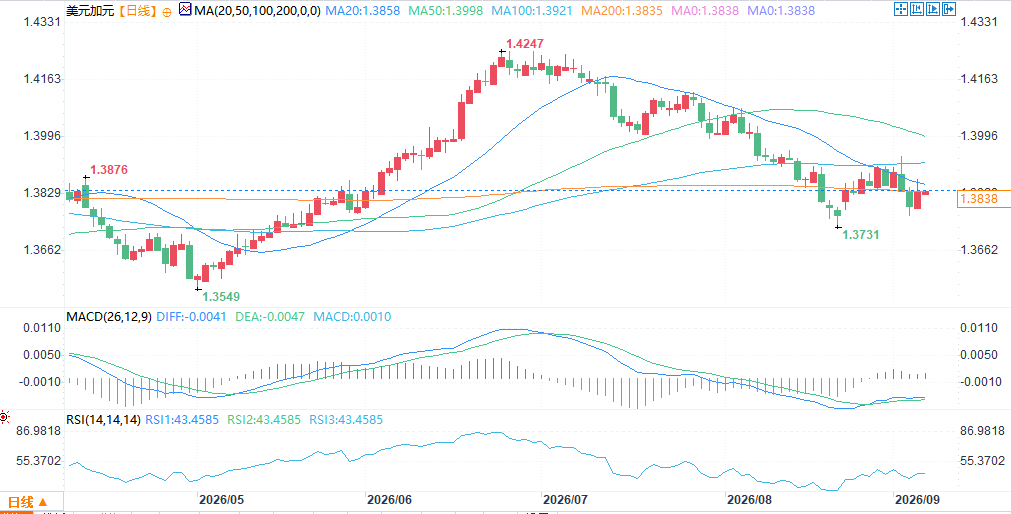 (USD/CAD daily chart, source: EasyForex) At 10:31 Beijing time, USD/CAD was trading at 1.3836/37.
Oil prices and hawkish signals from the Bank of Canada supported the Canadian dollar, but employment data weighed on it.
WTI crude oil futures rebounded to around $92 per barrel due to geopolitical tensions – the US and Iran clashed over the weekend, and Iran announced a new restricted zone in the Strait of Hormuz. The Bank of Canada's hawkish signals at its September meeting provided support for the Canadian dollar. However, TD Securities points out that the relative performance of US and Canadian employment data has altered the risk balance – US non-farm payrolls increased by 162,000 (far exceeding the expected 56,000), while Canadian employment data fell short of expectations, enough to offset the temporary support from the Bank of Canada's hawkish signals, and the Canadian dollar may face relative weakness. The rebound in oil prices directly improved Canada's terms of trade as an energy exporter, providing fundamental support for the Canadian dollar. The restrictions and escalating conflict in the Strait of Hormuz pushed up global oil risk premiums, with WTI prices trading around $92, reinforcing the traditional positive correlation between the Canadian dollar and oil prices. Meanwhile, the hawkish signals released by the Bank of Canada before its September meeting suggested that policy rates might remain higher and longer, potentially dampening expectations of further easing and attracting some funds into Canadian dollar assets. However, the relative divergence in employment data quickly changed the market risk balance. The significantly stronger-than-expected US non-farm payrolls data highlighted the resilience of the US economy, while weak Canadian employment data revealed signs of a cooling domestic labor market. TD Securities' analysis emphasizes that this data discrepancy was enough to offset the temporary boost from the central bank's hawkish stance, causing the Canadian dollar to become relatively weak in cross-currency pairs. Investors are therefore focusing more on the differences in economic momentum between the two countries, rather than a single policy signal. In the short term, if oil prices fail to rise further or subsequent Canadian data continues to be weak, the Canadian dollar may face increased downward pressure.The US dollar was supported by data, with inflation data becoming key.
US non-farm payrolls increased by 162,000, far exceeding expectations, while the unemployment rate remained stable at 4.1%. CME data showed the probability of a September rate hike rose to 58.3%. Although the US dollar is generally weak, the strong data may limit its decline. Goldman Sachs pointed out that if this week's CPI is moderate, the Federal Reserve may keep interest rates unchanged, even though the non-farm payrolls have cleared the way for a rate hike. If the divergence between US and Canadian data continues, the Canadian dollar may face further pressure; if oil prices remain high or Canadian data improves, the Canadian dollar may find support. The strong non-farm payrolls data has reignited discussions about the Fed's policy path, with the probability of a September rate hike rising to 58.3%, indicating that some investors are beginning to react to the resilience of the employment situation. The US dollar remains generally weak, but the data support has effectively limited further downside and prevented the formation of a one-sided weak trend. Goldman Sachs reiterated that inflation is the decisive variable—even if the employment report cleared some obstacles to a rate hike, if this week's CPI reading is moderate, the Fed may still choose to hold rates steady. This data-dependent framework makes the short-term movement of the US dollar highly sensitive to upcoming inflation data. The USD/CAD pair is fluctuating between 1.3750 and 1.3900, reflecting a temporary balance between bullish and bearish forces: on one hand, US data and potential interest rate hike expectations are supporting the US dollar, while on the other hand, oil prices and signals from the Bank of Canada are supporting the Canadian dollar. If the divergence between US and Canadian employment and growth data continues to widen, the relative pressure on the Canadian dollar may persist; conversely, if oil prices remain high or Canadian data improves, the Canadian dollar is expected to regain buying support. Geopolitical developments and inflation data will jointly determine the direction of a breakout from this range, and investors need to remain vigilant about both potential risks.Summarize
The USD/CAD pair is currently trading around 1.3840, supported by oil prices and a hawkish stance from the Bank of Canada, but mixed US and Canadian employment data are weighing on the Canadian dollar. Strong US non-farm payrolls data have increased the probability of a September rate hike to 58.3%, but inflation data remains the key factor. Investors should pay attention to the continued impact of divergent US and Canadian economic data and oil price movements on the exchange rate. (USD/CAD daily chart, source: EasyForex) At 10:31 Beijing time, USD/CAD was trading at 1.3836/37.- Risk Warning and Disclaimer
- The market involves risk, and trading may not be suitable for all investors. This article is for reference only and does not constitute personal investment advice, nor does it take into account certain users’ specific investment objectives, financial situation, or other needs. Any investment decisions made based on this information are at your own risk.