US military escort has become the "new normal," and it won't end until Iran backs down; will oil prices continue to rise?
2026-09-07 11:22:06
U.S. Energy Secretary Wright stated on Sunday (September 6th) that U.S. military escorts are crucial for maintaining oil flow through the Strait of Hormuz, suggesting the escort operation will not end anytime soon. He said, "A large number of ships are passing through, but this requires the U.S. military to complete. Iran is still causing trouble, but the U.S. Navy is winning this battle." Wright revealed that the daily flow through the strait has exceeded 9 million barrels, and with pipelines and other routes, regional flow has recovered to more than two-thirds of pre-conflict levels. The average price of gasoline in the U.S. has reached $4.15 per gallon (September record), and diesel prices have risen to a record high of $5.88 per gallon. 
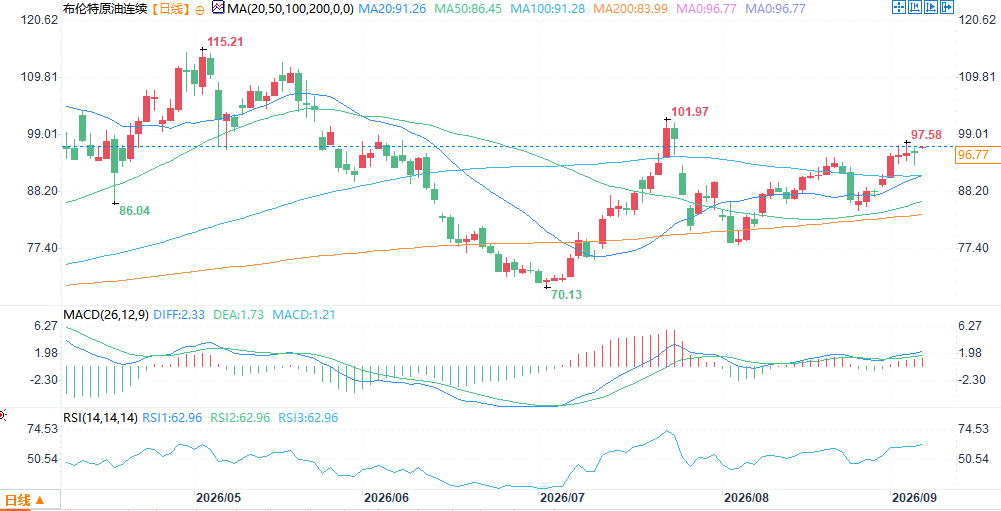 (Brent crude oil futures daily chart, source: EasyTrade) At 11:20 Beijing time, Brent crude oil futures were trading at $96.79 per barrel.
US escort missions will continue; the US Energy Secretary stated that traffic in the Strait of Hormuz has recovered to two-thirds of pre-conflict levels.
U.S. Energy Secretary Frank Wright stated on Sunday that U.S. military escorts are crucial for maintaining oil flow through the Strait of Hormuz, suggesting the escorts will not end anytime soon. He said, "We are getting a lot of ships through, but this requires the U.S. military to do it. Iran is still causing trouble, but the U.S. Navy is winning this battle." Wright stated that the daily flow through the strait has exceeded 9 million barrels per day, and with pipelines and other routes, regional flow has recovered to more than two-thirds of pre-conflict levels. Previously, Wright stated that approximately 17 million barrels of oil passed through the strait on Monday. Wright's statement clearly signals that the U.S. will continue to invest military resources to ensure the smooth flow of this critical oil route. As a vital choke point for global oil transportation, the recovery of flow through the Strait of Hormuz is directly related to the stability of the international energy market. A daily flow exceeding 9 million barrels, combined with supplementary overland pipelines and alternative routes, has restored the region's overall supply capacity to more than two-thirds of pre-conflict levels, alleviating the extreme tension caused by the conflict. However, the flow has not yet fully recovered to normal levels, indicating that the potential risk of disruption remains. The U.S. military escort has become the core means of ensuring passage, meaning that this mechanism is unlikely to be withdrawn in the short term. The market will therefore continue to focus on the efficiency and sustainability of the escort operation. If the flow can be further improved and stabilized, the geopolitical premium in oil prices may decline; conversely, any new disruptions could reignite supply concerns. Overall, the escort operation has become a key pillar in the current energy security landscape, and its continuity will directly affect the normal operation of global crude oil trade and price expectations.With clashes continuing over the weekend, is escorting ships becoming the "new normal"?
The US military attacked three Iranian oil tankers last Saturday, after the Iranian Revolutionary Guard launched ballistic missiles at two US destroyers. Wright acknowledged that escorting ships has become the "new normal," but hoped other countries would join the effort, stating that "trade is important to the world and shouldn't be just America's responsibility." South Korea is assessing the possibility of joining the escort operation, while Britain and France had previously proposed multinational mine-clearing and escort missions. The average price of gasoline in the US has reached $4.15 per gallon (September record), and diesel prices have risen to a record high of $5.88 per gallon. Brent crude futures are currently trading around $96.80 per barrel and may remain high in the short term, with attention focused on the sustainability of the escort missions and the progress of geopolitical conflicts. The ongoing conflict indicates that the intertwining of military confrontation and commercial shipping is unlikely to be resolved in the short term. The definition of escorting ships as the "new normal" reflects that all parties have come to regard armed protection as a regular means of ensuring energy transport, rather than a temporary emergency measure. Wright's call for other countries to share responsibility highlights the US's intention to transform unilateral escorting into a multilateral cooperation framework. South Korea's assessment and the multinational mission proposals previously put forward by the UK and France indicate a certain consensus within the international community on jointly maintaining security in the Taiwan Strait; however, practical implementation still requires coordination and time. Meanwhile, domestic refined oil prices in the US have reached record highs, with gasoline and diesel costs rising significantly, directly increasing the burden on consumers and the transportation industry, and potentially further contributing to inflation. Brent crude oil is therefore likely to remain at high levels, and the market will closely monitor whether the escort operation can continue to be effective, and whether the conflict shows signs of escalation or de-escalation. If multinational participation is successfully implemented, supply stability is expected to improve; if the conflict recurs, the high oil price and high freight rates may persist, putting continuous pressure on the global energy market.Summarize
Conflicts continued over the weekend, with Wright stating that escorting ships has become the "new normal." Fuel prices hit record highs, and South Korea is considering joining the escort efforts. On Monday in Asian trading, as of 11:18, Brent crude oil had risen more than 1% to $96.95 per barrel, not far from the more than five-week high of $97.58 reached last week. Analysts expect Brent crude futures to remain high in the short term, focusing on the sustainability of the escort and the progress of geopolitical conflicts. If the escort remains effective and more countries join, the geopolitical premium may marginally decline; if the conflict escalates or the escort is hindered, oil prices may rise further. The impact of US gasoline prices on political pressure will also be closely watched. (Brent crude oil futures daily chart, source: EasyTrade) At 11:20 Beijing time, Brent crude oil futures were trading at $96.79 per barrel.
- Risk Warning and Disclaimer
- The market involves risk, and trading may not be suitable for all investors. This article is for reference only and does not constitute personal investment advice, nor does it take into account certain users’ specific investment objectives, financial situation, or other needs. Any investment decisions made based on this information are at your own risk.