Institutions: Gold is becoming a strategic necessity amid high levels of government debt.
2026-09-07 11:26:10
As global government debt levels continue to rise, capital markets are undergoing a profound restructuring. In this transformation, gold's role is fundamentally changing. Christopher Hamilton, Head of Client Solutions for Asia Pacific at Invesco, recently pointed out that investors are gradually abandoning the traditional view of gold as a short-term tactical tool, instead elevating it to a long-term strategic asset allocation. Behind this shift lies not only concern about inflation and interest rates, but also a reshaping of confidence in the global monetary system, marking the beginning of a new era of value for gold.
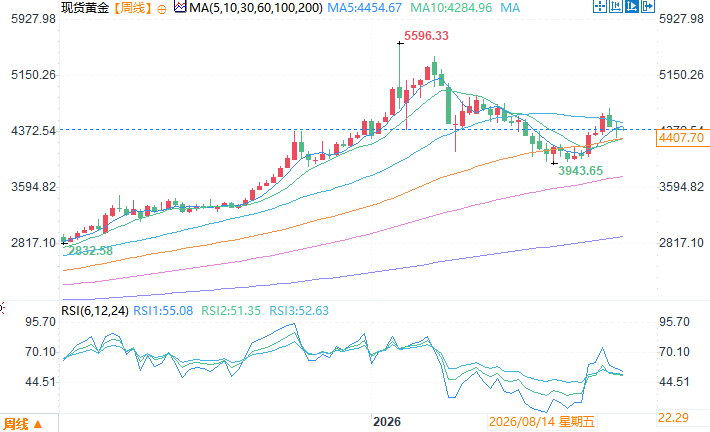 Spot gold weekly chart source: FX678. As of 11:23 AM Beijing time on September 7th, spot gold was trading at $4408.70 per ounce.
The root cause of bond market turmoil: the double whammy of economic resilience and inflation expectations.
In response to the recent widespread sell-off in the global bond market, Hamilton analyzed the two core drivers behind the continued rise in global bond yields. He pointed out that the US economy has demonstrated considerable resilience, providing fundamental support for the market. However, at the same time, concerns about inflation have resurfaced, particularly with the resurgence of term premiums, exacerbating investors' risk aversion. Hamilton emphasized that this return of term premiums is closely related to concerns about the US fiscal situation. Real yields are rising significantly, and increased productivity is also a contributing factor. Although the US Treasury has recently made efforts to lower long-term bond yields, the upward trend in yields remains unstoppable due to the combined effects of inflation, oil prices, and term premiums. This complex macroeconomic environment constitutes the main theme of current market volatility and further strengthens the logical basis for gold as a hedging tool.Strategic Repositioning: From Trading Instrument to Voting Machine for the Monetary System
When asked whether the rise in gold prices stemmed from a loss of investor confidence in central banks and governments, Hamilton offered a profound interpretation. He defined gold as a "shock absorber for fiscal and monetary shocks" and argued that its strategic value in investment portfolios is being reassessed. Hamilton vividly described gold as almost equivalent to a proxy vote of confidence in the monetary system. With the ever-expanding government debt balances of developed countries and the deterioration of overall fiscal conditions, gold, with its unique store-of-value properties, is increasingly becoming a more attractive asset class. He acknowledged that while investors previously viewed gold primarily as a short-term tactical allocation, the focus has now shifted to how to permanently embed gold into the strategic framework of investment portfolios, given deep concerns about debt and fiscal deficits. Although these concerns may ease in the short term, the objective existence of long-term risks provides ample justification for the strategic allocation demand for gold.Central Bank's Support and Market Maneuvering: A Tug-of-War Between Bulls and Bears Under Structural Support
Despite pressure from rising interest rates and a stronger dollar, the gold market has demonstrated strong resilience. In its July quarterly gold outlook, Invesco noted that even if soaring energy prices drive up inflation and interest rate hike expectations, continued central bank demand will still help gold prices achieve a positive close in 2026. The report points out that structural support remains solid. Data from the World Gold Council shows that a record 45% of central bank respondents expect to increase their gold reserves in the next 12 months, and a high 89% of respondents are optimistic about the growth trend of global central bank gold reserves. Hamilton stated that this is also confirmed in his recent research on global sovereign asset management, with most central banks increasing their gold allocations over the past three years, primarily driven by the need to cope with global volatility, hedge against inflation, and mitigate geopolitical uncertainty. However, the market is not without its concerns. Hamilton points out that while central bank gold purchases are not price-sensitive, investment demand is highly sensitive to price momentum. Rising gold prices can attract inflows, but falling prices can also trigger sell-offs, especially when investors need to lock in profits and seek liquidity for reallocation. For retail investors, the purchase of coins and small gold bars is an important source of demand during a long-term bull market, and their reaction to price corrections will be key to testing the market bottom.Conclusion
In conclusion, the value logic of gold has transcended its sole safe-haven attribute. For retail and professional investors, the decision to allocate gold is not merely about hedging geopolitical risks, but also about its low correlation with assets such as stocks, and its scarcity as an asset without issuers or credit risk. When monetary credibility, institutional stability, or market mechanisms are questioned, gold, with its long history of value storage, becomes an indispensable ballast in asset allocation. In an era of high global debt, including gold in strategic allocation is no longer an option, but an inevitable choice to cope with future uncertainties. Spot gold weekly chart source: FX678. As of 11:23 AM Beijing time on September 7th, spot gold was trading at $4408.70 per ounce.
- Risk Warning and Disclaimer
- The market involves risk, and trading may not be suitable for all investors. This article is for reference only and does not constitute personal investment advice, nor does it take into account certain users’ specific investment objectives, financial situation, or other needs. Any investment decisions made based on this information are at your own risk.