Non-farm payrolls data falling short of expectations, Harmark's hawkish stance, and geopolitical factors pushing up oil prices—silver is under triple pressure.
2026-09-07 11:40:09
On Monday (September 7) during the Asian session, spot silver traded in a narrow range, currently hovering around $66.00 per ounce. After a gap-down opening, it rebounded slightly but remains in negative territory. US non-farm payrolls increased by 162,000 in August (far exceeding the expected 56,000), the unemployment rate remained stable at 4.1%, and annual wage growth slowed to 3.1% (a smaller decline than expected), pushing the probability of a September rate hike back up to 58.3%. Federal Reserve's Hammark delivered a distinctly hawkish speech, stating that policy is "not restrictive" and inflation is "too high," hinting at the need for further rate hikes. Escalating tensions between the US and Iran over the weekend pushed up oil prices, reigniting inflation concerns. With multiple negative factors combined, silver is under significant short-term pressure. 
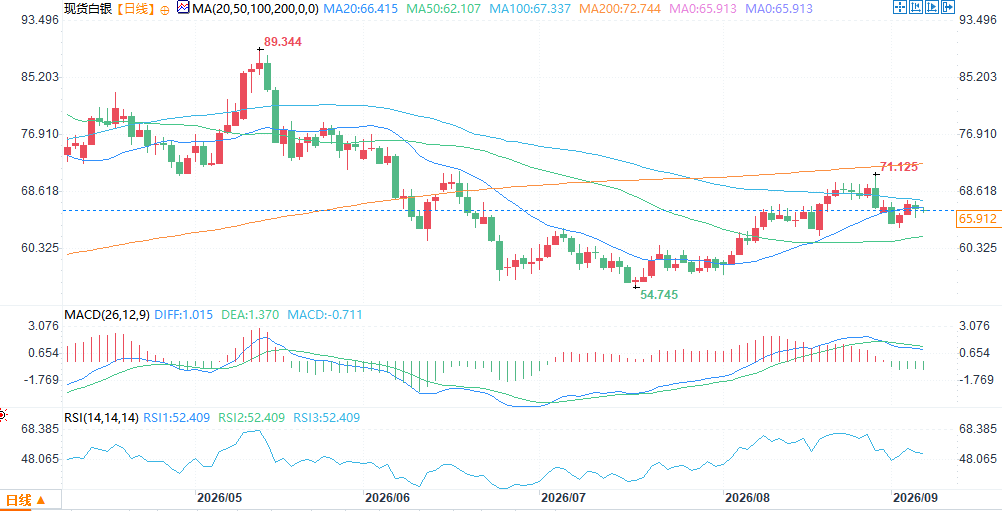 (Spot silver daily chart, source: EasyTrade) At 11:38 Beijing time, spot silver was trading at $65.81 per ounce.
Better-than-expected non-farm payrolls data increased the probability of an interest rate hike, putting downward pressure on silver prices.
Spot silver is under pressure around $66.00/oz, after a gap down opening. US non-farm payrolls increased by 162,000 in August (far exceeding the expected 56,000), the unemployment rate remained stable at 4.1%, and annual wage growth slowed to 3.1% (a smaller decline than expected), pushing the CME FedWatch tool's probability of a September rate hike back up to 58.3%. Strong employment data reinforced expectations of a Fed rate hike, strengthening the dollar and directly suppressing silver, a non-interest-bearing asset. The opportunity cost of holding silver increases in a high-interest-rate environment, leading to capital outflows from precious metals. The significantly better-than-expected non-farm payroll data reignited discussions that the Fed's policy may remain high for a longer period or even tighten again. The resilience shown in the job market weakened previous optimistic expectations of an economic slowdown, directly increasing the probability of a Fed rate hike in September. The dollar thus gained support and strengthened, increasing the cost of holding dollar-denominated silver. As a non-interest-bearing asset, silver's attractiveness decreases in a rising interest rate environment, with investors preferring to turn to interest-bearing assets or dollar cash. Funds flowed out of the precious metals sector, exacerbating selling pressure on silver. After a gap-down opening, prices faced resistance around $66, reflecting the market's swift and consistent reaction to the data. In the short term, strong employment data has altered risk appetite, and silver faces pressure not only from interest rate expectations but also from the linkage effect of the US dollar exchange rate. If subsequent data continues to confirm economic resilience, the downside potential for silver may further expand.Hammark's hawkish remarks reinforced expectations of interest rate hikes.
Federal Reserve Chairman Hammark delivered a distinctly hawkish speech, stating that policy is "not restrictive" and inflation is "too high," with local contacts indicating that "now is the time for the Fed to raise rates." This statement challenged any market expectations of a policy shift and reinforced the narrative of a strong dollar. Hammark's speech, with its clearly hawkish stance, quickly attracted market attention. He explicitly pointed out that the current policy stance is insufficient to adequately curb inflation and cited feedback from local contacts, directly echoing the discussion on the necessity of raising interest rates. This statement effectively challenged any market expectations of an imminent shift to easing, solidifying the narrative of "higher and longer" interest rates. For risk-sensitive precious metals such as silver, this means a continued increase in holding costs and a decline in the willingness to allocate funds. With the strengthening of the strong dollar narrative, pricing pressure on precious metals has increased simultaneously. The market is therefore reassessing the short-term interest rate path, and the downward pressure on silver has gained additional support at the policy communication level.Geopolitical conflicts drive up oil prices, reigniting inflation concerns.
The weekend saw an escalation of tensions between the US and Iran—US forces attacked three Iranian oil tankers, and Iran declared a new restricted zone in the Strait of Hormuz. WTI crude oil rebounded to around $92 per barrel, fueling inflation concerns. Rising oil prices suppressed silver prices through both inflation and interest rate hike expectations. Silver is likely to fluctuate between $65 and $68 in the short term, with non-farm payroll data and geopolitical developments pushing up the probability of an interest rate hike. If this week's CPI is moderate, the probability of a rate hike may decrease, and silver could rebound; if the CPI is high, the expectation of a rate hike will be further solidified, and silver may continue to be under pressure. The evolving geopolitical situation is also a key short-term variable. The renewed escalation of geopolitical conflict directly pushed up oil prices, with WTI rebounding to around $92, reigniting market concerns about imported inflation. Rising oil prices not only raise overall price expectations but also exert double pressure on silver by reinforcing the logic of the necessity of interest rate hikes. On the one hand, inflation concerns make it more difficult for the Federal Reserve to shift to easing; on the other hand, rising interest rate expectations further increase the opportunity cost of holding precious metals. Therefore, silver is fluctuating within the $65-$68 range, with the forces of bulls and bears temporarily balanced. Non-farm payroll data and geopolitical developments have jointly increased the probability of an interest rate hike, and the market's attention has now turned to this week's CPI. If the CPI reading is moderate, expectations of an interest rate hike may decline, and silver may see a technical rebound; if the CPI is overheated, the logic for an interest rate hike will be further solidified, and silver will face greater downward pressure. At the same time, any new developments in the Hormuz situation will be a significant catalyst for short-term price fluctuations, and investors need to simultaneously monitor the correlation between energy market developments and policy expectations.Institutional Views
In its latest research report, JPMorgan Chase lowered its average silver price target for the fourth quarter of 2026 to $63, reducing the full-year average price from approximately $84 to $70.6, and further lowering the 2027 average price to approximately $64. The core reason is that silver demand from the solar energy industry may decline by about 30% year-on-year (a reduction of approximately 60 million ounces), the physical market tensions are gradually easing, and the gold-silver ratio is expected to return to 70. Analysts point out that the extreme shortages that previously supported prices have begun to loosen, and high interest rates and a strong dollar have also increased holding costs. Although the market still expects a supply gap, the slowdown in demand is enough to push prices back to more sustainable levels. In the short term, silver may face downward pressure, while in the medium to long term, it is necessary to observe whether industrial demand stabilizes.Summarize
Spot silver is currently under pressure around $66, with the better-than-expected non-farm payrolls data pushing the probability of an interest rate hike to 58.3%. Hammark's hawkish remarks reinforced expectations of a rate hike, while geopolitical conflicts pushed up oil prices, reigniting inflation concerns. Silver may fluctuate between $65 and $68 in the short term, awaiting new direction from inflation data and geopolitical developments. Attention should be paid to the further impact of this week's CPI data on the probability of a rate hike. With multiple negative factors converging, silver is bearish in the short term, but geopolitical risks may provide some safe-haven support. Technically, watch the $65 support level; a break below this level could lead to a further decline towards $63-$64. (Spot silver daily chart, source: EasyTrade) At 11:38 Beijing time, spot silver was trading at $65.81 per ounce.
- Risk Warning and Disclaimer
- The market involves risk, and trading may not be suitable for all investors. This article is for reference only and does not constitute personal investment advice, nor does it take into account certain users’ specific investment objectives, financial situation, or other needs. Any investment decisions made based on this information are at your own risk.