The 10-year US Treasury yield broke through the 4.8% mark twice, potentially triggering a domino effect in global assets.
2026-09-07 14:38:05
U.S. Treasury yields are teetering on the brink, with the key 4.8% level becoming the focus of market attention. Matt Maley, chief market strategist at Miller Tabak + Co., has issued a stern warning that if the 10-year Treasury yield continues to break through this high level, it will not only severely damage the bond market but could also trigger a chain reaction of collapses in other asset classes. Against the backdrop of high fiscal deficits and a snowballing debt, mere verbal intervention is no longer sufficient to reverse the situation, and the logic of global asset pricing is facing a restructuring.
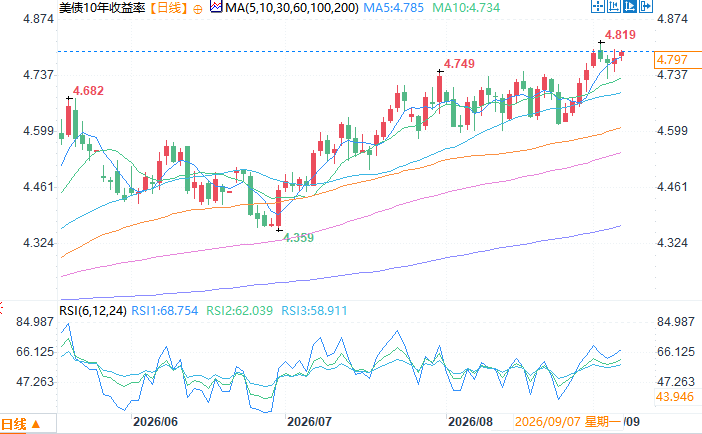 10-year US Treasury yield daily chart. Source: EasyTrade. At 14:31 Beijing time on September 7th, the 10-year US Treasury yield was 4.797%.
Defenses in crisis: The 4.8% threshold becomes a litmus test for the market.
Mali points out that 4.8% is a key watershed for the health of the US Treasury market, corresponding to the high point in January 2025. If yields stabilize at this level and continue to rise, it will send an extremely dangerous signal: uncontrolled fiscal policy is overwhelming policymakers' ability to manage borrowing costs. This not only means the bond market itself will be in turmoil, but also indicates that fiscal concerns have completely overwhelmed policy adjustments, leading to "substantial trouble" for other asset classes such as the stock market and housing market. Although the market is paying close attention to the 5% mark, Mali observes that the market's defensive threshold is being passively raised, from the initial 4.4% to 4.7%. This upward shift in the threshold reflects investors' resigned acceptance of the high-interest-rate environment and also suggests an increase in market fragility. If 4.8% is breached, panic could spread rapidly, triggering sharp fluctuations in asset prices.Intervention Failure: Fiscal Pressure Breaks Through Policy Ceiling
Faced with upward pressure on yields, US Treasury Secretary Scott Bessent recently attempted verbal intervention to lower interest rates, but reality delivered a heavy blow. Mali's analysis points out that such intervention efforts have completely failed in the current environment, especially given the large-scale shorting of US Treasuries by investors and the relatively thin market liquidity during the summer. Verbal intervention failed to trigger the expected bond rebound. This failure profoundly reveals a harsh reality: without addressing and resolving the underlying fiscal pressures, any market intervention is merely a stopgap measure. Currently, the US budget deficit and national debt have exceeded $40 trillion, and the heavy debt burden makes it impossible for investors to ignore the risks. At the same time, the government is competing with massive corporate borrowing for limited funding needs. This structural battle for funds keeps US Treasury yields high, becoming a Damocles' sword hanging over the market.Supply and demand strangle: A double whammy of trillions in debt and the struggle for capital
The supply-demand imbalance is exacerbating market tensions. Mali points out that from now until the end of the year, over $8.4 trillion in US government securities are expected to mature and roll over, creating immense pressure for refinancing. Meanwhile, September is likely to be a record month for high-grade corporate bond issuance, with Goldman Sachs even raising its 2026 forecast for US dollar investment-grade bond issuance to $2.3 trillion. This dual surge in government and corporate bond issuance is fiercely competing for limited market liquidity, further driving up borrowing costs. This pressure is not unique to the US; developed economies such as Japan, the UK, and France are also facing severe fiscal challenges. The global bond market is undergoing a profound paradigm shift, with investors demanding higher risk compensation when dealing with government debt. This has led to a structural increase in global long-term yields, creating long-term pressure on the valuation of risky assets.Asset Transformation: The Collapse of Long-Term Debts and the Rise of Safe-Haven Assets
The disorderly surge in long-term bond yields has a destructive impact far exceeding the bond market itself. Michael Chen, General Manager of Noah's Ark Hong Kong, stated that the runaway rise in long-term US Treasury yields will trigger a comprehensive repricing of assets reliant on long-term cash flows. Ultra-long-term bonds, overvalued growth stocks, commercial real estate, and some private equity assets will all face the risk of valuation collapse. Faced with this structural pressure, Chen recommends a defensive allocation strategy, favoring gold and hard currencies as structural hedging tools. He also suggests reducing holdings of ultra-long-term US Treasury bonds and maintaining positions in high-quality stocks, physical assets, and AI-related physical infrastructure, including sectors such as power, power grids, energy storage, and data centers. HSBC has expressed a similar cautious stance, raising its 2026 year-end forecast for the 10-year US Treasury yield to 4.65% and its 10-year German government bond yield forecast to 3%, believing that long-term bonds no longer offer investment value in developed markets.Conclusion
Ultimately, Mali believes that even a short-term market rebound leading to lower yields cannot mask the long-term structural crisis. Unless the US undertakes serious and thorough fiscal reforms, the shadow of the debt crisis will loom over the market for a long time. Any short-term policy embellishments cannot soften the long-term hard constraints. Once the upward trend in US Treasury yields is established, it will not only test the resilience of global assets but also herald the complete end of an era of low interest rates. Global investors are being forced to embrace a new era of high costs and high volatility. 10-year US Treasury yield daily chart. Source: EasyTrade. At 14:31 Beijing time on September 7th, the 10-year US Treasury yield was 4.797%.
- Risk Warning and Disclaimer
- The market involves risk, and trading may not be suitable for all investors. This article is for reference only and does not constitute personal investment advice, nor does it take into account certain users’ specific investment objectives, financial situation, or other needs. Any investment decisions made based on this information are at your own risk.