Goldman Sachs warns that escalating shipping attacks could push oil prices to $120, while natural gas and diesel supply shocks become a new market focus.
2026-09-07 14:54:05
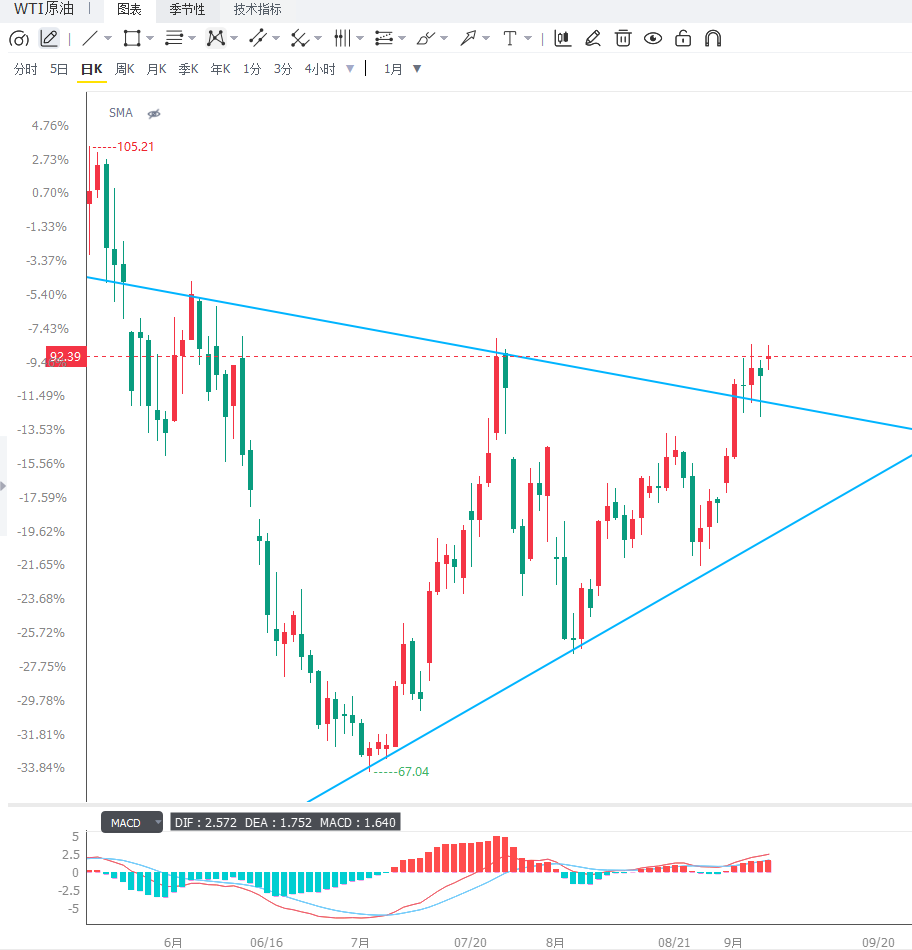
International oil prices continued their upward trend at the start of the week, with WTI crude rising to around $92 and Brent crude approaching $97. Escalating tensions between the US and Iran over the Strait of Hormuz, coupled with recent increases in attacks on oil tankers and other commercial vessels, have led the market to reassess the possibility of prolonged disruptions to Middle Eastern oil shipping. Goldman Sachs has therefore further raised its risk assessment for oil prices under extreme scenarios, believing that if shipping attacks continue to escalate, oil prices could rapidly approach $120 per barrel.  D'An Struve, co-head of global commodities research at Goldman Sachs, pointed out that a series of events in the past few days indicate that the further expansion of shipping disruptions and the continued escalation of risks have become significant market variables . The core of this judgment is not simply due to production cuts on the crude oil production side, but rather to potential systemic bottlenecks in the transportation sector. The Strait of Hormuz is a crucial global energy transport route; if ship passage remains obstructed, even if oil-producing countries still possess normal production capacity, they may be unable to reliably transport crude oil to Asia and other consumer markets. Recently, tanker traffic has fallen to its lowest level since May, and market concerns about continued supply chain disruptions have clearly intensified. This is also a key difference between this oil price surge and typical geopolitical risk events. In the past, the market often traded on expectations of "production disruptions" first, but now the risk has expanded to the entire energy chain of "production—transportation—refining—finished product supply." Increased transportation insurance, shipping costs, and difficulties in ship scheduling could further amplify energy price volatility. Goldman Sachs also presented a completely different scenario. If crude oil exports from the Middle East return to normal, the supply risk premium will quickly subside, and oil prices could fall back to $80 per barrel. The $40 scenario range formed between $120 and $80 indicates that future oil price movements are highly dependent on whether shipping risks worsen further or gradually return to normal. It's worth noting that Goldman Sachs did not simply recommend investors chase rising crude oil prices, but rather favored energy commodities such as natural gas and diesel. Their logic is that if shipping disruptions spread further, the refined oil and natural gas markets may face more severe supply shocks than crude oil. Currently, the diesel market is already showing clear signs of tightness, with US diesel prices hitting record highs and European diesel cracking margins remaining high. From a supply chain perspective, this change deserves close attention. Refineries typically adjust their production structure for different refined oil products based on profit margins, and when both crude oil transportation and refinery supply are disrupted simultaneously, products such as diesel, marine fuel, and gasoline may experience more pronounced regional shortages than crude oil. Latest market information shows that after global refineries were disrupted by geopolitical conflicts, some refineries tended to prioritize diesel and gasoline production, further compressing marine fuel oil supply. Therefore, if oil prices continue to rise in the future, the market should not only focus on the absolute prices of WTI and Brent, but also observe the price increases of diesel, fuel oil, and natural gas. If the price increase of refined energy products significantly exceeds that of crude oil, it means the market is shifting from purely geopolitical risk trading to actual supply shortage trading, at which point the impact of inflation may also significantly expand. Rising oil prices may also re-influence global monetary policy through energy cost channels. The US August non-farm payroll data was significantly stronger than expected, and the market has increased its bets on a Fed rate hike in September. If energy prices continue to rise sharply, the US CPI may face new upward pressure, further increasing the complexity of the Fed's policy decisions. Recent market trading shows that WTI has broken through $90, and changes in diesel prices and transportation costs are becoming important variables in inflation expectations. However, oil prices are still far from $120. The market has already priced in some geopolitical risk premiums; if a ceasefire occurs, shipping resumes, or major oil-producing countries stabilize exports through alternative transportation routes, the risk premium may quickly fall back. Therefore, $120 is more suitable as a stress scenario under "further deterioration of the shipping crisis" than as a baseline forecast. From a technical perspective, WTI has recently formed a clear short-term bullish trend. Oil prices extended their gains above $92 after breaking through the $90 mark, and the previous week saw a cumulative increase of nearly 10%, indicating that geopolitical risks are driving continued capital inflows into the energy market. In the short term, the $92 level has become a new important price center. If oil prices can hold above $92 and further break through $94, the market may continue to test the previous high near $96. If $96 is also effectively broken, then $98 and the $100 mark will become the next targets for the bulls. On the downside, the first level to watch is the $90 mark, which has gradually transformed from previous resistance into short-term support. If oil prices fall below $90 again, the retracement support near $87.50 needs to be monitored; if geopolitical risks significantly ease and cause a rapid decline in risk premiums, oil prices may further retest the $84.50 area. Overall, WTI is currently in a news-driven strong market, but the short-term gains have been substantial, and the risk of chasing the rally is rising accordingly. The technical outlook remains bullish, but if shipping risks in the Strait of Hormuz ease substantially, oil prices may experience a rapid profit-taking pullback.
  Editor's Summary: Goldman Sachs' recent target of $120 for oil prices is not so much about the target itself, but rather the shift in the underlying risk logic: the energy market is shifting from "crude oil supply risk" to "shipping, refining, and refined product supply chain risk." In the short term , as long as shipping in the Strait of Hormuz remains restricted, WTI still has room to challenge $94-96. Only if shipping disruptions continue to escalate will the market gradually trade extreme scenarios of $100 or even $120. Conversely, if exports return to normal, $80 will become a significant downside target after the risk premium rapidly diminishes. Therefore, three signals need to be closely monitored in the coming days: actual ship traffic in the Strait of Hormuz, diesel and fuel oil price performance, and whether there is a substantial decline in Middle Eastern crude oil exports. A significant deterioration in any of these variables could further amplify the upward potential of the energy market.
D'An Struve, co-head of global commodities research at Goldman Sachs, pointed out that a series of events in the past few days indicate that the further expansion of shipping disruptions and the continued escalation of risks have become significant market variables . The core of this judgment is not simply due to production cuts on the crude oil production side, but rather to potential systemic bottlenecks in the transportation sector. The Strait of Hormuz is a crucial global energy transport route; if ship passage remains obstructed, even if oil-producing countries still possess normal production capacity, they may be unable to reliably transport crude oil to Asia and other consumer markets. Recently, tanker traffic has fallen to its lowest level since May, and market concerns about continued supply chain disruptions have clearly intensified. This is also a key difference between this oil price surge and typical geopolitical risk events. In the past, the market often traded on expectations of "production disruptions" first, but now the risk has expanded to the entire energy chain of "production—transportation—refining—finished product supply." Increased transportation insurance, shipping costs, and difficulties in ship scheduling could further amplify energy price volatility. Goldman Sachs also presented a completely different scenario. If crude oil exports from the Middle East return to normal, the supply risk premium will quickly subside, and oil prices could fall back to $80 per barrel. The $40 scenario range formed between $120 and $80 indicates that future oil price movements are highly dependent on whether shipping risks worsen further or gradually return to normal. It's worth noting that Goldman Sachs did not simply recommend investors chase rising crude oil prices, but rather favored energy commodities such as natural gas and diesel. Their logic is that if shipping disruptions spread further, the refined oil and natural gas markets may face more severe supply shocks than crude oil. Currently, the diesel market is already showing clear signs of tightness, with US diesel prices hitting record highs and European diesel cracking margins remaining high. From a supply chain perspective, this change deserves close attention. Refineries typically adjust their production structure for different refined oil products based on profit margins, and when both crude oil transportation and refinery supply are disrupted simultaneously, products such as diesel, marine fuel, and gasoline may experience more pronounced regional shortages than crude oil. Latest market information shows that after global refineries were disrupted by geopolitical conflicts, some refineries tended to prioritize diesel and gasoline production, further compressing marine fuel oil supply. Therefore, if oil prices continue to rise in the future, the market should not only focus on the absolute prices of WTI and Brent, but also observe the price increases of diesel, fuel oil, and natural gas. If the price increase of refined energy products significantly exceeds that of crude oil, it means the market is shifting from purely geopolitical risk trading to actual supply shortage trading, at which point the impact of inflation may also significantly expand. Rising oil prices may also re-influence global monetary policy through energy cost channels. The US August non-farm payroll data was significantly stronger than expected, and the market has increased its bets on a Fed rate hike in September. If energy prices continue to rise sharply, the US CPI may face new upward pressure, further increasing the complexity of the Fed's policy decisions. Recent market trading shows that WTI has broken through $90, and changes in diesel prices and transportation costs are becoming important variables in inflation expectations. However, oil prices are still far from $120. The market has already priced in some geopolitical risk premiums; if a ceasefire occurs, shipping resumes, or major oil-producing countries stabilize exports through alternative transportation routes, the risk premium may quickly fall back. Therefore, $120 is more suitable as a stress scenario under "further deterioration of the shipping crisis" than as a baseline forecast. From a technical perspective, WTI has recently formed a clear short-term bullish trend. Oil prices extended their gains above $92 after breaking through the $90 mark, and the previous week saw a cumulative increase of nearly 10%, indicating that geopolitical risks are driving continued capital inflows into the energy market. In the short term, the $92 level has become a new important price center. If oil prices can hold above $92 and further break through $94, the market may continue to test the previous high near $96. If $96 is also effectively broken, then $98 and the $100 mark will become the next targets for the bulls. On the downside, the first level to watch is the $90 mark, which has gradually transformed from previous resistance into short-term support. If oil prices fall below $90 again, the retracement support near $87.50 needs to be monitored; if geopolitical risks significantly ease and cause a rapid decline in risk premiums, oil prices may further retest the $84.50 area. Overall, WTI is currently in a news-driven strong market, but the short-term gains have been substantial, and the risk of chasing the rally is rising accordingly. The technical outlook remains bullish, but if shipping risks in the Strait of Hormuz ease substantially, oil prices may experience a rapid profit-taking pullback. Editor's Summary: Goldman Sachs' recent target of $120 for oil prices is not so much about the target itself, but rather the shift in the underlying risk logic: the energy market is shifting from "crude oil supply risk" to "shipping, refining, and refined product supply chain risk." In the short term , as long as shipping in the Strait of Hormuz remains restricted, WTI still has room to challenge $94-96. Only if shipping disruptions continue to escalate will the market gradually trade extreme scenarios of $100 or even $120. Conversely, if exports return to normal, $80 will become a significant downside target after the risk premium rapidly diminishes. Therefore, three signals need to be closely monitored in the coming days: actual ship traffic in the Strait of Hormuz, diesel and fuel oil price performance, and whether there is a substantial decline in Middle Eastern crude oil exports. A significant deterioration in any of these variables could further amplify the upward potential of the energy market.
- Risk Warning and Disclaimer
- The market involves risk, and trading may not be suitable for all investors. This article is for reference only and does not constitute personal investment advice, nor does it take into account certain users’ specific investment objectives, financial situation, or other needs. Any investment decisions made based on this information are at your own risk.