German industrial output unexpectedly declined; can the European Central Bank's interest rate hike "support" the euro?
2026-09-07 15:04:11
The euro edged higher against the dollar in Asian trading on Monday (September 7), currently trading above 1.1610. German industrial production fell 1.1% month-on-month in July (expected +0.3%), with the year-on-year contraction widening to 1.6%, but the weaker-than-expected data failed to support the euro. Middle East geopolitical conflicts pushed up oil prices, putting additional pressure on the euro, but the dollar's rebound was limited due to the US Labor Day holiday. 
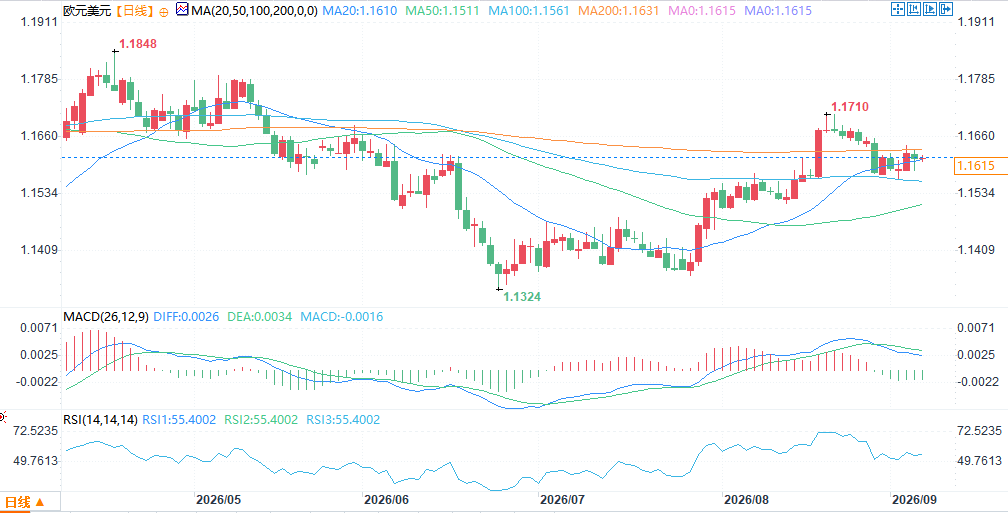 (Euro/USD daily chart, source: FX678) At 15:02 Beijing time, the euro was trading at 1.1613/14 against the US dollar.
German industrial output unexpectedly declined, but the euro reacted mildly.
German industrial output fell 1.1% month-on-month in July (expected +0.3%), with the June figure revised down to 0%, and the year-on-year contraction widening to 1.6%. The weak data failed to support the euro, while Middle East geopolitical conflicts pushing up oil prices put additional pressure on the euro, but the dollar's rebound was limited due to the US Labor Day holiday. The final reading of Eurozone Q2 GDP is expected to confirm a quarterly growth rate of 0.4% and an annualized rate of 1.1%. The significantly weaker-than-expected German industrial output data, falling 1.1% month-on-month and accompanied by a downward revision of the previous figure, along with a widening year-on-year contraction, highlights the continued pressure on the industrial sector of Europe's largest economy. This weak performance should have weighed on the euro, but the market reaction was generally muted, with the euro holding above 1.1610 against the dollar. The main reason is that Middle East geopolitical conflicts pushed up oil prices, increasing imported inflation and trade cost pressures on the Eurozone, exerting an additional negative impact on the euro. Meanwhile, the US Labor Day holiday resulted in thin trading, limiting the dollar's rebound momentum and preventing a clear directional breakout in the exchange rate. The market is still awaiting the final reading of Eurozone Q2 GDP, which is expected to confirm a modest growth rate of 0.4% quarter-on-quarter and 1.1% year-on-year, further confirming that the economic recovery remains weak. Overall, weak industrial data and geopolitical pressures on oil prices have jointly limited the euro's upside potential, but the holiday effect has also limited the dollar's strength, resulting in a relatively stable and narrow exchange rate.Markets are focused on the European Central Bank meeting and US CPI data.
This week, market focus shifts to the European Central Bank (ECB) meeting on Thursday (with a widely expected 25 basis point rate hike) and the US CPI data on Friday. The US August non-farm payrolls figure of 162,000 (far exceeding the expected 56,000) initially boosted the dollar, and CME data showed the probability of a September rate hike rose to 58.3%. However, Brown Brothers Harriman (BBH) believes that even if a September rate hike is "a foregone conclusion," the dollar is unlikely to reach a new cyclical high, as tightening by other major central banks limits policy divergence. The ECB rate hike expectation has been fully priced in, and the market will focus on Lagarde's hints about the future policy path. This week is highly concentrated with macroeconomic events, with market attention focused on the ECB interest rate decision on Thursday and the US CPI report on Friday. A 25 basis point rate hike by the ECB is widely expected, and this outcome has been largely priced in. Therefore, the real focus is on ECB President Lagarde's statements regarding the future policy path. If she hints at further tightening in December, the euro may receive support; if she signals that the tightening is nearing its end, it could trigger downward pressure. In the US, the much stronger-than-expected August non-farm payrolls data initially boosted the dollar and raised the probability of a September rate hike to 58.3%. However, Brown Brothers Harriman points out that even if a rate hike occurs, synchronized tightening by other major central banks will limit the scope for policy divergence, making it difficult for the dollar to easily reach new highs. Investors need to pay close attention to the details of policy communication and the actual readings of inflation data to assess the further evolution of interest rate expectation gaps and exchange rate trends.Summarize
The euro is currently trading above 1.1610 against the dollar, with weak German industrial output failing to provide support. The market is focused on the ECB meeting (interest rate hike expectations) and US CPI data. BBH believes that even if the Fed raises rates, the dollar is unlikely to reach new cyclical highs. If the ECB is hawkish or the CPI is moderate, the euro could move towards 1.1650; if the ECB is dovish or the CPI is overheated, the euro may fall back to around 1.1550. Attention should be paid to Lagarde's hints about the future path and US inflation data. (Euro/USD daily chart, source: FX678) At 15:02 Beijing time, the euro was trading at 1.1613/14 against the US dollar.
- Risk Warning and Disclaimer
- The market involves risk, and trading may not be suitable for all investors. This article is for reference only and does not constitute personal investment advice, nor does it take into account certain users’ specific investment objectives, financial situation, or other needs. Any investment decisions made based on this information are at your own risk.