Gold Trading Alert: Bulls and bears battle fiercely at the 4400 level; interest rate hike expectations suppress gold prices; can increased holdings by major countries reverse the trend?
2026-09-08 07:42:05
On Monday (September 7), spot gold continued its decline from Friday, but also saw a back-and-forth struggle around the $4400 level. Strong US employment data instantly reinforced market bets on a Fed rate hike this month, pushing up bond yields and putting pressure on gold, a non-interest-bearing asset. Meanwhile, escalating conflict in the Middle East pushed up oil prices and inflation concerns, further solidifying expectations of a rate hike. Gold prices found support twice near $4400, slightly above the key support level of the 100-day moving average at $4346. The People's Bank of China's 22 consecutive months of gold purchases boosted bullish sentiment, but the failure to break through the 200-day moving average at $4535 last week still made bulls hesitant. The two sides are fiercely battling around this range. Investors now need to digest the short-term impact of the employment data, await key inflation data this week, and closely monitor how the shipping and energy situation in the Gulf region will influence interest rate prospects through inflation. The short-term direction of gold may still be dominated by interest rate expectations, while the rise in oil prices brought about by the situation in the Middle East is currently more of a force reinforcing the logic of interest rate hikes and suppressing gold prices. On Tuesday (September 8) in early Asian trading, spot gold fluctuated slightly higher, currently trading around $4420 per ounce, with an increase of about 0.3%. 
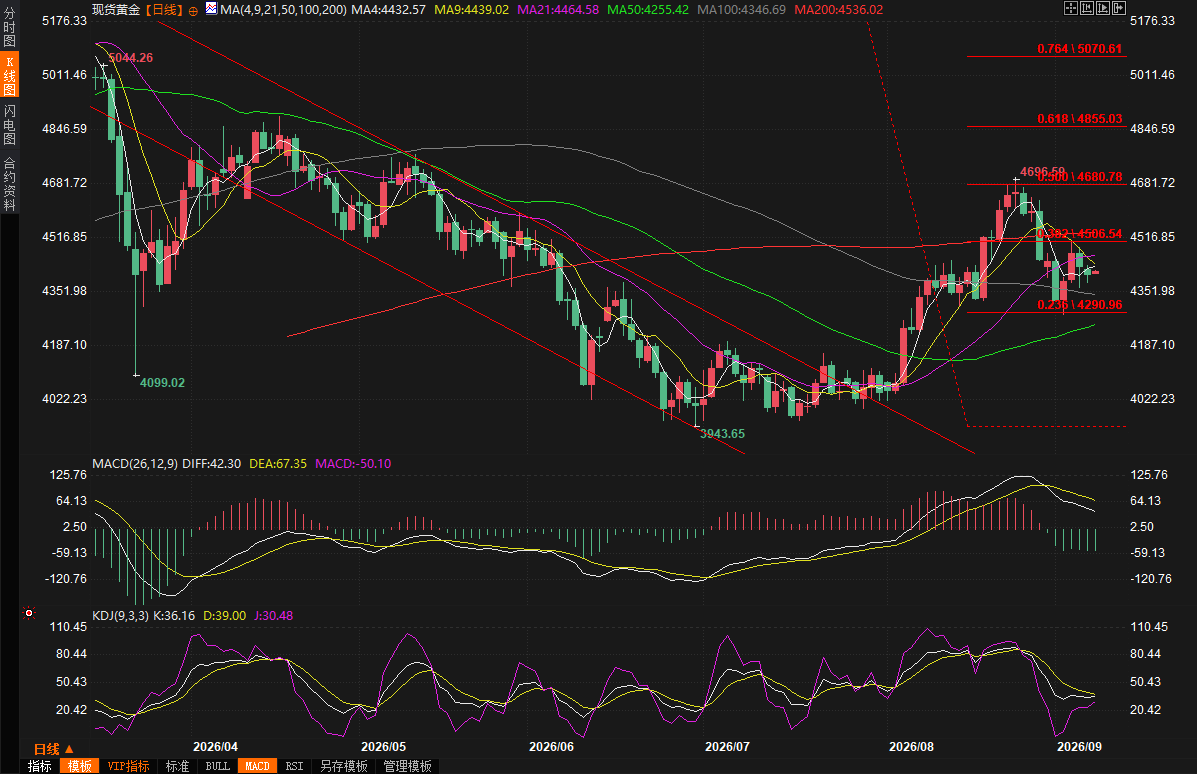 (Spot gold daily chart, source: FX678) At 07:38 Beijing time, spot gold is currently trading at $4419.63 per ounce.
Stronger-than-expected employment data quickly cast a shadow of interest rate hikes over the gold market.
The US August non-farm payrolls report released last Friday directly triggered Monday's gold price decline. The report showed 162,000 new jobs, significantly exceeding market expectations, while the unemployment rate remained stable at 4.1%. This data strongly demonstrated the resilience of the US labor market, quickly changing market expectations regarding the Federal Reserve's policy path. The CME Group's FedWatch tool showed that traders' probability of a 25 basis point rate hike at the Fed's September 15-16 meeting rose from about 50% before the jobs data release to around 60%, with some institutions even giving a median expectation of close to 58% to 60%. Ole Hansen, head of commodity strategy at Saxo Bank, pointed out that the price movements of gold and silver are in stark contrast to energy prices. After the strong jobs report pushed up bond yields and strengthened expectations of a September rate hike, gold and silver prices continued their decline. Spot gold closed down 0.56% on Monday at $4,406.23 per ounce; US gold futures for December delivery fell 0.5% to close at $4,456.40. Trading volume was relatively light due to the US holiday, but this did not obscure the fact that prices found significant buying support twice below $4,400. Hansen emphasized that current gold prices are still well above the important support level around $4,320, while selling pressure persists above $4,500. This pattern of "support below and resistance above" precisely illustrates that the market has not unilaterally sided with the bears, but rather, while digesting interest rate hike expectations, funds are still buying on dips at key levels. UBS's change of attitude is more representative. The bank had previously predicted no policy adjustments throughout 2026, but quickly revised its forecast after the release of employment data, believing that the Federal Reserve would raise interest rates by 25 basis points in September and December respectively. UBS Wealth Management stated in a report that hawkish policy messages—especially Federal Reserve Chairman Warsh's speech at Jackson Hole—combined with the inflation risks from supply bottlenecks and the strong performance of the August job market, were enough to prompt them to change their original judgment. Citigroup and Macquarie, among other institutions, have also raised their interest rate forecasts based on the latest employment data. Rising interest rates mean an increased opportunity cost of holding gold, which naturally puts downward pressure on non-yielding assets. While gold has traditionally been seen as a hedge against inflation, its appeal is often diminished in an environment of rising real interest rates. This week, the market will see two key inflation reports: the Producer Price Index (PPI) and the Consumer Price Index (CPI). The PPI released on Thursday and the CPI released the following day will further determine the final path of the Federal Reserve's September meeting. If inflation data continues to be high, expectations of interest rate hikes may strengthen further, and gold prices will still face short-term pressure; conversely, if the data shows signs of easing, gold may regain some breathing room. Federal Reserve Governor Waller has clearly stated that if the data confirms that inflationary pressures are easing, he tends to advocate maintaining interest rates unchanged. Therefore, this week's data releases will be a crucial watershed for the short-term direction of gold prices.The Middle East conflict has driven up oil prices and exacerbated inflation concerns, while expectations of interest rate hikes have suppressed gold prices, outweighing safe-haven demand.
While interest rate expectations dominate gold market sentiment, escalating tensions in the Middle East are further reinforcing, rather than weakening, the logic of interest rate hikes through oil prices and inflation, thus exerting net downward pressure on gold. The weekend's mutual attacks between the US and Iran targeting shipping routes pushed oil prices to a near six-week high, reigniting market concerns about inflation. Iranian Parliament Speaker Mohammad Bakir Ghalibaf explicitly warned that attacks on Iranian assets would be met with retaliation, pointing out that the entire Gulf region's energy infrastructure, including US oil and gas interests, is vulnerable. Iranian senior security official Mohsen Rezaei stated that Tehran will soon announce a new restricted zone in the Persian Gulf and unveil a new shipping route through the Strait of Hormuz. Any ships entering the area will be placed on Iran's sanctions list, and Iran will only commit to keeping the Strait of Hormuz open if the US ceases its sabotage, threats, and attacks. The Strait of Hormuz is a crucial artery for global oil and gas supplies; before World War II, approximately one-fifth of the world's oil and liquefied natural gas shipments passed through it. Shipping data shows that an average of only 10 commodity ships have passed through the Strait of Hormuz per day over the past 10 days, the lowest level since May. The US military struck three Iranian oil tankers on Saturday, one of which was near Hag Island, Iran's main oil export hub; this followed an attack by the Iranian Revolutionary Guard on a US warship. The conflict has also affected Gulf oil-producing nations such as the UAE, whose tankers have also been attacked in the Strait of Hormuz. The UAE has begun exploring alternative routes for energy exports and trade to avoid these activities being "hostage" by the war. Meanwhile, Israeli airstrikes in southern Lebanon, killing at least 12 people, have further escalated regional tensions. Despite a ceasefire agreement reached between Israel and Hezbollah in June, the attacks have raised market concerns about a possible resumption of military action. Tehran insists that any lasting agreement with Washington must include an end to Israeli attacks on Lebanon. The continued rise in energy prices directly increases inflation expectations, reinforcing rather than offsetting the Fed's interest rate hike path. Higher oil prices suggest potentially stickier inflation, supporting market bets that the Federal Reserve will maintain or even accelerate tightening, pushing up real interest rates and increasing the opportunity cost of holding gold. While gold traditionally possesses safe-haven characteristics during periods of geopolitical turmoil, in the current environment, rising oil prices and inflationary concerns, coupled with increased expectations of interest rate hikes, have overshadowed simple safe-haven buying, becoming the dominant force suppressing gold prices. Last Friday, Trump even stated that if the Federal Reserve does not cut interest rates as he demands, the US will cease trade with countries that have trade deficits with it. This political pressure, while adding uncertainty to the monetary policy outlook, is unlikely to offset the supporting effect of oil prices and inflation on interest rate expectations. Therefore, the market is more inclined to view the Middle East conflict as a catalyst reinforcing hawkish logic rather than simply a safe-haven event driving up gold prices.The People's Bank of China has increased its gold holdings for 22 consecutive months, indicating that the long-term demand logic remains solid.
While Western markets focus on interest rates and geopolitics, official gold purchases in the East are providing another layer of solid support for gold. The People's Bank of China (PBOC) announced on Monday that its gold reserves stood at 76.73 million ounces at the end of August, an increase of 650,000 ounces from the previous month, marking the 22nd consecutive month of increase. The dollar value corresponding to the gold reserves increased by $43.726 billion month-on-month to $350.08 billion. During the same period, China's foreign exchange reserves stood at $3.438325 trillion, an increase of $19.549 billion month-on-month. The continued increase in official gold holdings is both a necessity to hedge against the risks of dollar assets and a strategic choice to optimize reserve structure against the backdrop of rising global uncertainty. The 22-month record of continuous increases indicates that the PBOC's allocation of gold is not a short-term operation but rather has a clear long-term intention. This stabilizing demand from the sovereign level often acts as a floor when gold prices fall, making it difficult for the market to ignore the power of the East when assessing the medium- to long-term prospects of gold. Unlike Western investors who temporarily reduce their gold holdings due to interest rate expectations, official gold purchases are more based on strategic and diversification considerations, making them more sustainable and providing more resilient support for prices.With bullish and bearish forces intertwined, gold prices are at a critical juncture.
In summary, the gold market is currently in a sensitive phase where multiple forces are intertwined. Strong employment data has reinforced expectations of a Federal Reserve rate hike, pushing up real interest rates and directly suppressing gold prices. Escalating conflicts in the Middle East have increased oil prices and inflationary concerns, further solidifying the logic of rate hikes, and its suppressive effect on gold prices outweighs traditional safe-haven demand. The People's Bank of China's continued purchases of gold shares are solidifying the long-term logic from the demand side. Gold prices have shown strong buying interest around $4400, indicating that the market is not entirely bearish, while resistance above $4500 reminds investors that further upside potential requires supportive data and events. The PPI and CPI data to be released this week will be important catalysts for short-term direction. If inflation data is high, rate hike expectations may further intensify, and gold prices may face short-term downward pressure; if the data is moderate, gold is expected to retest the upper resistance. At the same time, any substantial progress on shipping restrictions in the Strait of Hormuz and further clashes between Iran and the United States could continue to strengthen rather than weaken interest rate expectations through oil prices and inflation, thereby indirectly suppressing gold prices. Investors should also pay attention to statements from Federal Reserve officials and whether the Trump administration's public pressure on monetary policy will trigger new market volatility. (Spot gold daily chart, source: FX678) At 07:38 Beijing time, spot gold is currently trading at $4419.63 per ounce.
- Risk Warning and Disclaimer
- The market involves risk, and trading may not be suitable for all investors. This article is for reference only and does not constitute personal investment advice, nor does it take into account certain users’ specific investment objectives, financial situation, or other needs. Any investment decisions made based on this information are at your own risk.