Iran's top security official announced the establishment of a no-go zone in the Strait of Hormuz; Brent crude oil hit a six-week high.
2026-09-08 09:26:05
Tensions escalated in the Strait of Hormuz over the weekend as the US and Iran exchanged attacks on maritime targets. The Iranian parliament speaker responded strongly to comments from the US defense secretary, threatening US energy facilities in the Gulf. Oil prices surged in response, with Brent crude reaching $98.03 per barrel on Monday (September 7), a six-week high, and refined products hitting record highs. Iran declared a new no-go zone, and Israel launched airstrikes on Lebanon, extending the conflict from sea to land, causing a sharp rise in risk aversion in the market. 
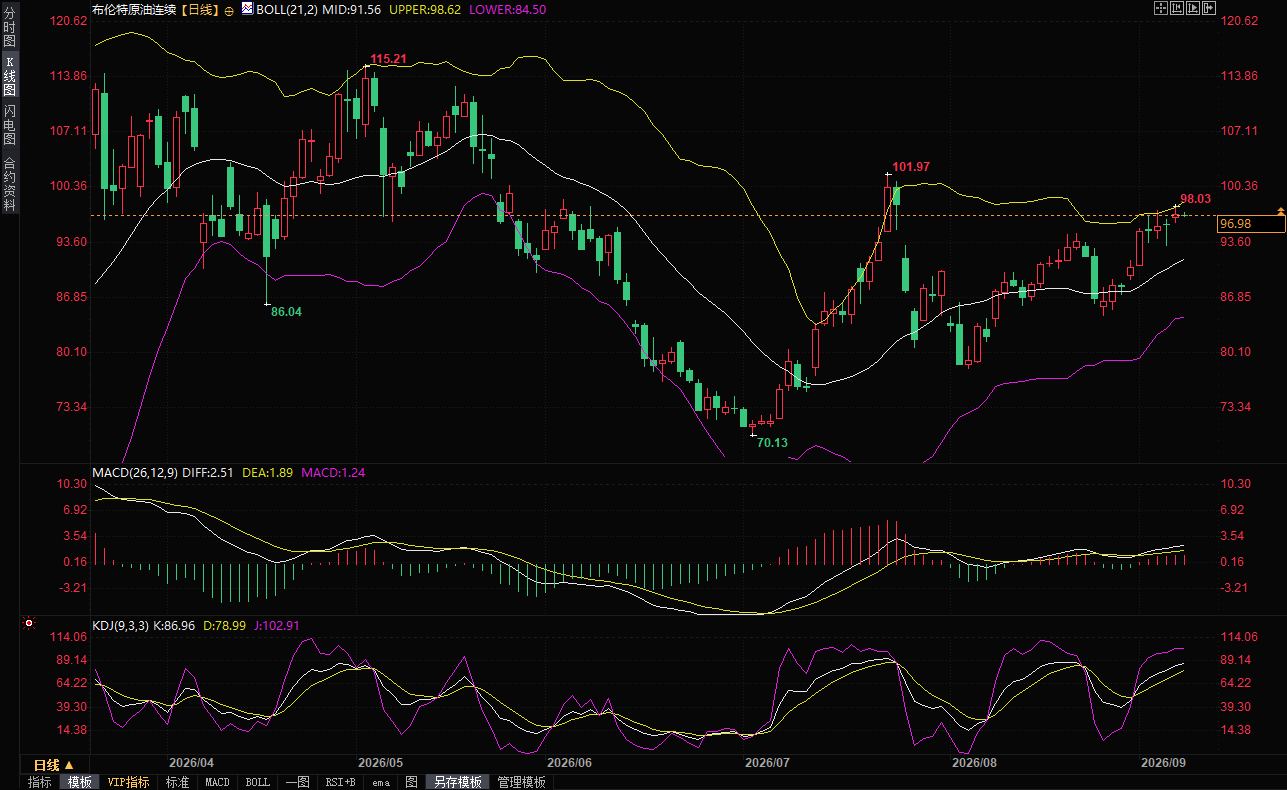 (Brent crude oil daily chart, source: EasyTrade) At 09:22 Beijing time, Brent crude oil is currently trading at $97.06 per barrel.
I. Geopolitical conflict continues to escalate, with Iran's top leadership issuing warnings of retaliation.
On September 7, Iranian Parliament Speaker Mohammad Baqer Qalibaf issued a stern warning to the United States: if the US military attacks Iranian assets again, Tehran will retaliate, and the entire Gulf region's energy infrastructure—including US-operated oil and gas facilities—is vulnerable. Qalibaf stated on social media platform X: "The oil and gas production chain here is vast, easily accessible, and unprotected. The US oil and gas companies in this area and these facilities face the same risk." This statement was a direct response to previous remarks by US Defense Secretary Hergesse, who claimed that Iran's tanker fleet was "completely defenseless," to which Qalibaf retorted, "Go ask those bases that are no longer operational." Previously, on September 6, Qalibaf stated in a public parliamentary session that the era of Iran's "reciprocal response" was over, and future responses to such actions would be "faster, more intense, and more painful."II. US and Iran launched attacks on oil tankers over the weekend, the largest since the start of the conflict.
Over the past weekend, the US and Iran exchanged military strikes against maritime targets in the Strait of Hormuz. The US Central Command issued a statement on September 5th, claiming that the US military "destroyed" three Iranian oil tankers that day in response to the Iranian Islamic Revolutionary Guard Corps' attack on two US warships patrolling "regional waters." One of the attacked tankers was located near Kharg Island, Iran's main oil export hub. The Iranian Revolutionary Guard Corps retaliated, claiming to have struck three vessels with ties to the US and three oil tankers transiting unauthorized routes in the Strait of Hormuz. Multiple media outlets described the exchange of fire as "the largest mutual attack since the start of the conflict."III. Brent crude oil briefly touched $98, and U.S. gasoline and diesel prices both hit record highs.
International oil prices surged on Monday, September 7, influenced by the weekend clashes. Brent crude futures rose 1.1% to settle at $97.31 a barrel, hitting a six-week high of $98.03 during the session. WTI crude rose 1.3% to around $92.7 a barrel, reaching a high of $93.27, the highest since July 23. Brent crude prices have risen nearly 40% since the start of the conflict between the US, Israel, and Iran in late February, and are up nearly 60% year-to-date. The OPEC+ seven major oil-producing countries decided at their online meeting on September 6 to maintain their October production levels, further eliminating market expectations of increased supply. US retail prices for refined petroleum products also rose. The average price of regular gasoline rose to about $4.15 per gallon, a record high for Labor Day and nearly $1 higher than the same period last year. The average retail price of diesel has also broken historical records, rising to $5.85 per gallon, surpassing the previous record of $5.819 per gallon set in June 2022.IV. Iran declares a "no-go zone" in the Strait of Hormuz, causing a sharp drop in traffic volume.
On September 6, Mohsen Rezaei, Secretary of Iran's Supreme National Security Council, announced that Iran would establish a new "no-go zone" outside the Strait of Hormuz in the coming days. This zone will begin at the US naval blockade line and extend into parts of the Persian Gulf; any ships entering the zone will be added to Iran's sanctions list. Rezaei stated, "We will only commit to keeping the Strait of Hormuz open when they (the Americans) stop their sabotage, threats, and attacks against Iran." Shipping data clearly reflects the impact of the situation on energy transport routes. Data from ship tracking agency MarineTraffic shows that ship traffic through the Strait of Hormuz has decreased by 28% to 77 vessels, with cargo voyages dropping from 45 to 33. The number of sanctioned vessels and shadow fleets passing through has plummeted from 50 to 23. Data released by Kpler shows that in the 10 days leading up to September 6, an average of only 10 commercial vessels passed through the Strait of Hormuz per day, the lowest level since May. Only 5 ships passed through on September 6, and only 2 on September 5. Kpler data further shows that 15 cargo ships transited the strait on September 4, which decreased to 13 on the 5th, and further to 10 on the 6th.V. Attacks on Lebanon exacerbate concerns about multi-front conflicts, with a diplomatic breakthrough seemingly far off.
Beyond the US-Iran conflict, another front in the regional situation is escalating. The Lebanese Ministry of Health stated that an Israeli airstrike on a village in southern Lebanon's Nabatiyeh province in the early hours of September 7th killed at least 12 people. The Lebanese Ministry of Public Health subsequently announced that Israeli attacks over the past three days had resulted in 27 deaths and 69 injuries. Although Israel and the Iranian-backed Hezbollah reached a ceasefire agreement in June, this airstrike has exacerbated concerns about a possible resumption of large-scale Israeli military action. Tehran insists that any lasting agreement with Washington must include a halt to Israeli attacks on Lebanon, further complicating diplomatic efforts to end the broader regional conflict. US Energy Secretary Wright acknowledged on September 6th that Washington might ultimately not sign a nuclear agreement with Tehran, stating that "an agreement may not be reached until the next Iranian government takes office." This statement further lowered market expectations for a recent diplomatic breakthrough.Editor's Summary
The military standoff between the US and Iran in the Strait of Hormuz has entered its sixth month, with the weekend's attacks on oil tankers marking another escalation in the conflict. Brent crude oil hit a six-week high, US diesel prices broke records, and daily traffic in the Strait of Hormuz fell to its lowest level since May—these three sets of data collectively paint a picture of a continuously expanding geopolitical risk premium. Iran's declaration of a "no-go zone" in the Strait signifies a shift from a "de facto" to "institutionalized management" of shipping disruptions, which could further drive up insurance and freight costs for global energy transport. Meanwhile, a new round of Israeli airstrikes against Lebanon indicates the risk of multi-point spread of the regional conflict, while the US Energy Secretary's statement that the nuclear agreement "may be shelved until the next Iranian government" suggests a lack of effective diplomatic de-escalation channels in the short term. With global oil inventories at low levels, any further disruption to the supply side could amplify price volatility. Current market pricing does not fully reflect the worst-case scenario of a complete blockage of the Strait of Hormuz; if shipping conditions continue to deteriorate or there are more sustained oil supply disruptions, the possibility of oil prices breaking through $100 is increasing. (Brent crude oil daily chart, source: EasyTrade) At 09:22 Beijing time, Brent crude oil is currently trading at $97.06 per barrel.
- Risk Warning and Disclaimer
- The market involves risk, and trading may not be suitable for all investors. This article is for reference only and does not constitute personal investment advice, nor does it take into account certain users’ specific investment objectives, financial situation, or other needs. Any investment decisions made based on this information are at your own risk.