Saudi Arabia under attack! The conflict in the Hormuz spreads to the Red Sea, reigniting geopolitical premiums on oil prices?
2026-09-08 08:08:08
On Tuesday (September 8) during Asian trading hours, US crude oil futures jumped more than $1 at the open, after reports of missile and drone attacks on Saudi Arabia's southwestern airports of Khamis Mushait and Abha. The conflict has expanded from the US-Iran conflict zone and the Strait of Hormuz to Saudi territory. The Iranian parliament speaker warned of reciprocal retaliation for further attacks. Over the weekend, the US and Iran exchanged attacks on oil tankers and warships, and maritime intelligence agencies reported that merchant ships are being used as tools of economic pressure. 
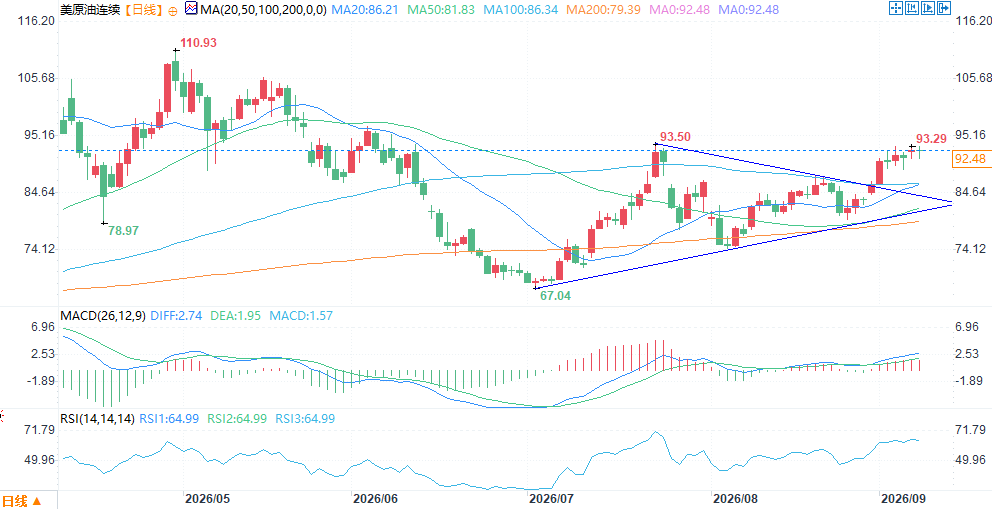 (US crude oil futures daily chart, source: FX678) At 8:00 AM Beijing time, US crude oil futures were trading at $92.56 per barrel.
Saudi Arabia attacked, conflict spreads to new geographical areas
Crude oil futures jumped more than $1 at the open, directly stimulated by news of Yemeni armed forces' missile and drone attacks on Khamis Mushait and Abha airports in southwestern Saudi Arabia over the weekend. This marks the first substantial spillover of the current US-Iran conflict onto Saudi territory, significantly breaking through the geographical boundaries previously confined to the Gulf waters, the area surrounding Iran, and the Red Sea shipping lanes. The market quickly priced in the new geopolitical risk premium, with Brent crude rising by about 8% last week and WTI crude by nearly 10%, indicating a sharp increase in investor concerns about supply disruptions. The Iranian parliament speaker subsequently issued a strong warning, stating that any further attacks would be met with reciprocal retaliation. Over the weekend, the US and Iran attacked each other's oil tankers and warships. Maritime intelligence agencies pointed out that merchant ships are being systematically used as tools to exert economic pressure, and the line between military targets and commercial shipping is increasingly blurred. This escalation further complicates the already tense situation in the Strait of Hormuz. As one of the world's largest crude oil exporters, Saudi Arabia's territorial security is directly related to the stability of global energy supply. If the attacks continue or expand to critical energy infrastructure such as refineries, pipelines, or export terminals, the market may reassess the scale of the supply shock. Traders are closely monitoring developments at the Yemen-Saudi border, further statements from Iranian officials, and potential US responses, as any new attacks or retaliatory actions could trigger sharp price fluctuations.Supply buffers nearly exhausted, Hormuz flow falls to its lowest level in May.
Shipping traffic in the Strait of Hormuz has fallen to its lowest level since May, coupled with U.S. gasoline and distillate fuel inventories being far below the same period last year and the five-year seasonal average, nearly exhausting the global crude oil market's supply buffer capacity. OPEC+ decided at its latest meeting to maintain its October production policy, with details of new quotas still pending further negotiation, failing to provide additional supply reassurance to the market. The market widely expects Iran to announce a new restricted zone outside the Strait of Hormuz in the coming days, further tightening transit rules or increasing inspections, which will directly push up transportation costs and insurance premiums. Brent crude futures face significant upward pressure in the short term; after the conflict spread to Saudi territory, geopolitical premiums have once again become the dominant factor. If Saudi energy infrastructure suffers substantial damage, oil prices could quickly break through the $100 per barrel mark; conversely, if the conflict shows signs of easing, prices may fall back to the $90-95 range. The current market focus is highly concentrated on developments on the Yemen-Saudi front, the specific implementation of subsequent Iranian threats, and the actual impact on commercial shipping. The low inventory environment amplifies the price elasticity of any supply disruptions, and refinery margins and refined product crack spreads have widened significantly. Investors need to continue to monitor satellite shipping data, weekly inventory reports, and official statements from major oil-producing countries, as these marginal information will determine the next direction of oil prices. Overall, the combination of supply-side fragility and geopolitical uncertainty suggests that the oil market will likely remain in a bullish, volatile pattern in the short term.Institutional Views
Goldman Sachs recently raised its Brent/WTI crude oil price forecast by $5 to $85/80 per barrel in December 2026, and its 2027 forecast from $80/75 per barrel to $80/75 per barrel in 2027. Goldman Sachs stated that if average crude oil production in the Gulf region is 4 million barrels per day lower than pre-war levels in 2027, Brent crude oil prices could exceed $120 per barrel. (US crude oil futures daily chart, source: FX678) At 8:00 AM Beijing time, US crude oil futures were trading at $92.56 per barrel.- Risk Warning and Disclaimer
- The market involves risk, and trading may not be suitable for all investors. This article is for reference only and does not constitute personal investment advice, nor does it take into account certain users’ specific investment objectives, financial situation, or other needs. Any investment decisions made based on this information are at your own risk.