The dollar index fell to a two-week low as the market awaited policy signals from the Federal Reserve ahead of the CPI release.
2026-09-08 14:00:05
The US dollar index continued its weakness in Asian trading on Tuesday, last trading around 98.80, marking its second consecutive day of pressure and briefly touching a more than two-week low. While the index remains above the lows reached in August, the recent rebound momentum has clearly weakened, and the market is awaiting further confirmation from US inflation data regarding the Federal Reserve's future policy path.  Recent US labor market data has provided some support for the US dollar. US non-farm payrolls increased by 162,000 in August, and the unemployment rate remained at 4.1%, performing better than previously expected. Strong employment data has boosted market expectations for a tightening of Federal Reserve policy, with current market pricing indicating a roughly 60% probability of a rate hike at the September meeting. However, the resilience of the labor market alone is insufficient for a sustained dollar rally; investors need more evidence of inflation to confirm policy direction. This week's US economic data will be a major catalyst for the dollar's movement. The US Producer Price Index (PPI) for August will be released on September 10th, and the Consumer Price Index (CPI) on September 11th. The CPI is particularly important. In July, the US CPI rose 3.4% year-on-year, and the core CPI rose 2.5% year-on-year, indicating that inflation remains significantly higher than the Fed's long-term target of 2%. The market currently expects overall inflation to remain high in August, while rapid increases in energy prices may further increase future inflationary pressures. Meanwhile, the recent significant strengthening of oil prices has also increased uncertainty surrounding dollar policy expectations. WTI crude oil has rebounded to around $92, while Brent crude has climbed above $97. Energy supply risks may be transmitted to inflation through gasoline, transportation, and production costs. If US inflation data shows renewed upward pressure, the market may further increase its expectations for Fed tightening, thus providing temporary support for the dollar. However, the dollar still faces pressure from the rapid appreciation of the yen. The dollar fell to around 153.53 against the yen on Tuesday, with the yen significantly stronger than its previous level of around 160. The yen's rise not only directly pressures the dollar index but also reflects the market's readjustment of major central bank policy expectations and carry trade positions. From a market structure perspective, the dollar is currently in a repricing phase between employment and inflation data. If PPI and CPI are higher than expected, especially if core inflation accelerates again, the dollar may gain new catalysts for appreciation; conversely, if inflation data is lower than expected, the market may lower its expectations for Fed rate hikes again, and the dollar index may continue to approach its August lows. From a daily chart perspective, the US dollar index remains in a short-term weak structure, currently trading below 99.00 and below the 200-day exponential moving average around 99.52, indicating that the medium-term rebound has not yet fully reversed the previous weak trend. Technically, the first important resistance level is around 99.23, with the 200-day moving average around 99.52 providing stronger resistance. If it reclaims this area, the next targets to watch are 99.72 and 100.20. Conversely, if the support around 98.55 is breached, the US dollar index may further test the structural support around 97.67. Looking at the 4-hour chart, the US dollar index has rebounded and then fallen back, with short-term highs gradually shifting downwards, indicating that bears still hold a certain advantage. 98.55 is currently a key short-term support level. If PPI or CPI is lower than expected and pushes the dollar below this level, the index may further seek support in the 97.67 area. The key resistance levels to watch are 99.23 and 99.52. Only by recovering and stabilizing above 99.52 can the short-term weakness be significantly improved.
 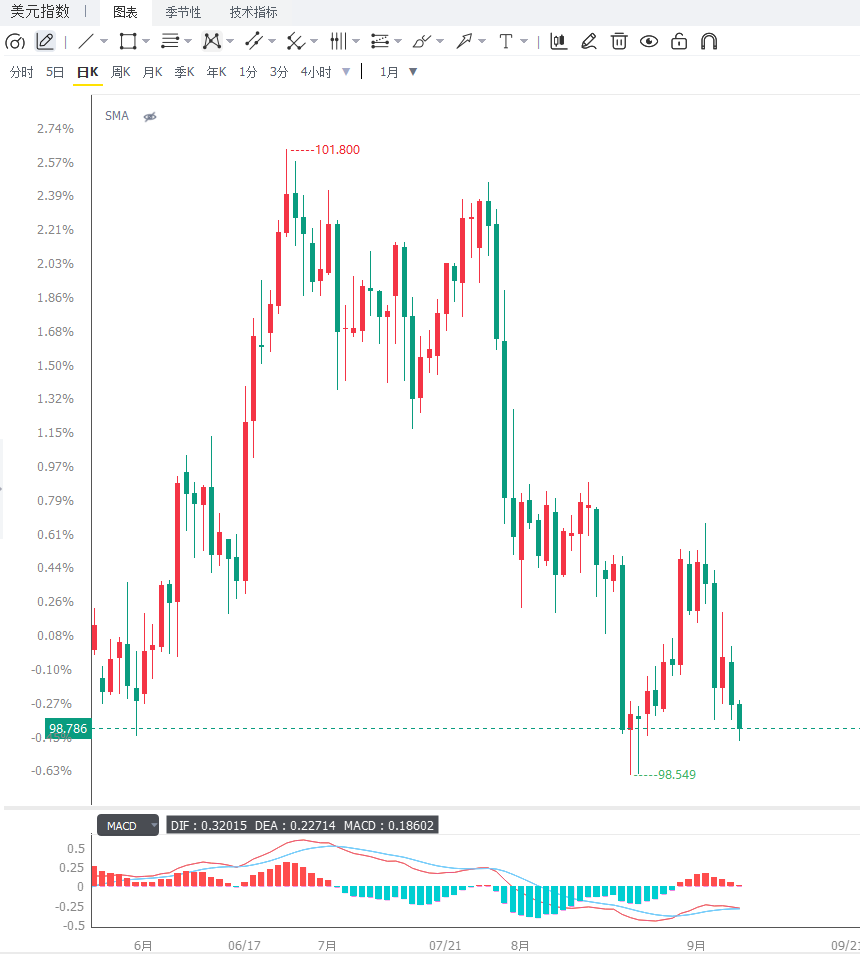 Editor's Summary: The core issue for the US dollar index has shifted from employment data to inflation data. The August non-farm payrolls data reinforced expectations of a tighter Fed policy, but the dollar did not experience a sustained upward trend, indicating that the market still needs further confirmation of inflation risks from PPI and CPI. In the short term, 98.55 is a key support level for the dollar index, while 99.23 to 99.52 constitutes a key rebound area. If inflation data falls short of expectations, the dollar's weakness may continue; if energy prices drive inflation back up, the dollar could rebound rapidly.
Recent US labor market data has provided some support for the US dollar. US non-farm payrolls increased by 162,000 in August, and the unemployment rate remained at 4.1%, performing better than previously expected. Strong employment data has boosted market expectations for a tightening of Federal Reserve policy, with current market pricing indicating a roughly 60% probability of a rate hike at the September meeting. However, the resilience of the labor market alone is insufficient for a sustained dollar rally; investors need more evidence of inflation to confirm policy direction. This week's US economic data will be a major catalyst for the dollar's movement. The US Producer Price Index (PPI) for August will be released on September 10th, and the Consumer Price Index (CPI) on September 11th. The CPI is particularly important. In July, the US CPI rose 3.4% year-on-year, and the core CPI rose 2.5% year-on-year, indicating that inflation remains significantly higher than the Fed's long-term target of 2%. The market currently expects overall inflation to remain high in August, while rapid increases in energy prices may further increase future inflationary pressures. Meanwhile, the recent significant strengthening of oil prices has also increased uncertainty surrounding dollar policy expectations. WTI crude oil has rebounded to around $92, while Brent crude has climbed above $97. Energy supply risks may be transmitted to inflation through gasoline, transportation, and production costs. If US inflation data shows renewed upward pressure, the market may further increase its expectations for Fed tightening, thus providing temporary support for the dollar. However, the dollar still faces pressure from the rapid appreciation of the yen. The dollar fell to around 153.53 against the yen on Tuesday, with the yen significantly stronger than its previous level of around 160. The yen's rise not only directly pressures the dollar index but also reflects the market's readjustment of major central bank policy expectations and carry trade positions. From a market structure perspective, the dollar is currently in a repricing phase between employment and inflation data. If PPI and CPI are higher than expected, especially if core inflation accelerates again, the dollar may gain new catalysts for appreciation; conversely, if inflation data is lower than expected, the market may lower its expectations for Fed rate hikes again, and the dollar index may continue to approach its August lows. From a daily chart perspective, the US dollar index remains in a short-term weak structure, currently trading below 99.00 and below the 200-day exponential moving average around 99.52, indicating that the medium-term rebound has not yet fully reversed the previous weak trend. Technically, the first important resistance level is around 99.23, with the 200-day moving average around 99.52 providing stronger resistance. If it reclaims this area, the next targets to watch are 99.72 and 100.20. Conversely, if the support around 98.55 is breached, the US dollar index may further test the structural support around 97.67. Looking at the 4-hour chart, the US dollar index has rebounded and then fallen back, with short-term highs gradually shifting downwards, indicating that bears still hold a certain advantage. 98.55 is currently a key short-term support level. If PPI or CPI is lower than expected and pushes the dollar below this level, the index may further seek support in the 97.67 area. The key resistance levels to watch are 99.23 and 99.52. Only by recovering and stabilizing above 99.52 can the short-term weakness be significantly improved. Editor's Summary: The core issue for the US dollar index has shifted from employment data to inflation data. The August non-farm payrolls data reinforced expectations of a tighter Fed policy, but the dollar did not experience a sustained upward trend, indicating that the market still needs further confirmation of inflation risks from PPI and CPI. In the short term, 98.55 is a key support level for the dollar index, while 99.23 to 99.52 constitutes a key rebound area. If inflation data falls short of expectations, the dollar's weakness may continue; if energy prices drive inflation back up, the dollar could rebound rapidly.
- Risk Warning and Disclaimer
- The market involves risk, and trading may not be suitable for all investors. This article is for reference only and does not constitute personal investment advice, nor does it take into account certain users’ specific investment objectives, financial situation, or other needs. Any investment decisions made based on this information are at your own risk.