The Japanese yen surged to a seven-month high! Driven by both interest rate hike expectations and GPIF adjustments, how much further can it rise?
2026-09-08 14:22:05
On Tuesday (September 8) during Asian trading hours, the yen rose to a seven-month high; the dollar fell as much as 0.94% against the yen to 152.89, a new low since February 17, before recovering slightly to around 153.55, narrowing its losses to 0.5%. Market expectations for a Bank of Japan rate hike next week have surged, coupled with speculation about potential adjustments to the government pension fund's asset allocation, both contributing to the yen's rise. 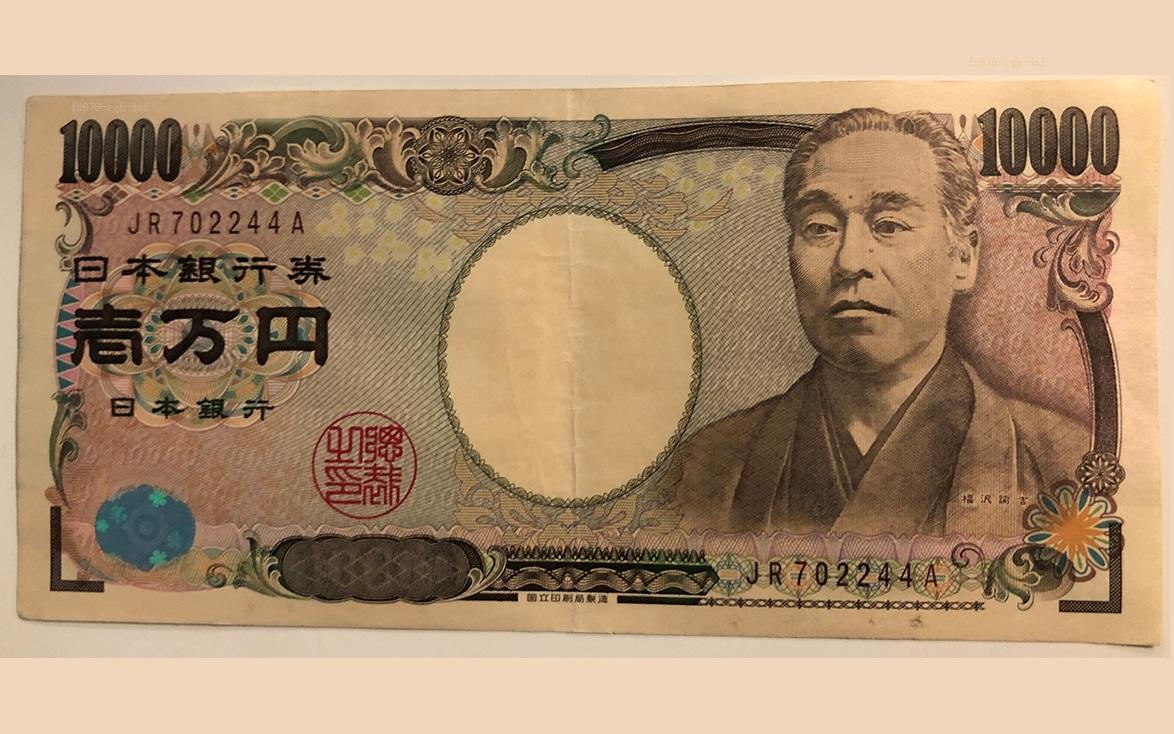
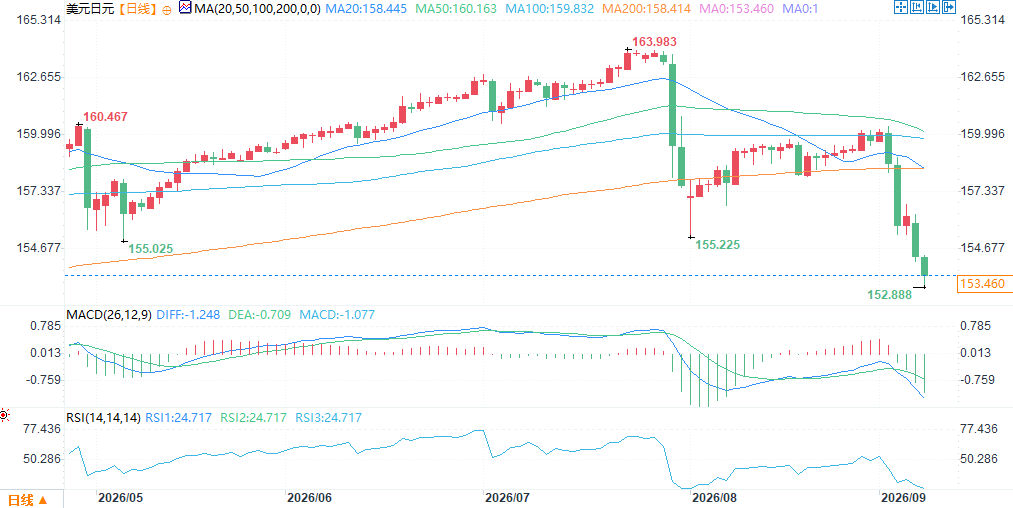 (USD/JPY daily chart, source: FX678) At 14:19 Beijing time, USD/JPY was trading at 153.58/59.
The yen rose to a seven-month high as expectations for an interest rate hike surged.
The USD/JPY pair briefly fell below 153, while the yen rose to a seven-month high. Bank of Japan policy board member Hajime Takada stated that "25 basis points is not a fixed rate," and further rate hikes are possible. This, coupled with speculation about potential adjustments to GPIF asset allocation, jointly pushed up the yen. The market is currently focused on this week's US PPI and CPI data, with CME data showing a roughly 60% probability of a September rate hike. HSBC noted that the market is pricing in a "faster" tightening pace from the Bank of Japan than in recent years, with overnight index swaps implying a cumulative 75 basis point rate hikes by April 2027, giving the September meeting an "exceptionally high" probability of a rate hike.The pace of carry trade unwinding has accelerated, establishing a medium-term bullish trend for the yen.
The yen's sharp rise is eroding massive carry trades, with cross-border yen borrowing reaching a record $2.35 trillion. The market is pricing in a 97% probability of a rate hike next week, but the key question is whether the yen can maintain its gains after the hike. If the Bank of Japan confirms continued tightening (such as hinting at quarterly rate hikes or higher terminal rates), the yen could push further towards 150; a dovish stance could see a rebound to the 155-157 range. The 30-year high yield on 10-year Japanese government bonds is a key variable supporting the yen's structural strength. Market expectations have shifted from "once every six months" to "at least three times," making the Bank of Japan's communication a crucial variable determining the yen's medium-term direction. The yen's strength also reflects the market's accelerating pricing of a narrowing US-Japan interest rate differential.Japan's finance minister confirmed that its policy stance remains unchanged; the yen's appreciation was driven by market expectations.
Japanese Finance Minister Satsuki Katayama stated publicly on Tuesday that despite the yen's appreciation to its highest level since February, the Japanese government's exchange rate policy stance remains unchanged. The government will continue its firm commitment to maintaining an orderly foreign exchange market environment and will maintain close communication and coordination with US Treasury Secretary Bessenter. Katayama emphasized that Japan's policy direction has "remained completely unchanged" since the joint intervention by Japan and the US in early August. She explained that the recent significant strengthening of the yen was mainly driven by a marked increase in market expectations for a Bank of Japan interest rate hike, rather than by any new large-scale intervention measures. In fact, Japan has not implemented any significant new round of direct intervention during this period. Katayama's statement aimed to signal policy continuity and stability to the market, preventing investors from over-interpreting the yen's appreciation as a policy shift. The Japanese government will continue to closely monitor the risk of excessive exchange rate volatility and, when necessary, coordinate with the US to jointly maintain the stability and orderly operation of the foreign exchange market.The yen is backed by policy support, and its short-term upward trend is expected to continue.
Katayama's statement confirmed the continuity of the US-Japan exchange rate coordination framework, suggesting that neither side has relaxed its focus on market volatility due to the yen's appreciation, thus providing policy support for the yen. The USD/JPY pair may trade in the 152-155 range in the short term. If the Bank of Japan confirms continued tightening, the USD/JPY pair may push further towards 150; if it adopts a dovish stance, the USD/JPY pair may rebound. The US-Japan exchange rate coordination framework provides policy support for the yen, and the market will focus on the outcome of next week's Bank of Japan meeting and its forward guidance. The yen's strength also reflects the market's accelerating pricing of a narrowing US-Japan interest rate differential, and large-scale unwinding of carry trades may further amplify the yen's appreciation momentum.Summarize
The yen rose to a seven-month high, with the market pricing in a faster-than-usual pace of tightening by the Bank of Japan. The USD/JPY pair is likely to trade in the 152-155 range in the short term, with attention focused on the outcome of next week's Bank of Japan meeting and its forward guidance. If continued tightening is confirmed, the yen may strengthen further; a dovish stance could lead to a rebound. The 30-year high in the 10-year Japanese government bond yield is a key variable supporting the yen's structural strength. Large-scale unwinding of carry trades could further amplify the yen's appreciation momentum. US inflation data will influence short-term volatility. (USD/JPY daily chart, source: FX678) At 14:19 Beijing time, USD/JPY was trading at 153.58/59.- Risk Warning and Disclaimer
- The market involves risk, and trading may not be suitable for all investors. This article is for reference only and does not constitute personal investment advice, nor does it take into account certain users’ specific investment objectives, financial situation, or other needs. Any investment decisions made based on this information are at your own risk.