The Houthis' sudden attack and the sharp rebound in oil prices after hitting a low point: is it a short-lived phenomenon or a trend?
2026-09-08 16:36:07
On Tuesday (September 8), during the Asian and European sessions, international oil prices rebounded sharply after hitting a low, influenced by news of the Houthi attack on Saudi Arabia. WTI crude rose more than 3%, trading around $94.2. This week, the Gulf situation entered a phase of "open confrontation": Iran rewrote the rules of passage in the Hormuz with "restricted zones and new shipping lane maps," while the United States threatened to "destroy oil tankers"; on the Red Sea side, the Houthi rebels launched a large-scale attack on southern Saudi Arabia. With two global energy chokepoints under pressure simultaneously, this is no longer a simple geopolitical event, but a repricing of structural risks on the supply side. 
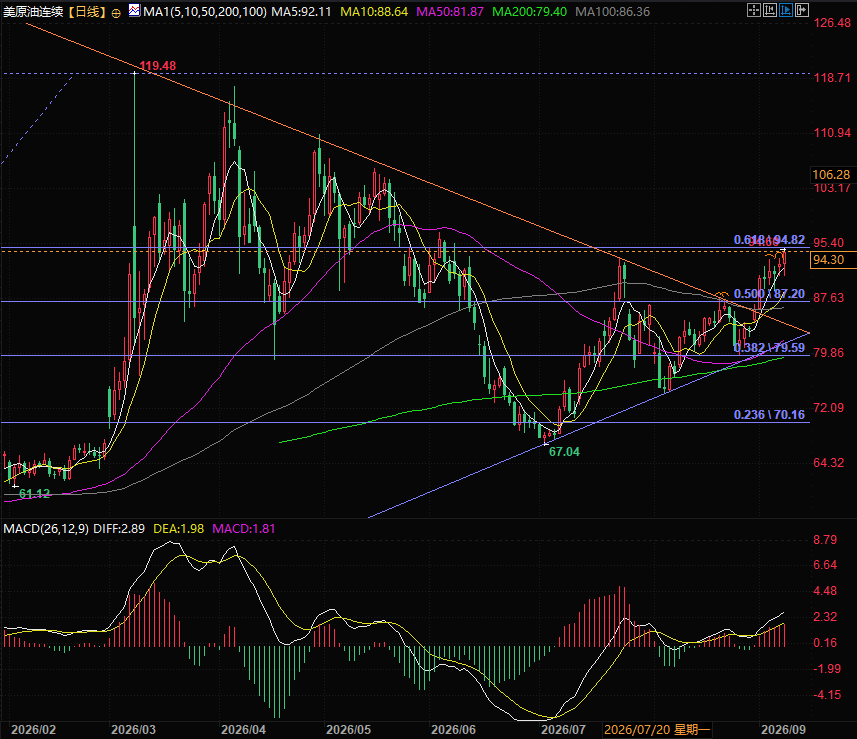 (WTI crude oil futures daily chart, source: EasyTrade) At 16:33 Beijing time, WTI crude oil futures were trading at $94.54 per barrel.
The US-Iran rivalry: Two sets of rules emerge in the Hormuz region.
Iranian Parliament Speaker Mohammad Ghalibaf warned on July 7 that if the United States attacks Iranian oil and gas assets, US energy assets in the Gulf region will face reciprocal retaliation; he stated bluntly that the Gulf oil and gas production chain is "large, easily accessible, and exposed to risks." US Defense Secretary Hergsays countered on July 5, claiming that Iranian oil tankers are "completely defenseless" and that the US would destroy Iranian tankers if they attacked US ships. On Monday, Rezaei, Secretary of Iran's Supreme National Security Council, announced new shipping restrictions and released a new shipping route map, extending the restricted area from near the US blockade line into parts of the Gulf. The proposed international shipping corridor passes through Iranian and Omani waters and will be managed with Iranian participation; the agreement is expected to be signed within days. Rezaei explicitly stated that whether Iran keeps the Straits open "entirely depends on the actions of the United States." This means that a situation of "two sets of rules" may emerge in the Gulf: Washington claims to uphold freedom of navigation, while Tehran demarcates its own shipping routes and restricted areas, and the Revolutionary Guard has warned that ships on "unauthorized" routes could become targets. This contest has been redefined by the Institute for International War Studies (ISW) and Columbia University's Center for Global Energy Policy (CGEP) as a "regional economic and maritime war." Iran has simultaneously unveiled an upgraded ballistic missile with a range exceeding 1,100 kilometers, shifting its narrative from "passive defense" to "preemptive strike," increasing the risk of miscalculation. The rivalry has spilled over to South Korea and Canada, and divisions have emerged within the Gulf alliance—the UAE has suspended financial ties with Iran and is accelerating the expansion of its east coast ports, pipelines, and alternative trade corridors to reduce its reliance on conflict routes.Houthi-Mandeb Strait: Another variable added to the Red Sea's flank
On Tuesday, Houthi rebels launched a large-scale attack on southern Saudi Arabia, injuring more than 70 people (including women and children), causing fires and temporary disruptions to operations at multiple oil facilities and public utilities. The coalition characterized the attack as a "serious escalation" and a "blatant violation of sovereignty." The coalition vowed retaliation, while the Houthis announced a statement regarding a "large-scale military operation deep into Saudi territory." Just hours earlier, the Houthis had accused Saudi Arabia of airstrikes on a prison in Al-Jawf province that killed six and injured seven, completely shattering the four-year ceasefire in Yemen. According to traffic data, the Bab el-Mandeb Strait was not blocked: the official baseline (for cargo ships over 1000 deadweight tons) is approximately 60 vessels per day, and early September measurements showed over 60 vessels, close to normal. However, Kpler's data for commercial vessels showed 29 vessels on Monday (17 the previous day), with approximately 23 "hidden" vessels passing through daily with their transponders off—the Houthis have imposed a maritime embargo on Saudi vessels since July 20, causing some oil tankers to turn around and bypass the embargo. For the market, the Bab el-Mandeb Strait is a "second front" in Iran's pressure campaign: both the Red Sea and the Persian Gulf present risk exposure.Saudi crude oil exports: Under pressure from both eastern and western routes
Saudi Arabia's exports are heavily reliant on two key chokepoints: the Strait of Hormuz to the east and the Bab el-Mandeb Strait to the west. Now, both routes are under pressure simultaneously: on the eastern route, the sharp drop in Hormuz traffic, the US-Iran attacks on oil tankers, and the establishment of new restricted zones in Iran have led to a comprehensive reassessment of security, insurance, and shipping routes at Persian Gulf loading ports; on the western route, the Houthi embargo directly targets Saudi-owned vessels, drastically increasing the risk to Saudi-flagged ships on the Red Sea route. While Saudi Arabia possesses east-west land pipelines that can partially bypass Hormuz, its flexibility in finding alternative routes is limited should the western route be blocked. Overall, Saudi Arabia's "dual-channel" strategy is under pressure on both sides, with logistics costs, war risk insurance premiums, and transportation time all deteriorating. The market needs to reprice its "temporary export discounts."Hormuz shipping capacity: reduced from 20 million barrels to approximately 7 million barrels.
Before the war, the Strait of Hormuz carried about one-fifth of the world's seaborne oil and liquefied natural gas, with approximately 90 to 140 commercial vessels passing through daily, and crude oil and refined product throughput of about 20 million barrels per day. Currently, Kpler data shows that only 7 commercial vessels passed through this Monday (compared to 8 the previous day), and the 10-day average as of September 6th was about 10 vessels, the lowest since May, dropping to around 5 vessels at one point over the weekend. Traffic volumes are equally dismal: Macquarie estimates that only about 7 million barrels per day currently transit the strait, while Vitor estimates about 10 million barrels per day, a 60-70% reduction compared to pre-war levels. After Iran closed the strait in March, the daily average rebounded to over 20 vessels during the agreement period in June and July, but shrank again after the agreement expired; now, with the added constraints of a "restricted zone" and a new shipping route map, a recovery in capacity seems a long way off.Institutional Viewpoint: Disagreements Focus on "Duration of Interruption"
Goldman Sachs has been the most vocal so far: On September 7th, Struvin, co-head of commodities research, warned that oil prices could surge to $120 per barrel if Middle East ship attacks escalate further, and recommended going long on natural gas and diesel. On the same day, Goldman Sachs raised its December 2026 Brent crude oil forecast by $5 to $85 per barrel and WTI to $80 per barrel, citing the possibility that shipping disruptions could continue into 2027. However, Goldman Sachs also cautioned that unless Middle Eastern oil infrastructure suffers large-scale damage, the potential for a significant price surge is limited—actual Persian Gulf exports are far higher than publicly available data, more and more tankers are turning off their transponders to circumvent statistics, and OECD commercial inventories remain resilient, meaning the price increase will be buffered by "hidden" attacks and inventory levels.Summary and Technical Analysis:
Iranian exports have been severely damaged by the US blockade and mutual attacks, and the obstruction of the Strait of Hormuz has further increased the export friction costs across the Gulf. Demand has not shown a significant contraction, and the anticipated supply-demand gap is driving oil prices higher. In this tight balance between oil demand and supply, the Houthi's marginal change has provided a significant boost to expectations of rising oil prices. However, it can also be observed that in the current international community, any attack or conflict needs a cause, requiring underlying logic and justification. The recent Saudi bombing of Houthi prisons has indeed triggered a humanitarian crisis, and it remains to be seen how Saudi Arabia will remedy the situation. Ultimately, the Houthis have no reason to continue attacking Saudi oil production facilities. Furthermore, the main problem at present is not insufficient production but the inability to ship oil out. The Houthis dare not close the Bab el-Mandeb Strait, so the impact on oil prices is likely to be short-lived rather than long-term, unless Saudi Arabia announces a production halt due to the impact or the conflict escalates. Technical Analysis: International oil prices continued to fluctuate significantly today, currently approaching the 0.618 Fibonacci retracement level of 94.82, which is also a previous area of heavy trading activity and presents significant resistance. Support lies around 91, another recent area of heavy trading activity. If oil prices do not retrace to the 91 level in the short term, they are likely to continue rising. (WTI crude oil futures daily chart, source: EasyTrade) At 16:33 Beijing time, WTI crude oil futures were trading at $94.54 per barrel.
- Risk Warning and Disclaimer
- The market involves risk, and trading may not be suitable for all investors. This article is for reference only and does not constitute personal investment advice, nor does it take into account certain users’ specific investment objectives, financial situation, or other needs. Any investment decisions made based on this information are at your own risk.