The situation in the Middle East has escalated sharply, with Brent crude oil futures approaching the $100 mark.
2026-09-09 08:48:06
On Wednesday (September 9) during Asian trading hours, Brent crude oil futures rose to $99.64 per barrel, a new high since July 27. The immediate trigger for this price surge was the sudden escalation of geopolitical tensions in the Middle East. According to media reports on Tuesday, a US official stated that in response to a missile attack attempt by the Iranian Revolutionary Guard Corps (IRGC) against a US warship, the US military had struck several Iranian oil tankers linked to the IRGC. This move marks a significant escalation of the military standoff in the Middle East. 
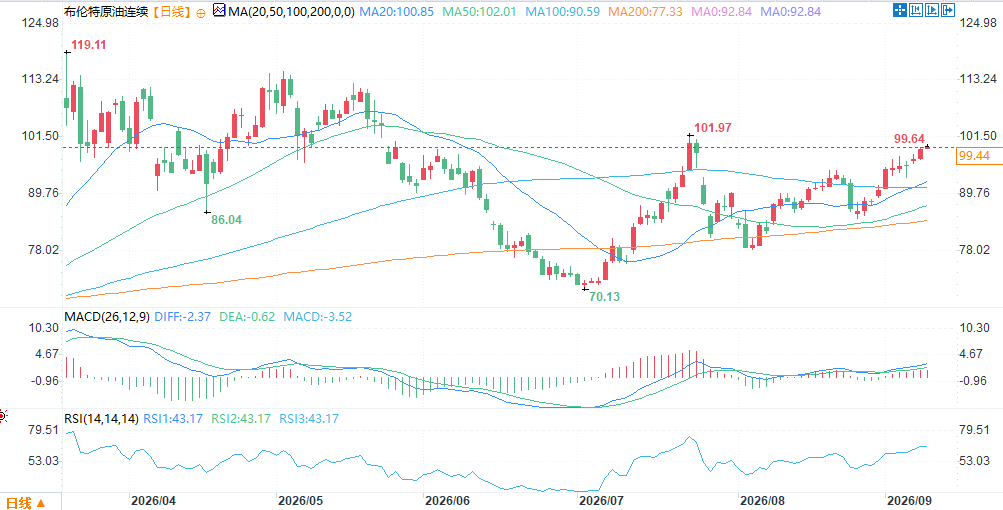 (Brent crude oil futures daily chart, source: EasyTrade) At 8:37 Beijing time, Brent crude oil futures were trading at $99.44 per barrel.
US military operation details
U.S. Central Command (CENTCOM) confirmed the operation in an official statement. The statement indicated that U.S. forces struck target oil tankers in the Gulf of Oman and near Iran's Kharg Island. During the operation, the U.S. military explicitly instructed the crew to abandon ship before attacking the vessels, a detail interpreted by some as an attempt to minimize casualties. CENTCOM characterized the targeted tankers as "part of a multi-billion dollar shadow network" that has long financially supported the Islamic Revolutionary Guard Corps (IRGC) and its proxy forces in the Middle East. Market and analyst analysts believe this operation marks a further escalation of U.S. efforts against related shadow fleets in Iran, moving beyond sanctions and seizures to directly cutting off funding sources through military means. The specific identities, cargo, and whether the tankers were carrying sensitive materials have not yet been officially disclosed in detail, but the statement emphasizes that these vessels play a key role in networks circumventing sanctions. This operation, occurring in sensitive waters, has itself posed a direct threat to shipping security around the Strait of Hormuz.Iran's response and regional repercussions
In a direct response to the US attack, the Islamic Revolutionary Guard Corps (IRGC) warned that ships in Kuwaiti and Bahrain ports housing US troops could be targets of retaliatory strikes. This statement significantly exacerbated security risks to key shipping lanes and port facilities in the Gulf region, prompting shipping and energy companies in the region to increase their vigilance. Meanwhile, Iran's semi-official Mehr News Agency reported hearing explosions near Kharg Island, home to Iran's main oil export facilities. Markets reacted swiftly to the potential supply disruption risk, with international oil prices fluctuating and traders reassessing the safety of passage through the Strait of Hormuz and the stability of Middle Eastern crude oil exports. Analysts point out that if the situation escalates further, not only will shipping insurance costs rise significantly, but risk premiums in the global energy market may also be repriced. Furthermore, the Houthi rebels in Yemen, another Iranian-backed group, announced another attack on Saudi Arabia's Jizan refinery, with a daily output of 400,000 barrels, and related facilities serving its domestic market.Hormuz flow drops to its lowest level in May
Shipping traffic in the Strait of Hormuz has fallen to its lowest level since May, coupled with U.S. gasoline and distillate fuel inventories being far below the same period last year and the five-year seasonal average, nearly exhausting the global crude oil market's supply buffer capacity. OPEC+ decided at its latest meeting to maintain its October production policy, with details of new quotas still pending further negotiation, failing to provide additional supply reassurance to the market. The market widely expects Iran to announce a new restricted zone outside the Strait of Hormuz in the coming days, further tightening transit rules or increasing inspections, which will directly push up transportation costs and insurance premiums. Brent crude futures face significant upward pressure in the short term; after the conflict spread to Saudi territory, geopolitical premiums have once again become the dominant factor. If Saudi energy infrastructure suffers substantial damage, oil prices could quickly break through the $100 per barrel mark; conversely, if the conflict shows signs of easing, prices may fall back to the $90-95 range. (Brent crude oil futures daily chart, source: EasyTrade) At 8:37 Beijing time, Brent crude oil futures were trading at $99.44 per barrel.- Risk Warning and Disclaimer
- The market involves risk, and trading may not be suitable for all investors. This article is for reference only and does not constitute personal investment advice, nor does it take into account certain users’ specific investment objectives, financial situation, or other needs. Any investment decisions made based on this information are at your own risk.