Gold Trading Alert: Houthi attack on Saudi Arabia fuels fuel prices, gold prices fall by more than 1%, with a target of $4300?
2026-09-09 07:56:06
On Tuesday (September 8), spot gold fell 1.15%, hitting a near one-week low of $4,345.69 per ounce during the session, before finally closing at $4,355.41. The Houthi rebels in Yemen launched a large-scale attack on Saudi energy facilities, and the military confrontation between the US and Iran in the Strait of Hormuz continued to escalate. Brent crude oil surged to $99.46 per barrel, exacerbating inflation concerns and supporting expectations of a Federal Reserve rate hike, thus putting downward pressure on gold prices. Gold prices are currently supported by the key 100-day moving average at $4,342. If this level is breached, the price may fall further towards the $4,300 mark. Investors will be closely watching the inflation data to be released this week. On Wednesday (September 9) in Asian trading, spot gold traded in a narrow range, currently hovering around $4,352 per ounce. 
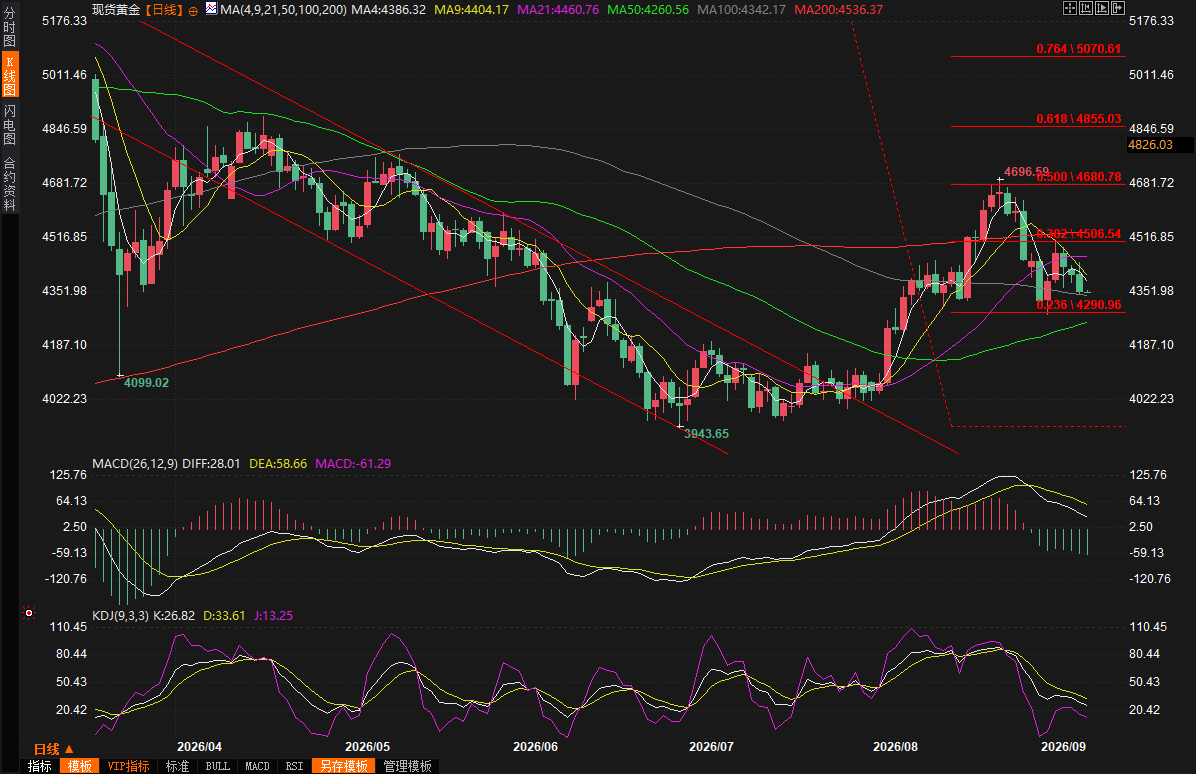 (Spot gold daily chart, source: FX678) At 07:51 Beijing time, spot gold is currently trading at $4352.68 per ounce.
The direct correlation between falling gold prices and soaring oil prices
Spot gold fell 1.15% on Tuesday, hitting a low of $4,345.69 per ounce before closing at $4,355.41 per ounce; December gold futures fell 1% to settle at $4,430.10. This performance echoed the strong employment data released earlier – US non-farm payrolls accelerated sharply in August, and the unemployment rate remained stable at 4.1%, indicating that the labor market remained resilient, directly prompting the market to reassess the Federal Reserve's policy path. The real pressure on gold prices was the simultaneous surge in oil prices. Brent crude oil touched $99.46 per barrel on Tuesday, a new high since July 24, before closing at $97.92, while US crude oil closed at $93.03, having reached a high of $94.73 per barrel during the session, both reaching six-week highs and entering technically overbought territory. The immediate trigger for the oil price surge was the attack on energy facilities in southern Saudi Arabia by the Iranian-backed Houthi rebels in Yemen, which caused fires at oil facilities and injured more than 70 people in four southern Saudi cities. Meanwhile, Tehran's threat of an "economic war" against the United States, coupled with the seventh month of the Middle East conflict, has sharply heightened market concerns about supply disruptions. High oil prices have directly reinforced inflation expectations. Rising energy prices often push up overall prices through cost transmission, and the Federal Reserve's primary concern is whether inflation is truly under control. The CME Group's FedWatch tool shows that traders currently expect a 60% probability of a rate hike at the Fed's September 15-16 policy meeting, significantly higher than the approximately 50% before the employment data release. Stone X senior market strategist Daniel Pavilonis stated that the increased probability of a rate hike has limited gold prices, which are currently trading within a range. Peter Grant of Zaner Metals also pointed out that the market is still digesting a stronger-than-expected employment report and awaiting this week's CPI and PPI data, while rising oil prices themselves are supporting rate hike expectations.The bond market's correlation with this week's inflation data will be a crucial test.
Echoing the gold market was the US Treasury market. On Tuesday, US Treasury yields rose slightly, with the two-year yield at 4.394% and the 10-year yield at 4.798%, narrowing the two-year/ten-year spread to approximately 40 basis points. Oil prices hitting a six-week high was also a significant factor pushing up yields—investors began adjusting their positions for scenarios of potentially further interest rate increases, sustained high inflation, and a resilient economy. The 10-year yield is nearing its highest level since October 2023, and the 30-year yield has risen to its highest level since 2007, raising concerns about the US fiscal situation and demand for long-term Treasury bonds. However, there was no panic selling. The US Treasury auctioned $58 billion in three-year notes on Tuesday, with strong demand. The winning yield was 4.474%, slightly below the expected level, and the bid-to-cover ratio reached 2.72 times, the highest since November of last year. This indicates that while short-term interest rate expectations are rising, investors still have a willingness to allocate to short- to medium-term US Treasuries. FHN Financial macro strategist Will Compernolle stated that the market is awaiting the Producer Price Index (PPI) and Consumer Price Index (CPI), which will truly determine the Fed's decision next week. Thursday's PPI and Friday's CPI will serve as a litmus test for both gold and bond prices—if inflation data again exceeds expectations, the probability of an interest rate hike may increase further, thus continuing to suppress gold; if the data is moderate, gold prices may gain some breathing room.Escalating Middle East Conflict: Safe-haven Support and Supply Shock Coexist
The recent correlation between oil and gold prices is inseparable from the rapidly escalating tensions in the Middle East. The US Central Command confirmed that on September 8th, after the Islamic Revolutionary Guard Corps (IRGC) targeted a US Navy warship twice with ballistic missiles over the past two days, the US military destroyed five Iranian oil tankers. The US ships successfully evaded the attacks without casualties. US Secretary of State Marco Rubio subsequently warned that every attempt by Iran to attack US warships would come at the cost of losing oil tankers. The Iranian Revolutionary Guard Corps, through state media, claimed to have used ballistic missiles to attack a US base in Azraq, Jordan, in retaliation for the US action, and claimed to have struck two US destroyers equipped with Aegis systems, causing "serious damage." The US has not yet officially confirmed this. Meanwhile, the US Treasury Department further intensified economic pressure on Iran, imposing 36 sanctions on the Iranian aviation industry, aiming to force companies such as Mahan Air to cease operations and expanding the sanctions to all other Iranian airlines, while also targeting shell companies, freight forwarders, and foreign intermediaries. The Treasury Department also suspended three aviation authorizations related to Iran, cutting off the ability to fly over Iranian airspace and use US-made aircraft. These measures, coupled with Houthi attacks on Saudi energy facilities, have deepened market concerns about a potentially prolonged disruption to shipping through the Strait of Hormuz. Goldman Sachs, HSBC, and other institutions have begun raising their oil price forecasts for the remainder of 2026 and 2027. Geopolitical risks should have provided safe-haven buying for gold, but current inflation and interest rate hike expectations driven by rising oil prices have temporarily outweighed this safe-haven premium. Gold's dual nature—both a safe-haven asset and a non-interest-bearing asset sensitive to interest rates—is now fully exposed. Investors are simultaneously worried about the potential for further impacts on global energy supplies and the economic outlook from the Middle East conflict, while also facing the reality that the Federal Reserve may tighten policy more quickly.Additional disturbances from trade frictions and the global macroeconomic background
Beyond the Middle East and monetary policy, the escalating trade friction between the US and Canada has added uncertainty to the global macroeconomic environment. The White House released detailed tariff implementation rules for relevant Canadian products, clarifying that goods already in the US before September 29th but not yet declared for domestic sale will still be subject to a 50% tariff rate. It also plans to ban the import of certain Canadian automobiles and some alcoholic beverages starting September 29th. US officials stated that the import ban amounts to billions of dollars, covering dairy products, most alcoholic beverages, and motorcycles, and aims to address "deficiencies" in the USMCA (United States-Mexico-Canada Agreement). While these measures do not directly affect the gold market, they may indirectly disrupt global asset pricing, including gold, by influencing North American supply chains, inflation expectations, and risk sentiment.Market Outlook
In summary, the current gold price adjustment is the result of a complex interplay of multiple forces: oil prices surged due to the Middle East conflict, igniting inflation concerns and boosting expectations of a September rate hike by the Federal Reserve; strong employment data further reinforced this trend; and the upcoming PPI and CPI data this week will be key variables determining the short-term direction of gold prices. If inflation data remains strong, gold may continue to face pressure and even fall below $4300; if the data shows easing inflationary pressures, coupled with the uncertainty of the Middle East situation, safe-haven demand is expected to regain the upper hand. (Spot gold daily chart, source: FX678) At 07:51 Beijing time, spot gold is currently trading at $4352.68 per ounce.
- Risk Warning and Disclaimer
- The market involves risk, and trading may not be suitable for all investors. This article is for reference only and does not constitute personal investment advice, nor does it take into account certain users’ specific investment objectives, financial situation, or other needs. Any investment decisions made based on this information are at your own risk.