Gold has returned to around $4,400, but has not escaped the consolidation: the underlying interest rate constraints are more crucial.
2026-09-09 15:00:06
On Wednesday, September 9th, spot gold was fluctuating around $4400 per ounce, Brent crude oil futures were around $99.5 per barrel, the US dollar index was around 98.7, and the USD/JPY exchange rate was around 153. Gold had previously fallen by about 2.6% over three consecutive trading days, before recovering due to a weakening dollar. The current market dynamic is not simply a matter of "safe-haven trading," but rather a simultaneous shift in four pricing chains: energy prices, inflation expectations, interest rate paths, and the dollar exchange rate. 
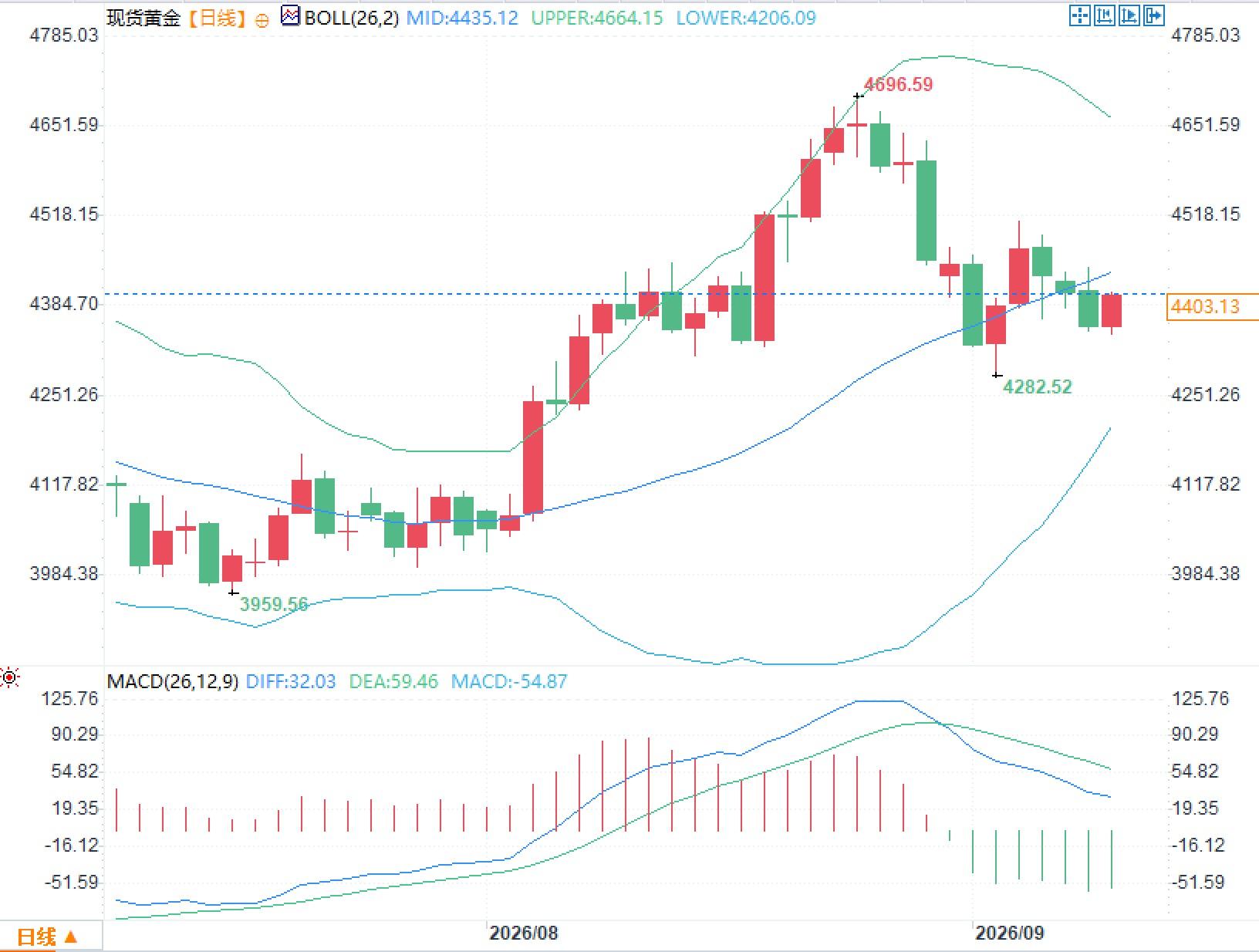 In the MACD indicator, the DIFF line is below the DEA line, and the histogram is in negative territory, reflecting a significant cooling of the previous unilateral momentum and a reassessment of prices. Meanwhile, the recent large fluctuations in the chart indicate that short-term funds are increasingly sensitive to macroeconomic news.
Gold pricing is caught in a tug-of-war of multiple variables; a weak dollar and high oil prices are not necessarily mutually beneficial.
The dollar index retreated this week, while the yen rose to a near seven-month high, providing significant external support for gold. A weaker dollar reduces the exchange rate cost for non-dollar funds holding gold, but this effect is being offset by interest rate risks from rising oil prices. With Brent crude approaching $100 per barrel, the market is reassessing the possibility of energy costs being passed on to transportation, production, and service prices. Therefore, gold currently faces a classic "dual conflict": increased safe-haven demand boosts holding intentions, while inflation risks may raise nominal and real interest rate expectations, the latter typically suppressing the relative valuation of non-interest-bearing assets. This structure explains why gold has not exhibited a simple one-sided reaction to escalating regional conflicts. More importantly for the market is to analyze the sources of risk: if price changes primarily stem from a weaker dollar, the correlation between gold and exchange rates will increase; if they mainly originate from energy shocks, the market often reassesses inflation, bond yields, and policy rates simultaneously, allowing gold's safe-haven attribute to hedge against rising opportunity costs.Energy inflation has once again become a policy variable, and data sensitivity has increased significantly ahead of the Fed's September meeting.
The latest data shows that the US Consumer Price Index (CPI) rose 3.4% year-on-year in July, the core index rose 2.5% year-on-year, and energy prices rose 14.7% year-on-year. This means that energy itself is already a highly volatile component of the inflation structure. It's important to note that changes in crude oil prices do not directly translate to core inflation, but rather first affect gasoline, transportation, and inflation expectations, and then have a secondary transmission through business costs and service prices. The US Producer Price Index (PPI) for August will be released on September 10th, and the CPI for August will be released on September 11th. Compared to looking solely at the year-on-year figures, the market is more focused on month-on-month momentum, core service prices, and the energy component, as these factors determine whether the recent oil price shock is merely a relative price change or is expanding into more persistent price pressure. The official schedule confirms that the Federal Reserve's September policy meeting will be held from September 15th to 16th.The Federal Reserve's constraints stem from the combination of "inflation not receding" and "employment not weakening."
The Federal Reserve maintained the target range for the federal funds rate at 3.50% to 3.75% at its July meeting, with 9 votes in favor of maintaining the rate and 3 votes favoring a 25 basis point hike, indicating a lack of consensus within the Fed regarding tolerance for inflation risks. August non-farm payrolls increased by 162,000, and the unemployment rate remained at 4.1%, with employment data offering no significant pressure for policy easing. Interest rate futures have recently been fluctuating around 58% to 60% implied probability of a 25 basis point rate hike in September, suggesting that the market has not formed a highly consistent expectation, and inflation data could still significantly alter pricing. This is the macroeconomic basis for the current high-level fluctuations in gold prices. Gold is not simply trading in inflation levels, but rather in the difference between inflation and policy response. If rising inflation brings stronger tightening expectations, real interest rates may rise, and safe-haven demand may not fully offset changes in holding costs. If inflationary pressures are more often attributed to energy supply shocks, and policy responses are constrained by growth and financial conditions, then the relationship between gold and real interest rates may weaken in stages. The most important thing to observe at present is which of the two mechanisms is dominating marginal pricing, rather than mechanically interpreting rising oil prices as either bullish or bearish for gold. This means that the market's focus is not on the word "interest rate hike" itself, but on whether short-term interest rates can continue to rise against the backdrop of high oil prices, and whether real interest rates will rise in tandem. Only when these two variables change together will the opportunity cost constraint on gold significantly strengthen; if they diverge, the correlation between price and macroeconomic variables will become more unstable.The daily technical structure indicates a cooling of momentum.
Looking at the daily chart, after a rapid rise in the previous period, gold has returned to the vicinity of the middle Bollinger Band. The Bollinger Bands still maintain a relatively wide width, indicating that the recent volatility is significantly higher than during the previous sideways phase. In the MACD indicator, the DIFF line is below the DEA line, and the histogram is in negative territory, reflecting a significant cooling of the previous unilateral momentum and a reassessment of prices. Meanwhile, the recent large fluctuations in the chart indicate that short-term funds are increasingly sensitive to macroeconomic news.Frequently Asked Questions
Question 1: Why hasn't gold consistently exhibited a purely safe-haven appeal despite escalating regional conflicts? Answer: Because the same event simultaneously increases risks in both oil and inflation. While safe-haven demand increases the willingness to allocate to gold, higher policy interest rate expectations raise the opportunity cost of non-interest-bearing assets. These two forces may offset each other, therefore the price reaction depends on the relative changes in the US dollar, real interest rates, and capital flows. Question 2: Why are the Producer Price Index (PPI) and Consumer Price Index (CPI) more important this week than usual? Answer: With oil prices approaching $100/barrel, the market needs to determine whether the energy shock is beginning to transmit to broader price items. If core services, month-on-month momentum, and inflation expectations change simultaneously, the adjustment in policy interest rate pricing will typically be greater than the reaction when only the energy component is considered.- Risk Warning and Disclaimer
- The market involves risk, and trading may not be suitable for all investors. This article is for reference only and does not constitute personal investment advice, nor does it take into account certain users’ specific investment objectives, financial situation, or other needs. Any investment decisions made based on this information are at your own risk.