With the Bank of Japan raising interest rates in September a foregone conclusion, what's next for the yen?
2026-09-09 15:30:07
On Wednesday (September 9), the US dollar continued its decline against the Japanese yen during the European session, currently trading around 153.20. Michael Wan, an analyst at Mitsubishi UFJ Financial Group, pointed out that the recent continued strengthening of the yen remains a focus of market attention. The USD/JPY exchange rate has experienced increased volatility in the past few trading days, briefly dipping to 152.88 yesterday, a new low since February 19. Despite mixed domestic economic data from Japan—strong labor cash income but weak GDP data—market expectations for a 25 basis point rate hike by the Bank of Japan in September have not changed, and investors' attention remains focused on the Bank of Japan's policy communication and favorable signals regarding the yen. 
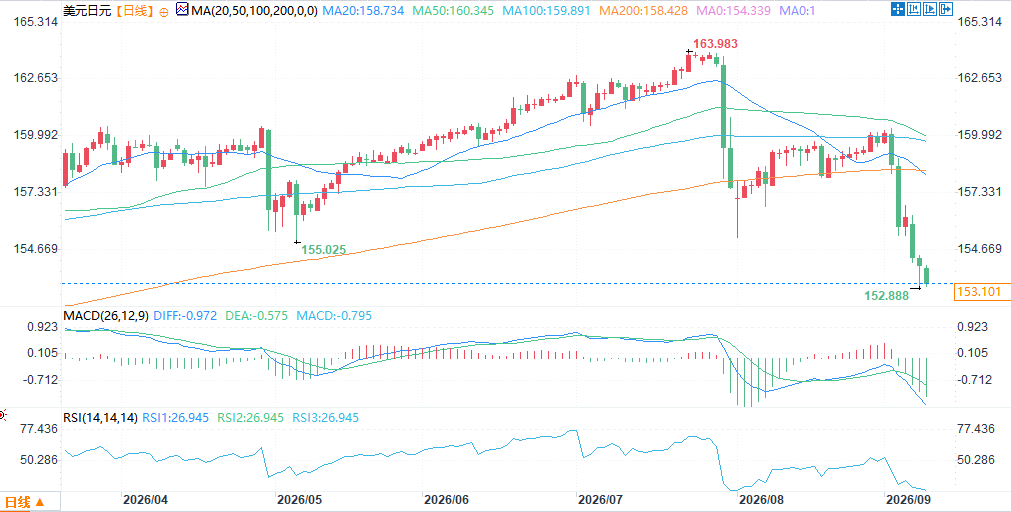 (USD/JPY daily chart, source: FX678) At 15:20 Beijing time, USD/JPY was trading at 153.28/29.
The strong yen dominated the market, and data did not change the pricing of interest rate hikes.
Wan stated that the core focus of the Asian market remains the continued strengthening of the yen, while the market is also closely monitoring other global factors, including soaring oil prices, the US Treasury's buyback program, and the US CPI data to be released later this week. The USD/JPY exchange rate experienced significant volatility over the past 24 hours—the exchange rate fell to 152.88 at one point before rebounding slightly to close near 153.97. Overall, the latest Japanese economic data has not changed market pricing in a September rate hike by the Bank of Japan. The market has almost fully priced in a 25 basis point rate hike, and investors' focus has shifted to the Bank of Japan's policy communication regarding the longer-term interest rate path. Traders believe that short-term fluctuations reflect more of a position adjustment and a shift in risk sentiment than a fundamental change in policy expectations. The yen's strength has become a dominant variable in the regional market, and its spillover effects on carry trades and Asian currencies will continue to be a key focus this week.The game behind Bessant's "information advantage" rhetoric
The Mitsubishi UFJ report also mentioned US Treasury Secretary Bessenter's remarks regarding the yen. Bessenter challenged traders and the market, implying he possessed more information about the intentions of Japanese policymakers and the Bank of Japan, thus countering market forces shorting the yen. This statement signaled US concern about the yen's exchange rate and suggested that communication between the US and Japan on exchange rate issues might be closer than the market expected. Market interpretations suggest that Bessenter's wording carried a clear element of verbal intervention, intended to curb excessively bearish speculative positions on the yen, while conveying the US's stance of not wanting the yen to appreciate too quickly and impact bilateral trade and financial stability. This "information advantage" statement intensified market speculation about the possibility of policy coordination, potentially limiting the downside potential of the USD/JPY exchange rate in the short term and prompting some short positions to be closed prematurely.Historical Perspective: The Divergence of Paths After the Yen's Sharp Depreciation
The report points out that historically, a sharp drop of 10% or more in the USD/JPY exchange rate within a short period is not uncommon. However, the key question is whether this movement is driven by domestic Japanese factors or by external factors (such as a surge in risk aversion and the resulting sharp increase in volatility)—the latter having a broader spillover effect on other markets. Mitsubishi UFJ believes that the yen's appreciation so far has been largely driven by domestic Japanese factors, thus emerging markets as a whole and carry trades have remained resilient. However, the bank also warns that this risk needs continued monitoring—if the driving force behind the yen's strength shifts from domestic factors to external risk aversion, the risk of carry trade unwinding and pressure on emerging markets will increase significantly. Historical experience shows that domestically driven appreciation is usually more manageable, while sharp declines driven by external shocks are often accompanied by synchronized adjustments in global risk assets; therefore, the market needs to closely monitor changes in volatility and capital flows.Summarize
Mitsubishi UFJ's core assessment can be summarized as follows: the yen's strength remains unchanged, driven primarily by domestic factors, interest rate hike expectations have been fully priced in, and external risks cannot be ignored. The market has already fully priced in a 25 basis point rate hike by the Bank of Japan in September, and the focus has shifted to guidance on the long-term interest rate path. Remarks by US Treasury Secretary Bessenter suggest US concern about the yen's exchange rate, adding an additional variable to the policy game. Currently, the yen's appreciation is mainly driven by domestic factors in Japan, with carry trades and emerging markets remaining resilient, but investors need to be wary of tail risks arising from the shift in driving factors. This week's US CPI data will be a key external variable affecting the USD/JPY exchange rate. (USD/JPY daily chart, source: FX678) At 15:20 Beijing time, USD/JPY was trading at 153.28/29.
- Risk Warning and Disclaimer
- The market involves risk, and trading may not be suitable for all investors. This article is for reference only and does not constitute personal investment advice, nor does it take into account certain users’ specific investment objectives, financial situation, or other needs. Any investment decisions made based on this information are at your own risk.