Iran bombs another US military base, but the risk of a drop in oil prices is accumulating.
2026-09-09 16:20:07
On Wednesday (September 9), international oil prices continued their strong upward trend. WTI crude oil is currently trading around $94.59, up 1.67%. In early September 2026, the Middle East energy geopolitical conflict will see a new marginal escalation, with the direct confrontation between the US and Iran at sea intensifying, Iranian proxies launching cross-regional operations, and the Houthis increasing the risk to Saudi Arabia's Red Sea energy corridor. Multiple unforeseen variables are rapidly impacting crude oil pricing. All the new conflicts in this round are concentrated in the September window, breaking the previous balance of power, pushing up the global oil geopolitical risk premium, causing shipping congestion in the Straits, disrupting regional oil export capacity, and significantly exacerbating short-term market volatility.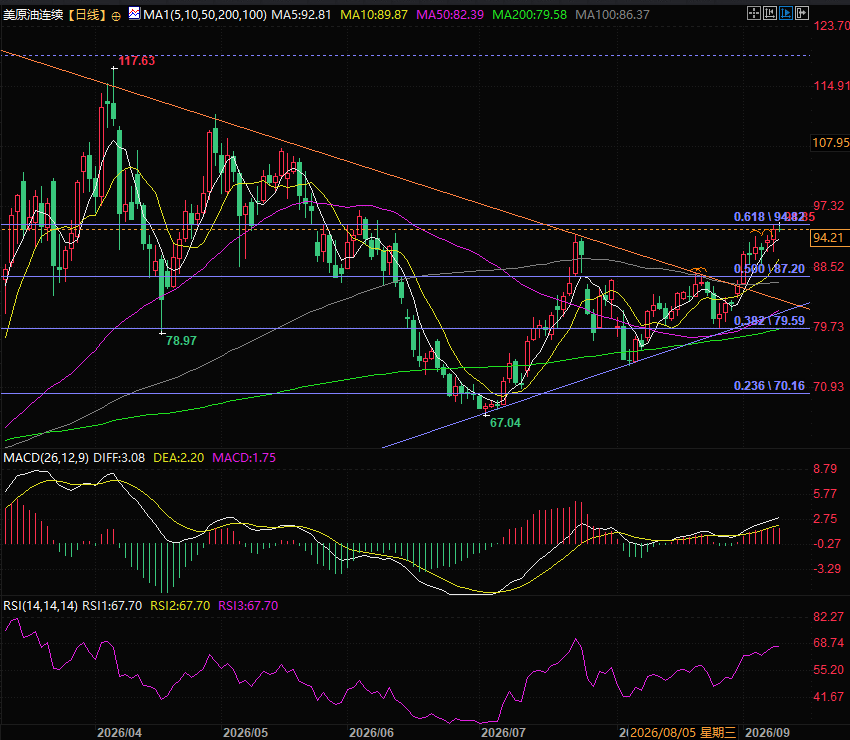 (WTI crude oil futures daily chart, source: EasyTrade) At 16:13 Beijing time, WTI crude oil futures were trading at $94.20 per barrel.
The maritime rivalry between the US and Iran continues to escalate, with the scope of attacks on oil tankers expanding once again.
The US-Iran rivalry has entered a new retaliatory cycle, with the intensity of attacks on oil tankers at sea continuing to escalate. The US Central Command released an official statement on social media, disclosing the full cause of this round of conflict: On September 8th local time, the US military officially destroyed five Iranian oil tankers. Two days prior, the Iranian Islamic Revolutionary Guard Corps had launched two ballistic missile attacks on a US warship. The US warship successfully evaded all attacks, causing no US casualties, and its vessels continued patrols in the relevant waters. This round of US strikes was a retaliatory action against the failed Iranian missile attack. Following the US strikes on the Iranian oil tankers, on the evening of the 8th local time, the Iranian Islamic Revolutionary Guard Corps issued an emergency warning regarding the US attack on Iranian oil tankers, accusing Kuwait and Bahrain of being "accomplices" by harboring US troops and cooperating with US actions. It formally warned all oil tankers docked or anchored in the ports and anchorages of both countries, demanding the immediate evacuation of their crews. It clarified that all relevant vessels, whether docked or anchored, would be considered targets for Iranian retaliatory strikes, significantly expanding the high-risk shipping area in the Gulf. In response to the subsequent substantial counterattack, the Iranian Islamic Revolutionary Guard Corps launched a multi-dimensional military retaliation in the early hours of September 9. In addition to striking the US military base in Azraq in Jordan, it focused on energy transport vessels at sea, severely damaging two US destroyers and eight associated US oil tankers. It also struck 10 vessels that illegally passed through the restricted area of the Strait of Hormuz under the cover of the US military. The intensity of the maritime confrontation reached a new high in recent times.Shipping through the Strait of Hormuz is disrupted, but 50% of its capacity is still available.
Shipping risks in the Strait of Hormuz continue to escalate, with risk premiums replacing purely physical supply disruptions as the core driver of current crude oil trading growth. As of September 7, the number of vessels stranded in the Strait and the Gulf of Oman continued to grow, with 42 oil tankers awaiting passage, 18 of which were fully loaded with crude oil, totaling 11.1 million barrels of oil stranded at sea, equivalent to 11% of global daily crude oil demand. It is important to note that "although the risk of attack remains in the area, the Strait of Hormuz is not currently completely closed to navigation. However, its actual navigability is far below pre-war levels. According to data from the U.S. Energy Information Administration (EIA), oil traffic through the strait has plummeted from approximately 21.6 million barrels per day before the war to approximately 4.9 million barrels per day in the second quarter of 2026, less than a quarter of the pre-war level. To maintain oil exports, the U.S. military has established escort channels, claiming a daily escort volume of nearly 10 million barrels. Overall, the current actual transport volume is roughly equivalent to about 50% of the pre-war level. Goldman Sachs predicts that even if the situation eases in the future, due to Middle Eastern oil-producing countries finding alternative routes, the strait's transport volume may only recover to about 70% of pre-war levels, forming a new normal." However, due to the high-risk situation, proactive risk avoidance and navigation with navigation devices disabled have become the norm, significantly increasing shipping costs and shipping insurance rates, directly raising the cost of spot trading in Middle Eastern crude oil and causing the regional crude oil spot premium to continue to expand. Meanwhile, negotiations between Iran and Oman on joint control of the Strait of Hormuz have made new substantial progress, with the waterway governance game and military confrontation advancing simultaneously, adding new uncertainties to the crude oil market.Houthi rebels launched a surprise attack on Saudi oil and gas facilities, disrupting alternative crude oil export routes.
The latest conflict between Saudi Arabia and the Houthi rebels has completely blocked Saudi Arabia's alternative oil export routes, creating a double risk confluence between the two straits. On September 8, the Houthi rebels launched their largest offensive of the year, launching missiles and drones in rapid succession to precisely target key oil and gas producing areas in southern Saudi Arabia, including Jizan and Najran. This ignited fires at multiple Aramco oil facilities, resulting in 73 casualties. Refining and storage capacity in southern Saudi Arabia was temporarily shut down, directly impacting Saudi Arabia's oil export capacity. This round of attacks was highly targeted, covering key industrial bases and energy facilities along Saudi Arabia's Red Sea coast, completely disrupting Saudi Arabia's alternative export strategy relying on the Bab el-Mandeb Strait, the Suez Canal, and overland pipelines. Previously, to avoid risks in the Strait of Hormuz, Saudi Arabia had shifted its oil export focus to the Red Sea, with pipeline traffic surging from 650,000 barrels per day in June to 1.9 million barrels per day in August. However, the latest Houthi attacks across the entire region have plunged this crucial alternative route into a highly dangerous state. Saudi oil tankers have been forced to adopt "dark navigation" mode, and Red Sea oil traffic has plummeted by 30% compared to June, essentially rendering global alternative seaborne oil routes ineffective. This is also an important marginal variable related to oil prices recently, and one of the main reasons for the rise in oil prices.Institutional Viewpoint:
Currently, major global institutions have collectively raised their oil price forecasts, forming a consensus of short-term bullishness, medium-term high-level fluctuations, and a significant surge in the event of extreme conflict. The only differences lie in the duration of the conflict and the pace of premium realization. Bank of America holds the most aggressive view, predicting that if the Middle East conflict escalates and oil and gas facilities are damaged, oil prices could reach as high as $150 per barrel. Goldman Sachs raised its oil price target by $5, predicting that Middle East shipping disruptions may continue until 2027. The mainstream view is that the geopolitical shipping risks of the two Straits in the Middle East are the only core factor in pricing. The US-Iran and Saudi-Hove tensions are putting pressure on the two major oil routes, the Hormuz and the Red Sea, coupled with warnings of Iranian attacks on tankers at unoccupied ports and the closed loop of US-Iran retaliation, leading to a continuous accumulation of geopolitical premiums. Before the conflicts involving ship attacks and facility attacks ease, oil prices are more likely to rise than fall, and Brent crude has a very high probability of stabilizing above $100 in the short term.Summary and Technical Analysis:
The escalating standoff between the Houthis, Saudi Arabia, and the US and Iran has led to a sustained rise in oil prices due to these new geopolitical events. However, oil prices are also reflecting the geopolitical risks associated with the Strait of Hormuz, suggesting that further clashes are needed to sustain the price increases. But can this clashes be sustainable? The answer is likely no. As analyzed in previous articles, firstly, tanker capacity has not been completely disrupted, remaining at around 50%. Secondly, both sides are currently using fighting as a pretext for negotiations. The current oil price trend indicates that Iran holds the upper hand and has gained a strategic advantage. However, whether the continued rise in oil prices will force the US to concede, or whether the US will maintain its sanctions, and whether the world will stabilize oil prices by reducing its dependence on the Strait of Hormuz, remains to be seen. In other words, the higher oil prices rise, the more likely the US will intervene. This inherent force means that the rise in oil prices will inevitably involve wide fluctuations. Technical Analysis: Oil prices have recently been hovering around the 0.618 Fibonacci retracement level, but have maintained a short-term bullish pattern. The 5-day moving average is currently an important level to watch for bullish movement. If oil prices can remain stable around 94.82, there is still a chance for further gains, but it is very close to the 100 mark. Stock prices are likely to experience significant volatility when they reach around 100. (WTI crude oil futures daily chart, source: EasyTrade) At 16:13 Beijing time, WTI crude oil futures were trading at $94.20 per barrel.
- Risk Warning and Disclaimer
- The market involves risk, and trading may not be suitable for all investors. This article is for reference only and does not constitute personal investment advice, nor does it take into account certain users’ specific investment objectives, financial situation, or other needs. Any investment decisions made based on this information are at your own risk.