Bessenter to make its move tonight: The size of the US Treasury repurchase program will be revealed soon.
2026-09-09 21:47:07
On Wednesday (September 9th) during the European and American trading sessions, international gold and oil prices rose together, with spot gold up 1.6% and international oil prices up around 3%. Oil prices rose due to the ongoing US-Iran conflict, while gold prices were influenced by anticipation of increased market liquidity following the announcement of the specific scale of the Treasury bond repurchase program by US Treasury Secretary Scott Bessenter tonight. US Treasury Secretary Scott Bessenter is reshaping the pace of US Treasury market regulation with a decisive and assertive style, and the core details of a long-term US Treasury bond repurchase policy that has attracted global attention are about to be revealed. The US Treasury Department will announce the specific scale of this round of US Treasury bond repurchase operations around 11 pm Beijing time on Wednesday, with the actual transactions taking place on Thursday. The entire regulatory action aims to stabilize US Treasury yields and ensure the smooth operation of the market, affecting the nerves of global bond and foreign exchange markets. As early as August 19th, the Treasury Department officially announced this repurchase plan, clarifying that the minimum repurchase scale would not be less than $4 billion, mainly targeting 10-year and 20-year US Treasury bonds. This minimum scale is already twice that of regular repurchase operations. Currently, several major Wall Street institutions unanimously predict that $4 billion is merely the lower limit of regulation, and the scale of this round of repurchases is highly likely to be significantly upgraded. The market generally expects the initial size to fall within the range of $5 billion to $6 billion, and the possibility of introducing even more aggressive and extreme regulatory measures cannot be ruled out. In the view of these institutions, a repurchase scale of $6 billion is already a strong regulatory measure. If it is further expanded to three to four times the normal scale, it will significantly slow down the growth rate of net supply of US Treasury bonds and completely reshape the supply and demand pattern of the bond market. 
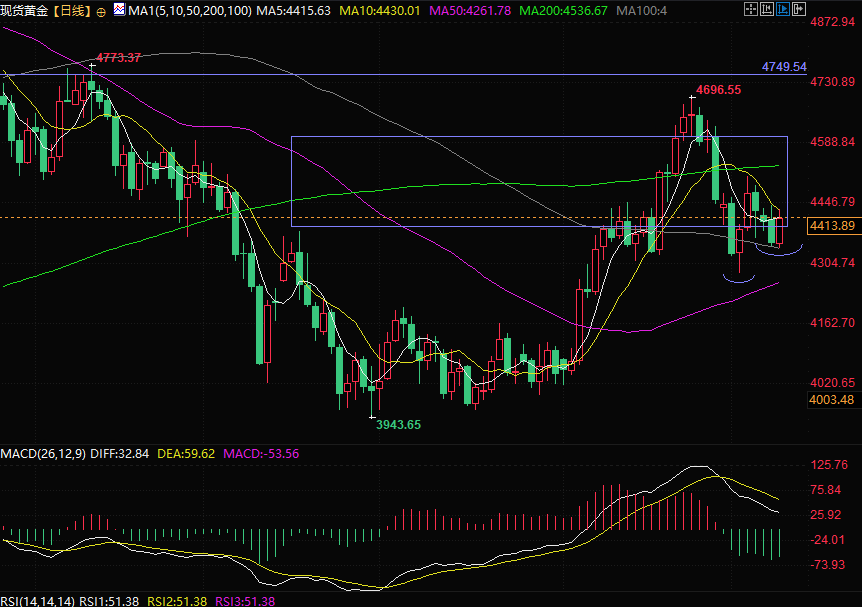 (Spot gold daily chart, source: EasyTrade) At 21:44 Beijing time, spot gold is currently trading at $4417 per ounce.
A strong statement to the market, coordinated exchange rate adjustments to mitigate debt risks.
Compared to quantitative policy measures, Bessant's sharp market stance has become the core focus of this round of regulation. This week, he publicly and forcefully addressed foreign exchange traders, stating that "the market power is now in the hands of the Treasury," showing no fear of challenges from speculative forces. In a speech at Southern Methodist University, he reiterated his tough stance, allowing traders to freely bet on short selling, demonstrating the Treasury's firm confidence in its regulation. This statement is not merely market intimidation, but stems from a meticulously coordinated regulatory logic. This US Treasury repurchase program complements the yen's support policy, with the core objective of mitigating the potential risk of a large-scale sell-off of US Treasury bonds. As the largest overseas holder of US Treasury bonds, Japan holds $1.1 trillion in holdings. If the Bank of Japan were to initiate a sell-off, it would inevitably push up US Treasury yields significantly. Currently, the US debt burden remains high, with total federal debt exceeding $40 trillion and the fiscal deficit approaching $2 trillion. Fluctuations in yields will further exacerbate fiscal pressure, which is the core motivation behind the Bessant government's series of aggressive regulatory policies.Market controversies have emerged, and aggressive regulation harbors long-term concerns.
Bessant's unconventional and forceful intervention, while stabilizing bond market expectations, has also triggered market volatility and industry controversy. Since the repurchase program was announced, the US Treasury market has experienced slight fluctuations, with the benchmark 10-year Treasury yield rising by about 10 basis points and the 30-year yield rising in tandem. Although it has not yet broken through the key warning line of 5.3%, signals of market volatility have already emerged. Industry analysts generally believe that Bessant's regulatory style has completely overturned the US Treasury's long-standing policy tradition of "predictable and gradual" measures. Ian Lingen, head of interest rate strategy at BMO Capital Markets, expressed clear concerns, stating that while short-term forceful intervention can smooth market volatility and stabilize yields, excessive administrative intervention may damage the credibility and stability of US Treasuries as a core global asset. As the core bond market with the best global liquidity and deepest market depth, the smooth and orderly operation of US Treasuries is crucial, and aggressive regulatory methods may pose a hidden danger to long-term market stability.Awaiting final implementation, it will become a core indicator of the new policy style.
Currently, global financial markets are holding their breath awaiting the official announcement of the scale of this round of US Treasury bond repurchases. This policy implementation will not only directly determine the short-term trend of US Treasury yields and reshape the supply and demand structure of the bond market, but will also comprehensively define the financial regulation style of the US Treasury under Bessett's leadership. The future policy direction of the US bond and foreign exchange markets, as well as the US's approach to debt risks and intervention in financial markets, will all be based on this significant repurchase policy. Its subsequent market impact and policy transmission effects deserve continued attention. (Spot gold daily chart, source: EasyTrade) At 21:44 Beijing time, spot gold is currently trading at $4417 per ounce.
- Risk Warning and Disclaimer
- The market involves risk, and trading may not be suitable for all investors. This article is for reference only and does not constitute personal investment advice, nor does it take into account certain users’ specific investment objectives, financial situation, or other needs. Any investment decisions made based on this information are at your own risk.