A chart shows that freight rates across multiple sectors have rebounded, with the Baltic Dry Index posting a slight increase.
2026-09-09 22:18:06
Latest data shows that on September 9, 2026, the Baltic Dry Index (BDI) reached 3620 points, a three-day high, up 1.00% week-on-week (compared to the previous value), marking the largest increase in three days and the second consecutive day of increase (including zero growth). Looking at the short-term charts, the recent 11 BDI data points show: 9 positive increases, 2 negative increases, and 0 zero increases. Specifically, the Panamax Freight Index (BPI) was 2414 points, unchanged from the previous value; the Capesize Freight Index (BCI) was 6400 points, up 1.38%; and the Supramax Freight Index (BSI) was 1704 points, up 0.65%. For detailed 720-day and 10-year trend charts of the Baltic Dry Index and its three sub-indices, please refer to the charts specially created by FX678. 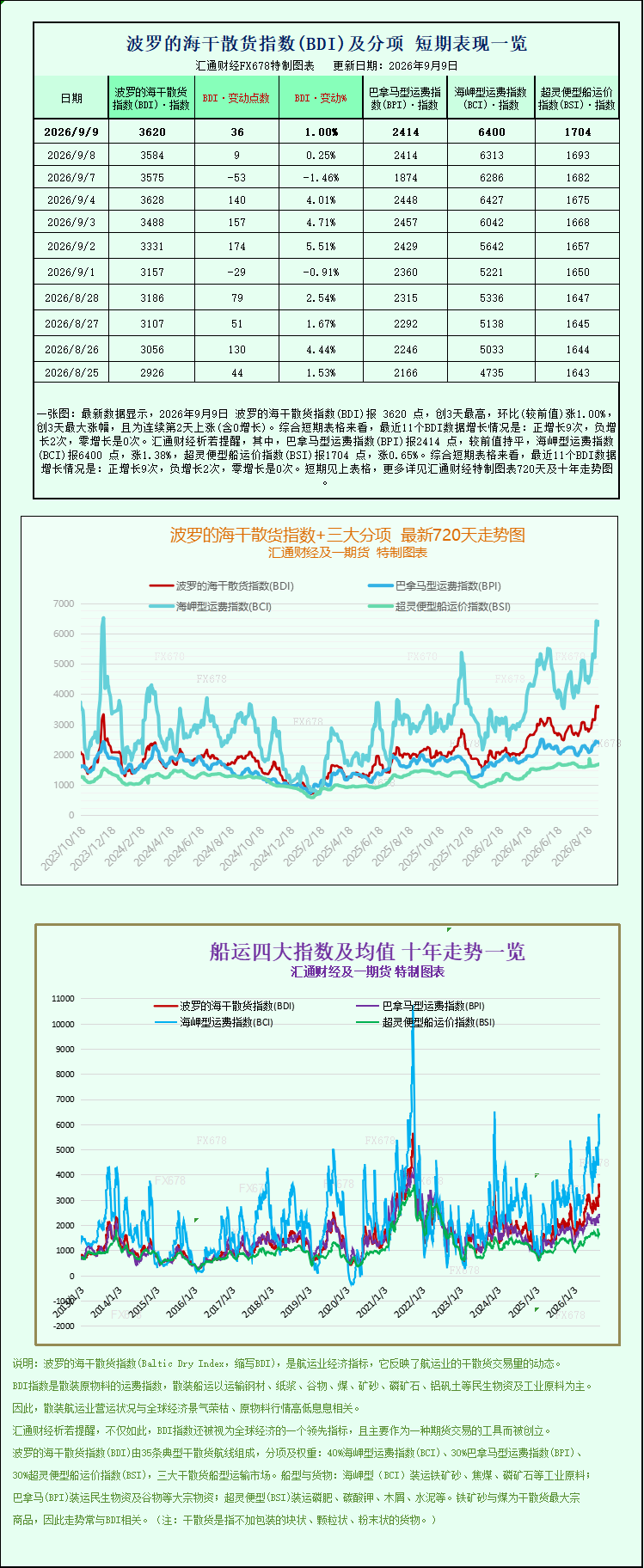 On Wednesday, the international shipping market saw a temporary recovery, with the Baltic Dry Index (BDI) showing a steady increase. The collective strengthening of freight rates across all vessel types was the core driving force behind this upward trend. As a key indicator of the global dry bulk shipping market, the Baltic Dry Index (BDI) tracks ocean freight rates for bulk commodities such as iron ore, coal, grain, and minerals in real time. Its fluctuations directly reflect changes in global commodity trade activity, industrial production pace, and the global supply and demand pattern in maritime shipping, making it an important leading indicator for observing global economic and trade conditions. Data shows that the Baltic Dry Index, which covers the freight rates of the three major dry bulk vessel types—Capesize, Panamax, and Supramax—rose by 36 points, or 1%, to close at 3620 points, continuing the recent overall upward trend. Looking at the data for specific vessel types, freight rates for different tonnages showed significant divergence, with large ocean-going vessels leading the market in increases, while medium and small vessels saw steady growth, indicating a continued recovery in overall industry sentiment. Capesize vessels, the largest in size and primarily serving long-distance bulk mineral transportation, performed the best, becoming the core driver of the index's rise. The Capesize index surged 87 points, a 1.4% increase, closing at 6400 points, ranking first among the three major vessel types. On the revenue side, Capesize vessels mainly engaged in the ocean transport of 150,000-ton iron ore and thermal coal saw their average daily earnings increase by $788 compared to the previous period, reaching a daily revenue of $54,538. This round of Capesize freight rate increases was mainly due to faster overseas mine shipments, concentrated release of long-haul ocean transport demand, and increased global commodity restocking demand, leading to a supply shortage of large dry bulk carriers and consequently higher freight rates. It is worth noting that iron ore spot prices moved in the opposite direction to the strengthening shipping freight rates. After four consecutive days of increases, international iron ore prices experienced a correction on September 9th, indicating a shift in market sentiment. The core reason for this price decline stems from concerns about demand in the Chinese market. As the world's largest iron ore consumer, China's steel industry has been continuously adjusting its production pace. Currently, domestic steel companies are generally facing the dilemma of compressed profit margins. The recovery of steel demand from downstream construction and manufacturing industries is weaker than expected, putting downward pressure on steel prices. This forces steel companies to proactively conduct maintenance and reduce production, directly weakening the demand for iron ore. At the same time, the recent increase in iron ore imports has led to ample market supply. This loose supply and demand situation has further exacerbated the downward pressure on iron ore prices, resulting in a divergence between rising shipping freight rates and falling spot ore prices. The Panamax market, the main medium-sized vessel type, remained relatively stable, maintaining a high level of fluctuation. The Panamax index remained unchanged from the previous trading day, closing steadily at 2414 points, with the overall market showing little volatility. In terms of operating revenue, Panamax vessels, mainly engaged in the transportation of bulk commodities such as coal, grain, and fertilizer in the 60,000 to 70,000 ton range, saw a slight increase of $1 in daily revenue, recording $21,725. Panamax vessels are primarily suited for short-to-medium-haul ocean routes and regional food and energy trade. Recently, stable global food exports and robust demand for coal in the Asia-Pacific region have provided solid support for freight rates. However, there has been no significant increase in end-user trade demand, preventing a substantial rise in freight rates, which have remained generally stable. Small, flexible dry bulk carriers also saw steady increases. The Supramax index rose 11 points, or 0.7%, to close at 1704 points. These vessels are small in tonnage and flexible in their routes, suitable for short-haul, multi-category, and small-volume dry bulk cargo transportation, and widely serve regional building materials, food, and niche mineral trade. Recent increases in global regional trade activity and a recovery in short-haul shipping demand in Southeast Asia, the Middle East, and South America have driven steady growth in demand for smaller vessels, pushing freight rates slightly higher and completing the overall market recovery across all vessel types. In summary, the recent rise in the Baltic Dry Index is a result of the combined effects of a temporary tightening of global shipping capacity and a structural recovery in commodity trade. The current dry bulk shipping market exhibits a clear structural trend: large mining carriers benefited from a strong increase in overseas shipments, medium-sized trading vessels maintained stable operations, and small, flexible vessels steadily recovered, with freight rates across the entire sector rising in tandem to stabilize and rebound the index. Regarding future market trends, industry analysts believe the market will maintain a structurally differentiated pattern in the short term. On the one hand, the peak autumn shipping season for overseas mines is approaching, and long-haul iron ore and coal transportation demand is expected to continue to be released, supporting Capesize freight rates at high levels. On the other hand, the pace of production cuts in the domestic steel industry and the strength of the recovery in end-user demand will continue to affect iron ore trade and related shipping demand, becoming a key factor restricting a significant rise in the index. Meanwhile, the global autumn harvest transportation season is gradually approaching, and the concentrated release of subsequent grain transportation demand is expected to continue to benefit Panamax and Supramax freight rates, providing support for the index's subsequent trend. Overall, the Baltic Dry Index is likely to fluctuate with a slightly upward bias in the short term, and the phased recovery trend is expected to continue.
On Wednesday, the international shipping market saw a temporary recovery, with the Baltic Dry Index (BDI) showing a steady increase. The collective strengthening of freight rates across all vessel types was the core driving force behind this upward trend. As a key indicator of the global dry bulk shipping market, the Baltic Dry Index (BDI) tracks ocean freight rates for bulk commodities such as iron ore, coal, grain, and minerals in real time. Its fluctuations directly reflect changes in global commodity trade activity, industrial production pace, and the global supply and demand pattern in maritime shipping, making it an important leading indicator for observing global economic and trade conditions. Data shows that the Baltic Dry Index, which covers the freight rates of the three major dry bulk vessel types—Capesize, Panamax, and Supramax—rose by 36 points, or 1%, to close at 3620 points, continuing the recent overall upward trend. Looking at the data for specific vessel types, freight rates for different tonnages showed significant divergence, with large ocean-going vessels leading the market in increases, while medium and small vessels saw steady growth, indicating a continued recovery in overall industry sentiment. Capesize vessels, the largest in size and primarily serving long-distance bulk mineral transportation, performed the best, becoming the core driver of the index's rise. The Capesize index surged 87 points, a 1.4% increase, closing at 6400 points, ranking first among the three major vessel types. On the revenue side, Capesize vessels mainly engaged in the ocean transport of 150,000-ton iron ore and thermal coal saw their average daily earnings increase by $788 compared to the previous period, reaching a daily revenue of $54,538. This round of Capesize freight rate increases was mainly due to faster overseas mine shipments, concentrated release of long-haul ocean transport demand, and increased global commodity restocking demand, leading to a supply shortage of large dry bulk carriers and consequently higher freight rates. It is worth noting that iron ore spot prices moved in the opposite direction to the strengthening shipping freight rates. After four consecutive days of increases, international iron ore prices experienced a correction on September 9th, indicating a shift in market sentiment. The core reason for this price decline stems from concerns about demand in the Chinese market. As the world's largest iron ore consumer, China's steel industry has been continuously adjusting its production pace. Currently, domestic steel companies are generally facing the dilemma of compressed profit margins. The recovery of steel demand from downstream construction and manufacturing industries is weaker than expected, putting downward pressure on steel prices. This forces steel companies to proactively conduct maintenance and reduce production, directly weakening the demand for iron ore. At the same time, the recent increase in iron ore imports has led to ample market supply. This loose supply and demand situation has further exacerbated the downward pressure on iron ore prices, resulting in a divergence between rising shipping freight rates and falling spot ore prices. The Panamax market, the main medium-sized vessel type, remained relatively stable, maintaining a high level of fluctuation. The Panamax index remained unchanged from the previous trading day, closing steadily at 2414 points, with the overall market showing little volatility. In terms of operating revenue, Panamax vessels, mainly engaged in the transportation of bulk commodities such as coal, grain, and fertilizer in the 60,000 to 70,000 ton range, saw a slight increase of $1 in daily revenue, recording $21,725. Panamax vessels are primarily suited for short-to-medium-haul ocean routes and regional food and energy trade. Recently, stable global food exports and robust demand for coal in the Asia-Pacific region have provided solid support for freight rates. However, there has been no significant increase in end-user trade demand, preventing a substantial rise in freight rates, which have remained generally stable. Small, flexible dry bulk carriers also saw steady increases. The Supramax index rose 11 points, or 0.7%, to close at 1704 points. These vessels are small in tonnage and flexible in their routes, suitable for short-haul, multi-category, and small-volume dry bulk cargo transportation, and widely serve regional building materials, food, and niche mineral trade. Recent increases in global regional trade activity and a recovery in short-haul shipping demand in Southeast Asia, the Middle East, and South America have driven steady growth in demand for smaller vessels, pushing freight rates slightly higher and completing the overall market recovery across all vessel types. In summary, the recent rise in the Baltic Dry Index is a result of the combined effects of a temporary tightening of global shipping capacity and a structural recovery in commodity trade. The current dry bulk shipping market exhibits a clear structural trend: large mining carriers benefited from a strong increase in overseas shipments, medium-sized trading vessels maintained stable operations, and small, flexible vessels steadily recovered, with freight rates across the entire sector rising in tandem to stabilize and rebound the index. Regarding future market trends, industry analysts believe the market will maintain a structurally differentiated pattern in the short term. On the one hand, the peak autumn shipping season for overseas mines is approaching, and long-haul iron ore and coal transportation demand is expected to continue to be released, supporting Capesize freight rates at high levels. On the other hand, the pace of production cuts in the domestic steel industry and the strength of the recovery in end-user demand will continue to affect iron ore trade and related shipping demand, becoming a key factor restricting a significant rise in the index. Meanwhile, the global autumn harvest transportation season is gradually approaching, and the concentrated release of subsequent grain transportation demand is expected to continue to benefit Panamax and Supramax freight rates, providing support for the index's subsequent trend. Overall, the Baltic Dry Index is likely to fluctuate with a slightly upward bias in the short term, and the phased recovery trend is expected to continue.
- Risk Warning and Disclaimer
- The market involves risk, and trading may not be suitable for all investors. This article is for reference only and does not constitute personal investment advice, nor does it take into account certain users’ specific investment objectives, financial situation, or other needs. Any investment decisions made based on this information are at your own risk.