The euro has been pushed up to 1.16, but I still haven't received the new script.
2026-09-09 21:58:08
On Wednesday, September 9th, the euro was trading around 1.1650 against the US dollar, up about 0.20% on the day. The US dollar index fell back to around 98.70, close to its lowest level since August 21st, while the dollar fell against the yen to around 153.30, down about 4% this month. The market has temporarily handed pricing power to cross-asset correlations: the sharp rise in the yen has pressured the dollar basket, forcing the euro to rise passively; however, with the ECB decision on Thursday, the US producer price index on the same day, and the consumer price index on Friday all following, traders have not yet considered the short-term rebound a trend consensus. The Middle East conflict has entered its seventh month, with US crude oil rising to around $95.7 per barrel and Brent crude oil surpassing $100 per barrel. The energy premium continues to reshape the inflation path and interest rate expectations in Europe and the US. 
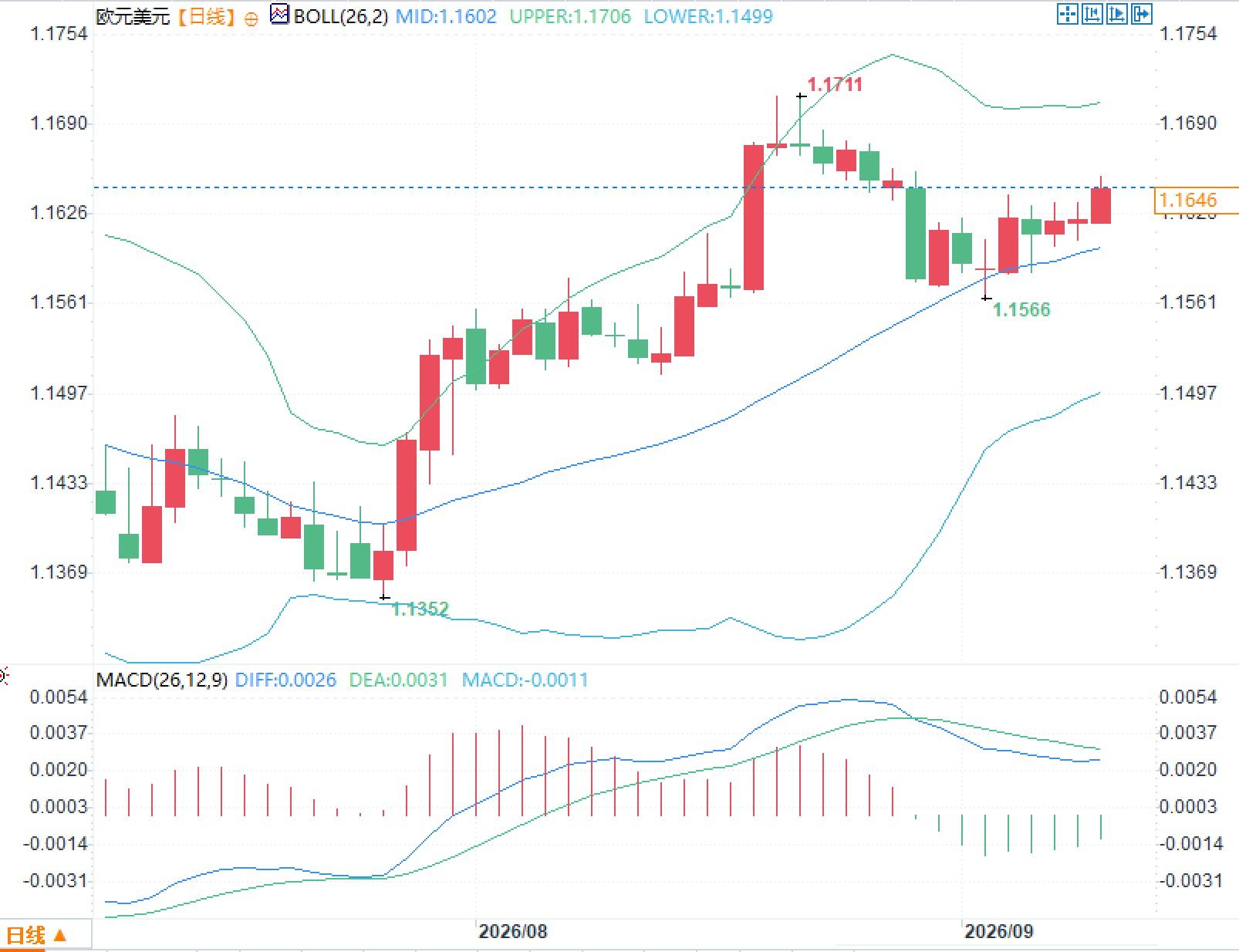
The ECB's interest rate hike has already been priced in; Lagarde's press conference is the real source of volatility.
The market has almost fully priced in the European Central Bank's (ECB) 25 basis point increase in the deposit facility rate to 2.50% on Thursday. This could be the second rate hike this year: it was raised from 2.00% to 2.25% in June, and remained unchanged in July. With futures implied probabilities nearing certainty, the marginal information from the decision text itself is limited. What will truly reshape the forward curve is ECB President Christine Lagarde's press conference. Following the July meeting, Lagarde clearly stated that the full impact of the energy shock had not yet materialized, and revealed that some Governing Council members had discussed whether to raise rates immediately, but ultimately the Council chose to wait for more data. After the June rate hike, she refuted the notion that the action was simply an "insurance" rate hike, emphasizing that at the time, they faced the prospect of simultaneous upward revisions in both headline and core inflation. These statements shift the focus of the September meeting from whether to raise rates to whether the option of further action would remain after the initial hike. Nomura's latest assessment aligns with market consensus: they anticipate no further clear path for rate hikes after Thursday's increase, but emphasize that the risks are clearly skewed towards continued rate increases due to ongoing tensions in the Middle East. The team also states that they do not foresee ECB rate cuts in the coming years. The key information lies not in the specific rate points, but in the term structure: if Lagarde emphasizes meeting-by-meeting, data-dependent approaches, and no pre-defined path, the pricing of future rate hikes may be compressed; if she lists the energy second-round effect alongside wages and service prices, a premium will still be maintained at the far end of the yield curve.Energy premiums are reshaping the inflation structure; nominal and core inflation have diverged.
The Eurozone's harmonized index of consumer prices (HICP) rose to 3.3% year-on-year in August, up from 2.9% in July, reaching a near three-year high. The energy component rose approximately 14.3% year-on-year, a significant acceleration from 10.3% in July; the core component, excluding energy and food, fell to 2.4% year-on-year, while services prices rose approximately 3.0%. Nominal inflation is being propped up by oil prices, while core and services inflation have not accelerated in tandem, making this the most difficult segment to address in policy communication. US crude oil is currently trading at around $95.7 per barrel, continuing to rise from the beginning of the month; Brent crude is approaching $100 per barrel. The ongoing conflict continues to push up shipping risk premiums, and the transmission lag from energy to food, goods, and services is uneven. For the ECB, if only core inflation is considered, the urgency of raising interest rates is weaker than the nominal reading; if only energy inflation is considered, a rate hike might be interpreted by the market as an overreaction to supply shocks. Therefore, the key words at the press conference will focus on the second-round effect, anchoring inflation expectations, and whether the medium-term target can be returned to 2%, rather than announcing the complete path all at once. The US is similarly tied to oil prices. The 10-year Treasury yield is hovering around 4.80%, near its highest level since November 2023. This rise in yields reflects a persistent inflation premium, rather than a one-sided reinforcement of the growth narrative. Federal Reserve officials have repeatedly emphasized the need to bring inflation back to the 2% target, and high oil prices make this constraint difficult to offset by short-term fluctuations in the labor market.In the data window preceding the Fed decision, interest rate expectations are still undergoing two-way adjustments.
Federal funds futures indicate a near 60% probability of a 25 basis point rate hike at the September 15-16 meeting, with the target range revised upward from 3.50%-3.75% to 3.75%-4.00%. August non-farm payrolls increased by 162,000, and the unemployment rate remained at 4.1%, indicating no immediate need for easing in the labor market. Therefore, the Fed can focus more on inflation. Key observation windows are the Producer Price Index (PPI) on Thursday and the Consumer Price Index (CPI) on Friday. The market consensus for August's overall US CPI year-on-year growth is around 3.4%, with core growth potentially declining slightly from 2.5%. The PPI is seen as a leading indicator of pipeline pressure. A strong reading would further increase the probability of a September rate hike; a weak reading could reduce the probability to around 50/50. High oil prices make both scenarios impossible to eliminate in advance. The euro/dollar exchange rate is therefore under double constraints: the ECB rate hike is already priced in, US inflation has not yet materialized, and a weaker dollar index only provides short-term room for maneuver, not a policy conclusion. A cross-market comparison reveals that the simultaneous existence of a appreciating yen, high US Treasury yields, and rising crude oil prices indicates a redistribution of funds among interest rates, energy, and safe-haven assets, rather than trend trading in a single currency. This week, the key focus should be on the density of Lagarde's statements regarding the options for future rate hikes, and the breakdown of the contributions of energy, core commodities, and housing to US inflation, rather than interpreting intraday fluctuations around 1.1650 as a directional decision.Frequently Asked Questions
Question 1: Does the rise in the euro against the dollar equate to a sudden strengthening of the Eurozone's fundamentals? Answer: Not at all. The current rise is mainly due to the repricing of cross-currency pairs resulting from the decline in the dollar index and the sharp rise in the yen. Eurozone overall inflation rose to 3.3% in August, while core inflation fell to 2.4%, with growth roughly in line with potential levels. There was no demand expansion sufficient to independently drive the exchange rate. The price increase reflects a change in the denominator, not a rewriting of the numerator narrative. Question 2: The ECB is almost certain to raise interest rates by 25 basis points. Why does the market still view Thursday as a risk event? Answer: The rate hike itself has already been fully priced in by interest rate futures; volatility will come from the press conference. If Lagarde emphasizes that the energy shock has not yet fully materialized and that policy will still be decided at each meeting, the pricing of future rate hikes will resume; if this action is described as a limited response to realized inflation, the premium at the far end of the curve may converge. The amount of information conveyed by the decision figures and the tone of the communication is not equivalent. Question 3: With oil prices reaching $100/barrel, why are interest rate expectations in Europe and the US not locked in the same direction? Answer: Energy is driving up nominal inflation, but the core paths are not synchronized. The core Eurozone rate has declined, while the core US rate remains close to 2.4% to 2.5%, and the labor market and neutral interest rate estimates differ between the two regions. Oil prices have increased the risk of an upper limit on rate hikes, but have not eliminated data dependence. Therefore, interest rate expectations in Europe and the US can be simultaneously pushed up by energy premiums and pulled back by core components, resulting in parallel corrections rather than a single-direction lock-in.- Risk Warning and Disclaimer
- The market involves risk, and trading may not be suitable for all investors. This article is for reference only and does not constitute personal investment advice, nor does it take into account certain users’ specific investment objectives, financial situation, or other needs. Any investment decisions made based on this information are at your own risk.