September 10th Financial Breakfast: US Treasury Secretary caps debt buybacks at $6 billion; gold prices linger around $4400, awaiting inflationary judgment; Brent crude oil returns to $100, stirring risk sentiment.
2026-09-10 07:28:06
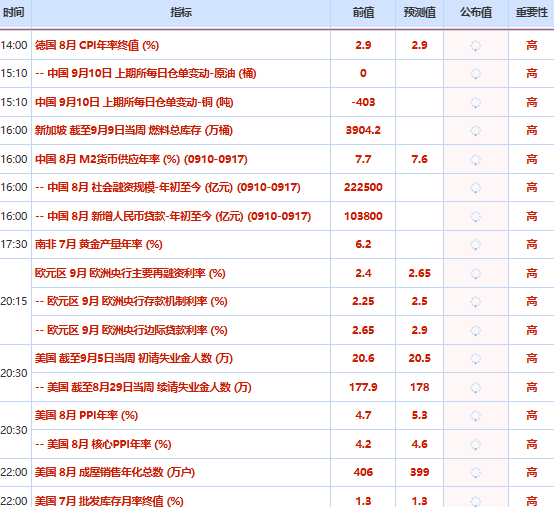
On Thursday (September 10, Beijing time) in early Asian trading, spot gold was trading around $4,400.52 per ounce. Gold prices were pressured by the continued weakness of the US dollar, hovering near a two-week low, and investors were awaiting US PPI data on Thursday and CPI data on Friday to assess the Federal Reserve's policy path. Oil prices rose on Wednesday as Brent crude climbed above $100, reflecting a shift in market expectations that the conflict would remain at a low intensity. 
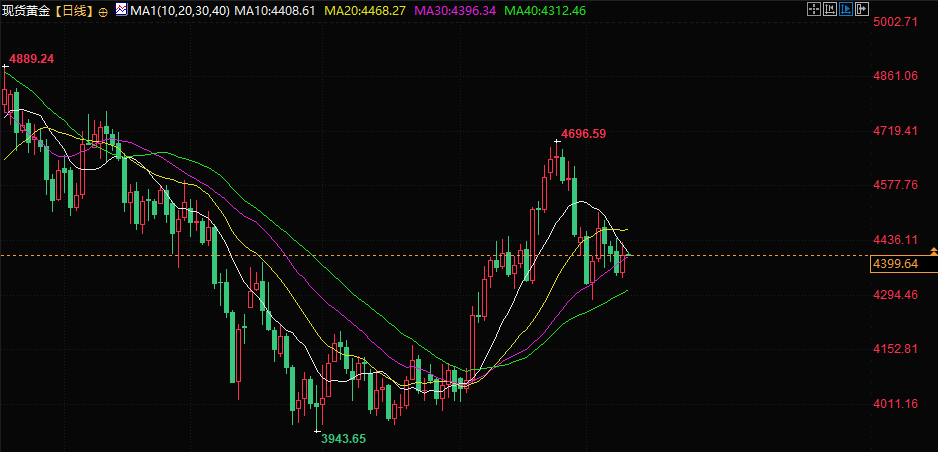 StoneX analysts pointed out that the inflationary pressures from the current oil price surge and the resulting disruptions to the freight supply chain are pushing up bond yields, as current monetary policy focuses more on curbing inflation. Although the benchmark 10-year US Treasury yield briefly touched its highest level since November 2023 before retreating, the market still expects a roughly 60% probability of a Fed rate hike next week. Other precious metals also rose, with spot silver up 2.33% to $67.26 per ounce, platinum surging 5.1% to $1,906.20, and palladium rising 1.2% to $1,365.50. However, the World Platinum Investment Council (WPIC) stated that due to weak investment and jewelry demand, the global platinum market will turn into a supply surplus for the first time since 2022 this year.
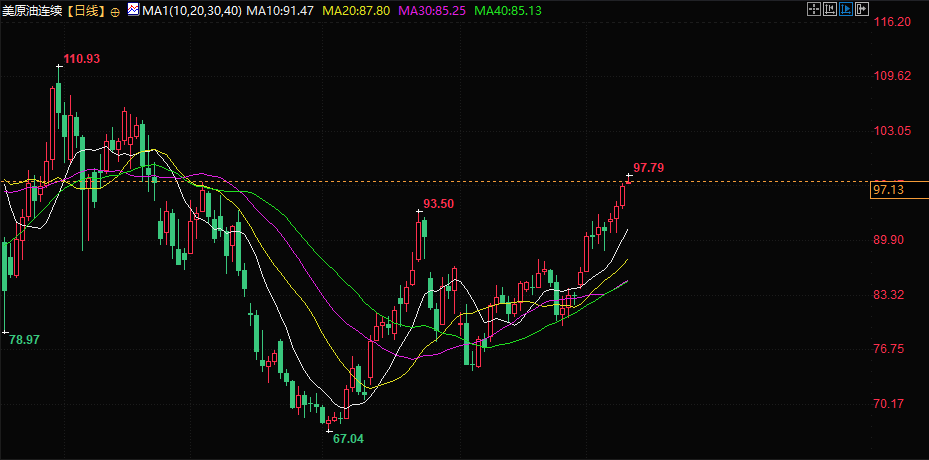 Amid concerns about potential disruptions to Middle Eastern energy supplies stemming from the escalating tensions between Iran and the United States over tanker attacks (Iran attacked 10 ships near the Strait of Hormuz, and the US sank five Iranian tankers), the head of commodities strategy at Saxo Bank pointed out that the market needs to reassess the duration of the crisis and supply constraints. The physical market has already reflected the tense reality; Brent crude, the global pricing benchmark, has been above $100 since September 3rd, and refined product prices have remained above $100 for an extended period. Currently, the average price of gasoline in the US is around $4.22 per gallon, and diesel is approaching $6 per gallon. Meanwhile, shipping volume in the Strait of Hormuz is significantly lower than pre-war peaks, with only six commodity carriers passing through on Tuesday (down from the 10-day average of about 12). As a result, the EIA has raised its oil price forecasts for this year and next, citing the rapid decline in global oil inventories due to supply disruptions in the Middle East.
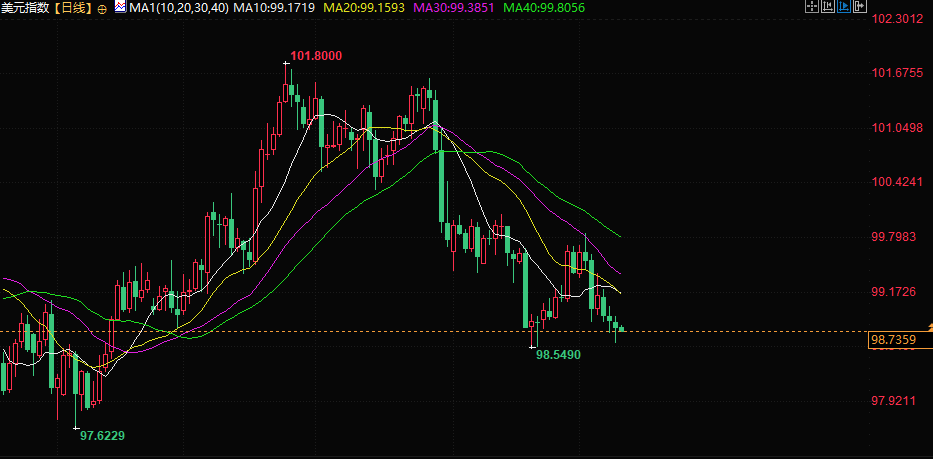 Convera strategists pointed out that the US policy premium limited the dollar's rise while the yen strengthened with Treasury support. However, oil prices and interest rate expectations were temporarily decoupled, and the dollar narrowed its losses after the US Treasury announced it would triple the size of its long-term bond repurchase program (up to $6 billion). The yen has risen about 4% this month, strengthening not only against the dollar but also against the euro, pound, and carry trade currencies. The market widely expects the Bank of Japan to raise interest rates by 25 basis points next week, coupled with US Treasury Secretary Bessenter's warning against betting on a yen depreciation (his stance has shifted from explicitly ruling out intervention in January), which together supported the yen. The euro edged up 0.05% against the dollar to 1.1628, nearing a two-week high (markets expect the ECB to raise rates on Thursday), while the pound rose 0.04% to 1.3542. The Canadian dollar was only slightly affected by the escalating US-Canada trade conflict, falling just 0.18% to 1.3808. Market focus remains on Friday's US inflation data and next week's Federal Reserve and Bank of Japan decisions, with a strong US jobs report reigniting expectations of a Fed rate hike next week (probability of about 60%).
Key Focus Today
stock market
U.S. stocks closed lower on Wednesday, with the S&P 500 falling 0.48% to 7,636.46, the Nasdaq down 0.64% to 26,253.34, and the Dow Jones Industrial Average declining 0.77% to 52,381.02. Brent crude oil broke through the sensitive $100 per barrel mark due to global supply concerns and tensions in the Middle East, exacerbating inflationary pressures. Except for the energy sector, which rose 1.1%, all other sector indices closed lower. Meanwhile, the U.S. Treasury announced a buyback of up to $6 billion in long-term Treasury bonds (less than the $8 billion to $10 billion expected by some analysts), pushing the 10-year Treasury yield to its highest level since November 2023, reducing the attractiveness of stocks. In individual stocks, Apple fell 0.3% after its new CEO Tenus's first phone launch event, while Meta surged over 6% after unveiling an AI assistant capable of autonomously sending emails, selling cars, or booking trips, limiting the S&P 500's decline. Alphabet, Google's parent company, fell 2.3% after announcing at least $15.1 billion in AI infrastructure investment in Finland over the next two years (including a nuclear power supply agreement). Dow Chemical's stock fell 0.6% after news that it was considering withdrawing from its $20 billion partnership with Saudi Aramco. The Philadelphia Semiconductor Index rose slightly by 0.37%, benefiting from AMD's 3% gain. Trading volume was relatively light, with a total of 14.7 billion shares traded, slightly below the 20-day average of 14.9 billion shares. Investors are awaiting Thursday's PPI and Friday's CPI data to determine the Fed's interest rate path; traders are currently betting on a 60% probability of a rate hike next week.Gold Market
Spot gold rose more than 1% on Wednesday, closing at $4,401.73 per ounce, influenced by the continued pressure on the dollar hovering at a two-week low, the escalation of the Middle East war causing Brent crude to break through $100 per barrel for the first time since July 24, and investors awaiting US PPI data on Thursday and CPI data on Friday to assess the Federal Reserve's policy path. StoneX analysts pointed out that the inflationary pressures from the current oil price surge and the resulting disruptions to the freight supply chain are pushing up bond yields, as current monetary policy focuses more on curbing inflation. Although the benchmark 10-year US Treasury yield briefly touched its highest level since November 2023 before retreating, the market still expects a roughly 60% probability of a Fed rate hike next week. Other precious metals also rose, with spot silver up 2.33% to $67.26 per ounce, platinum surging 5.1% to $1,906.20, and palladium rising 1.2% to $1,365.50. However, the World Platinum Investment Council (WPIC) stated that due to weak investment and jewelry demand, the global platinum market will turn into a supply surplus for the first time since 2022 this year.oil market
Oil prices surged on Wednesday, with Brent crude rising 2.3% to settle at $101.59 a barrel and WTI crude rising 2.57% to settle at $96.67 a barrel, both marking their highest closing levels since May 22, signaling a shift in market expectations that the conflict would remain at a low intensity. Amid concerns about potential disruptions to Middle Eastern energy supplies stemming from the escalating tensions between Iran and the United States over tanker attacks (Iran attacked 10 ships near the Strait of Hormuz, and the US sank five Iranian tankers), the head of commodities strategy at Saxo Bank pointed out that the market needs to reassess the duration of the crisis and supply constraints. The physical market has already reflected the tense reality; Brent crude, the global pricing benchmark, has been above $100 since September 3rd, and refined product prices have remained above $100 for an extended period. Currently, the average price of gasoline in the US is around $4.22 per gallon, and diesel is approaching $6 per gallon. Meanwhile, shipping volume in the Strait of Hormuz is significantly lower than pre-war peaks, with only six commodity carriers passing through on Tuesday (down from the 10-day average of about 12). As a result, the EIA has raised its oil price forecasts for this year and next, citing the rapid decline in global oil inventories due to supply disruptions in the Middle East.Foreign exchange market
The dollar index was flat around 98.80 on Wednesday, influenced by the escalating conflict in the Middle East pushing Brent crude oil above $100 a barrel and market positioning for next week's Federal Reserve and Bank of Japan policy meetings. The dollar traded near a seven-month low against the yen on Wednesday, falling 0.3% to close at 153.51 yen, not far from Tuesday's low of 152.89. Convera strategists pointed out that the US policy premium limited the dollar's rise while the yen strengthened with Treasury support. However, oil prices and interest rate expectations were temporarily decoupled, and the dollar narrowed its losses after the US Treasury announced it would triple the size of its long-term bond repurchase program (up to $6 billion). The yen has risen about 4% this month, strengthening not only against the dollar but also against the euro, pound, and carry trade currencies. The market widely expects the Bank of Japan to raise interest rates by 25 basis points next week, coupled with US Treasury Secretary Bessenter's warning against betting on a yen depreciation (his stance has shifted from explicitly ruling out intervention in January), which together supported the yen. The euro edged up 0.05% against the dollar to 1.1628, nearing a two-week high (markets expect the ECB to raise rates on Thursday), while the pound rose 0.04% to 1.3542. The Canadian dollar was only slightly affected by the escalating US-Canada trade conflict, falling just 0.18% to 1.3808. Market focus remains on Friday's US inflation data and next week's Federal Reserve and Bank of Japan decisions, with a strong US jobs report reigniting expectations of a Fed rate hike next week (probability of about 60%).International News
Iran Claims Strong Counterattack Capability and Lists Ceasefire Conditions On the 9th local time, CCTV reporters learned that Hossein Mohbi, spokesman for the Iranian Islamic Revolutionary Guard Corps, issued a statement warning that Iran now possesses a strong countermeasure and deterrent capability. If the enemy attacks two to three Iranian targets, Iran will retaliate with a forceful strike against 20 enemy targets. The spokesman emphasized that if the enemy wishes to end the current situation, the following conditions must be met: a complete cessation of military operations and abandonment of further threats; the withdrawal of Israeli troops from Lebanon; the lifting of the blockade against Yemen; the unfreezing of Iran's $24.4 billion in frozen assets; and an end to interference in Iran's nuclear capabilities and missile development programs. (CCTV News) US Treasury Announces $6 Billion Long-Term Bond Buyback Cap, Disappointment Looms Over Markets The US Treasury Department announced that, under the expanded Treasury bond buyback program, it will purchase up to $6 billion in long-term government bonds in its first operation. After Treasury Secretary Bessenter publicly stated that the buyback size could exceed $4 billion, some traders have raised their forecasts for Thursday's buyback operation. Bessant reiterated on Tuesday that while he cannot change the "equilibrium" price of U.S. Treasuries, his goal is to mitigate market volatility and prevent narratives that could potentially harm the U.S. Treasury market from gaining momentum. U.S. Treasuries continued their decline after the Treasury announced the size of its repurchase program. The 10-year yield rose 6 basis points to 4.85%. This market reaction suggests that some investors had expected a larger repurchase program. Guneet Dhingra, U.S. interest rate strategist at BNP Paribas, said before the announcement that a repurchase cap of $7 billion would be a surprise to the market, and any size below that could trigger selling pressure. The ultimate effectiveness of the expanded repurchase program remains to be seen. U.S. Treasury yields initially fell after the Treasury announced the expansion last month, but soon rebounded. The benchmark 10-year yield hit its highest level since 2023 last week. Iran condemns U.S. attack on Iranian ships, says it has retaliated. The Iranian Foreign Ministry issued a statement on the 9th condemning the U.S. attack on several Iranian ships on the 8th. In response, Iranian armed forces have launched attacks on U.S. military bases and ships. The statement claimed that the US attacks on Iranian vessels in the Persian Gulf and the Gulf of Oman were part of the US military action, maritime blockade, and economic warfare against Iran, violating the UN Charter and international law, escalating regional tensions, and threatening regional and international peace and security. The statement said that in response to the US attacks on Iranian vessels, the Iranian armed forces had struck US military bases and facilities in the region and carried out "defensive strikes" against several US vessels. The statement also said that the Iranian armed forces "will not hesitate" in exercising their legitimate right to self-defense and will resolutely respond to all military aggression by the enemy in an appropriate manner. The Iranian Foreign Ministry also urged the UN Security Council and the UN Secretary-General to take immediate action to stop the US military action against Iran, which blatantly undermines international peace and security. The US Central Command announced on social media on the 8th that the US destroyed five Iranian oil tankers that day after Iran attacked a US warship. The Iranian Islamic Revolutionary Guard Corps issued a statement on the 9th, stating that in response to the US strikes on Iranian oil tankers in the Persian Gulf, the Revolutionary Guard struck two US warships and eight oil tankers that day, and also struck 10 vessels that violated regulations. The U.S. Central Command subsequently denied on social media that its naval vessels had been attacked by Iran. (Xinhua) World Gold Council: European Gold ETFs See $7.9 Billion Inflow in August, a Record High for the Region The World Gold Council stated that European gold ETFs continued to contribute significantly to global capital inflows in August, with purchases reaching $7.9 billion, a record high for the region. In addition to various factors supporting North American gold demand, European investors continued to worry about fiscal sustainability and high sovereign financing costs. Against this backdrop, gold's value as a portfolio diversification tool and an alternative asset to sovereign debt remains a significant driver of demand. Continued strong buying following the July gold price rebound also indicates that investors increasingly view the summer gold price correction as an opportunity to rebuild strategic positions, rather than a window for selling. The UK ($4.4 billion) remained the main source of European capital inflows, marking its second-largest monthly net inflow in its history. France saw a record $1.5 billion in inflows that month, further reflecting the broad allocation demand from investors across Europe. The probability of a Federal Reserve rate hike in September is 60.2%, and the probability of at least one rate hike this year is 87.3%. According to CME's "FedWatch": the probability of the Fed keeping rates unchanged by September is 39.8%, and the probability of a cumulative 25 basis point rate hike is 60.2%. The probability of the Fed keeping rates unchanged by October is 28.3%, the probability of a cumulative 25 basis point rate hike is 54.3%, and the probability of a cumulative 50 basis point rate hike is 17.3%. The probability of the Fed keeping rates unchanged by December is 12.7%, and the probability of at least a 25 basis point rate hike is 87.3%.Domestic News
A groundbreaking breakthrough in "golden blood"! Recently, in the heart of the Taklamakan Desert, the Manshen 301-H4 ultra-deep well in the Hudson-Fuman oilfield successfully commenced production. Technicians extracted oil buried 8,000 meters underground. The oil, a honey-golden color, is a light crude oil, a premium raw material in petroleum refining. Internationally, wells exceeding 4,500 meters are generally considered deep wells, and those exceeding 6,000 meters are called ultra-deep wells. With the successful commissioning of the Manshen 301-H4 ultra-deep well, the Hudson-Fuman oilfield has now commissioned 25 ultra-deep wells this year, with newly built ultra-deep production capacity exceeding 300,000 tons. China National Petroleum Corporation (CNPC) is cultivating a new ultra-deep reserve area with reserves exceeding 100 million tons here, accelerating the deep exploration and development process in the Taklamakan Desert. (CCTV Finance)- Risk Warning and Disclaimer
- The market involves risk, and trading may not be suitable for all investors. This article is for reference only and does not constitute personal investment advice, nor does it take into account certain users’ specific investment objectives, financial situation, or other needs. Any investment decisions made based on this information are at your own risk.