Gold Trading Alert: Oil Prices Break $100, Dollar Under Pressure, Gold Prices Rebound 1%! PPI Data Released Tonight
2026-09-10 07:53:06
Global gold markets saw a significant rebound on Wednesday (September 9th), with spot gold surging to $4433.95 per ounce before closing at $4401.73, a daily gain of over 1%. December gold futures also closed at $4458.80, up approximately 0.5%. This rebound occurred amid a confluence of factors: continued pressure on the US dollar, escalating tensions in the Middle East pushing up oil prices, and the market's close attention to key inflation data this week. Investors are enjoying the short-term benefits of safe-haven demand and a weaker dollar, while simultaneously feeling apprehensive about the upcoming Producer Price Index (PPI) and Consumer Price Index (CPI) figures—data that will directly influence the probability of a rate hike at next week's Federal Reserve policy meeting, with current market expectations rising to around 60%. Gold is at a sensitive crossroads: geopolitical and energy shocks provide upward momentum, but potential tightening of monetary policy could pose a downside risk. The first test today will be the US PPI data. In early Asian trading on Thursday (September 10th), spot gold fluctuated slightly lower, currently trading around $4395 per ounce. 
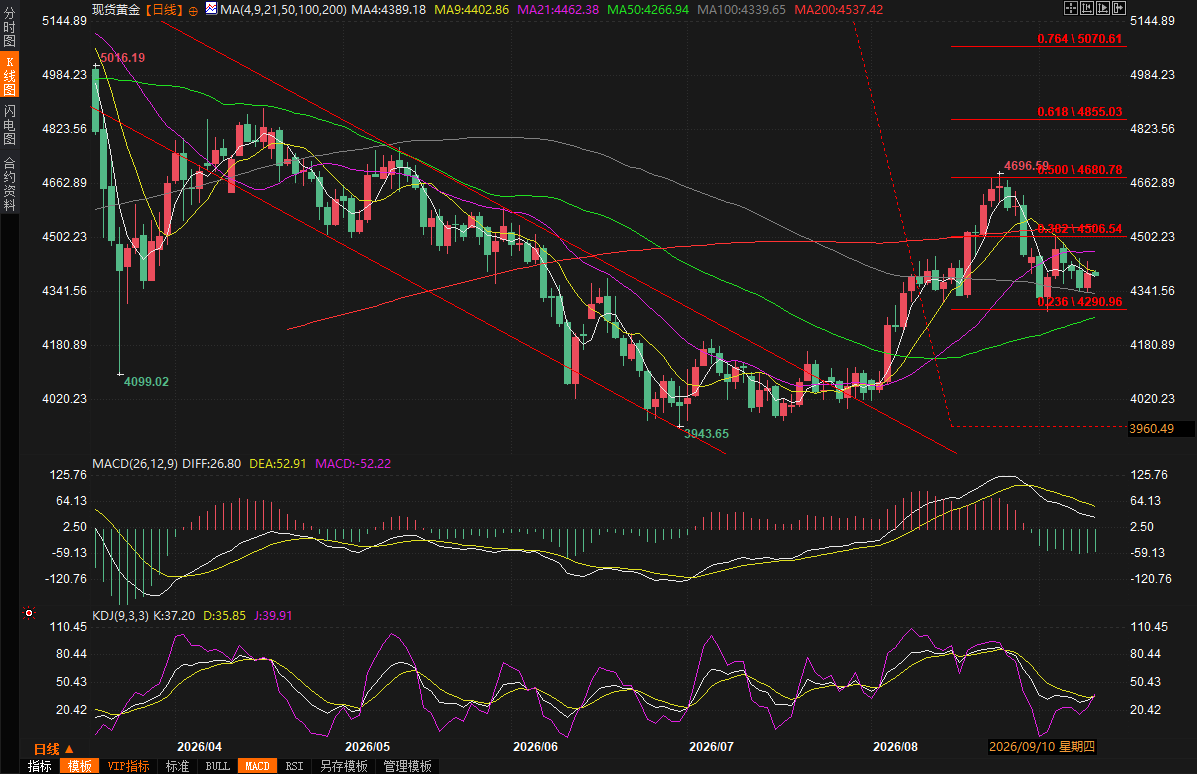 (Spot gold daily chart, source: EasyTrade) At 07:48 Beijing time, spot gold is currently trading at $4394.18 per ounce.
A weaker dollar and geopolitical premiums together supported gold prices.
The most direct support for this round of gold price increases comes from the weakness of the US dollar. The dollar index is hovering near its lowest level in nearly two weeks, making dollar-denominated gold more attractive to investors holding other currencies. David Meger, head of metals trading at High Ridge Futures, pointed out that the recent slight pressure on the dollar has created a somewhat favorable environment for the gold market. At the same time, the sudden escalation of the Middle East conflict has further strengthened gold's safe-haven appeal. The US and Iran engaged in their largest naval offensive in six months near the Strait of Hormuz. The Iranian Revolutionary Guard claimed to have attacked 10 ships, including two US vessels, while the US announced the destruction of five Iranian oil tankers and released videos of the ships catching fire and sinking. The conflict also spread to US military bases in Jordan, with Iran launching ballistic missiles, most of which were intercepted by Jordan. Simultaneously, fighting between Saudi Arabia and the Houthi rebels in Yemen has escalated, forming a second front. These events directly impact key global energy supply routes. Before the war, about one-fifth of the world's oil was transported through the Strait of Hormuz. Recently, oil shipments through the strait have fallen from 8-9 million barrels per day before the resumption of fighting to a low of about 2 million barrels per day. As a result, Brent crude oil broke through $100 per barrel for the first time since July 24, settling at $101.21, a rise of over 3%. The surge in oil prices, coupled with inflation expectations and supply chain disruptions, has in turn affected the bond market and the dollar's performance. Rhona O'Connell, head of market analysis at StoneX, observed that the freight and supply chain disruptions behind this oil price increase are pushing up bond yields because current monetary policy is more focused on curbing inflation than in the past. The yield on the 10-year US Treasury note briefly touched its highest level since November 2023 before falling back. Kevin Ford, a foreign exchange and macro strategist at Convera, pointed out that the US policy premium has limited the dollar's rise, while the yen has strengthened with the support of the US Treasury, creating a temporary disconnect between interest rate expectations and oil price movements. These factors combined have created a relatively favorable short-term environment for gold: a weakening dollar has reduced holding costs, and geopolitical uncertainty has increased demand for safe-haven assets.Inflation data and interest rate hike expectations constitute a potential hedging force.
However, the market is not entirely bullish. Investors are truly focused on the key US inflation data to be released this week—Thursday's Producer Price Index (PPI) and Friday's Consumer Price Index (CPI). These data will provide crucial clues as to whether the Federal Reserve will raise interest rates at its policy meeting on September 15-16. Last Friday's much stronger-than-expected August jobs data has reignited expectations of a rate hike, with federal funds futures indicating a roughly 60% probability of a rate hike next week. Oil prices breaking through $100 have further exacerbated these concerns. Rising fuel costs could be passed on to consumer prices, making inflation, already above the Fed's 2% target, even more stubborn. Lawrence Gillum, chief fixed-income strategist at LPL Financial, stated bluntly that the inflation situation is becoming more entrenched, which could prompt the Fed to raise rates. Meanwhile, the US Treasury announced on Thursday that it would expand its long-term Treasury repurchase program to a maximum of $6 billion, three times the previous amount. This news helped narrow the dollar's losses and partially alleviated upward pressure on yields. The 10-year Treasury bond was successfully issued at a winning bid rate of 4.834%, with demand being the strongest since 2019, pushing yields back from intraday highs. This complex tug-of-war makes gold's price movement highly volatile. On the one hand, if inflation data continues to be high, the market may further strengthen expectations of interest rate hikes, thus putting downward pressure on gold, a non-interest-bearing asset; on the other hand, if the data is moderate, or if the Middle East conflict leads to wider supply chain disruptions and increased risk aversion, gold is expected to continue its upward trend. OCBC strategists also emphasized that the latest escalation in the Middle East situation means that the impact of rising energy prices on Federal Reserve policy remains a market focus.Concerns and opportunities coexist on both the supply and demand sides.
From a longer-term perspective, gold's fundamentals remain supported by multiple factors. Geopolitical risk premiums are unlikely to dissipate quickly in the short term, especially given Iran's threat to declare a wider maritime no-navigation zone, extending to the port of Chabahar near Pakistan, and the surge in refined oil prices even exceeding that of crude oil itself—US diesel retail prices have reached a record high, exceeding $5.94 per gallon. These factors will continue to push up global inflation expectations, indirectly benefiting gold. Meanwhile, the market is also observing the movements of other precious metals. The World Platinum Investment Council points out that the platinum market will experience its first annual supply surplus since 2022 this year, contrasting with gold and highlighting the different sensitivities of different metals to the macroeconomic environment. For gold, the current environment is more demand-driven: central bank gold purchases, investor hedging, and the relatively declining attractiveness of dollar assets are all providing bottom support.Market Outlook
In summary, Wednesday's gold price increase was a result of the combined effects of a weakening dollar and the Middle East conflict, rather than being driven by a single factor. Oil prices breaking through the $100 mark brought both inflationary pressure and amplified safe-haven demand; this week's inflation data will be a litmus test for short-term direction. If the data strengthens expectations of interest rate hikes, gold prices may face a pullback; if the conflict escalates further or inflation is temporarily under control, gold is expected to move to higher levels. Overall, gold prices are fluctuating between the 100-day moving average of $4342 and the 200-day moving average of $4537. Close attention needs to be paid to data releases before Friday and any new developments in the Middle East situation. In the short term, the resistance level near the 21-day moving average of $4462 should also be noted. (Spot gold daily chart, source: EasyTrade) At 07:48 Beijing time, spot gold is currently trading at $4394.18 per ounce.
- Risk Warning and Disclaimer
- The market involves risk, and trading may not be suitable for all investors. This article is for reference only and does not constitute personal investment advice, nor does it take into account certain users’ specific investment objectives, financial situation, or other needs. Any investment decisions made based on this information are at your own risk.