Even with the Gulf bypass pipeline increasing its capacity to 6.8 million barrels per day, it's not enough to alleviate the immediate crisis; HSBC says balance won't be achieved until mid-2027.
2026-09-10 08:38:08
Brent crude futures opened higher in Asian trading on Thursday (September 10), briefly touching $101.91 per barrel, close to the $101.97 per barrel reached on July 23. HSBC warned in its latest research report that continued disruptions to shipping in the Strait of Hormuz and the fragile standoff between the US and Iran are keeping the oil market in a "tighter and longer" state. If diplomatic efforts completely fail, Brent crude prices could climb further to $120 per barrel. 
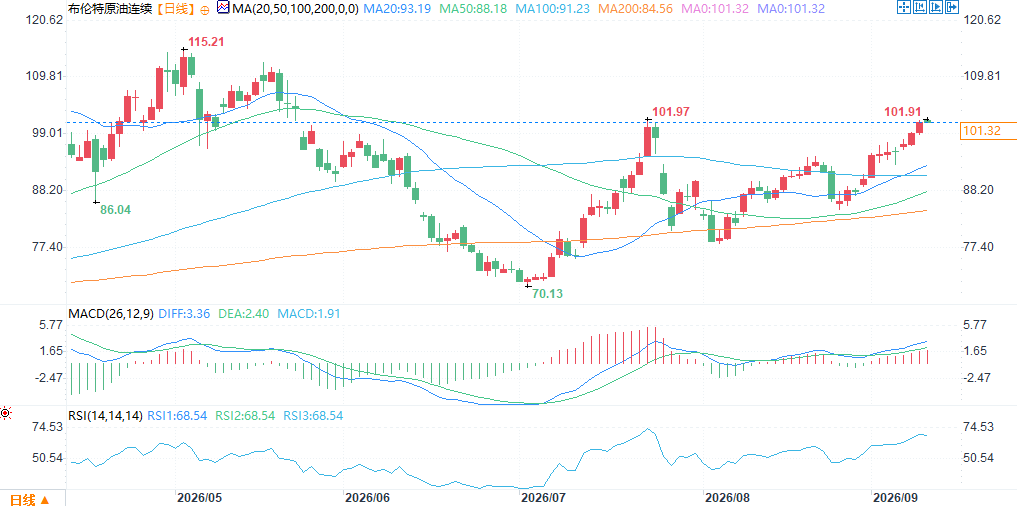 (Brent crude oil futures daily chart, source: EasyTrade) At 8:26 Beijing time, Brent crude oil futures were trading at $101.30 per barrel.
The "new normal" in Hormuz: a 30% traffic flow rate, far lower than the pre-conflict 20 million barrels per day.
HSBC's senior global oil and gas analyst team points out that since the breakdown of the US-Iran memorandum of understanding in July, traffic in the Strait of Hormuz has stabilized at around 30% of pre-conflict levels—despite significant daily fluctuations. HSBC characterizes the current situation as "continuously damaged" rather than a complete closure or full reopening. This ambiguous state of "incomplete disruption, incomplete recovery" is precisely the most difficult environment for the market to price—it cannot completely eliminate risk premiums, nor can it sustain panic buying. HSBC believes this situation may persist for longer because neither side currently has a sufficient incentive to reach a lasting agreement, and the inertia of military standoffs is far easier to maintain than diplomatic breakthroughs. In HSBC's baseline scenario, a fragile understanding is maintained between the US and Iran—both sides avoid full-scale war but are unable to reach an enforceable long-term agreement. This arrangement is highly susceptible to repeated breakdowns, and uncertainties regarding security, governance, and insurance will persist. Specifically, HSBC expects Hormuz liquid throughput to gradually recover from the current approximately 6 million barrels per day (bpd) to 8 million bpd by the end of 2026, and then to 9.5 million bpd by mid-2027. Even so, the 9.5 million bpd level is still far below the pre-conflict throughput of 19-20 million bpd. This means that the global oil market will face a persistent structural supply gap over the next 18 months, and the rate of inventory depletion may exceed most traders' expectations. This recovery rate assumption is more conservative than the market's previous mainstream expectations. HSBC believes that even in the most optimistic scenario, Hormuz throughput capacity cannot recover to pre-conflict levels in the short term—infrastructure inspections, crew return, insurance market recovery, and the rebuilding of shipping company confidence will all take longer than the market expects. And every new military clash will reset this recovery process to zero. For traders, this means that the "Hormuz risk premium" will no longer be a short-term, impulsive pricing variable, but will become a structural component embedded in the forward curve.The bypass pipeline partially mitigated the impact, but it's a long-term solution that can't address the immediate problem.
Existing and under-construction pipelines in Saudi Arabia and the UAE are playing an increasingly important bypass role. HSBC's baseline scenario shows that bypass traffic will increase from slightly over 4 million barrels per day currently to 6.8 million barrels per day by mid-2027, bringing total Gulf exports to approximately 16.5 million barrels per day. However, even with the increase from bypass pipelines, HSBC does not believe the market will return to balance by mid-2027 – implying continued inventory depletion in the coming quarters. Meanwhile, the bank also highlighted factors supporting refining margins: limited Gulf refined product exports, depleted inventories, high freight and insurance costs, supply disruptions related to Russia, and limited spare refining capacity. HSBC has therefore raised its refining margin assumptions for 2026-2028.Three scenarios: $90 benchmark vs. $120 stalemate vs. $70 recovery
HSBC also listed two alternative scenarios, with the price differences between the three scenarios being extremely large, fully illustrating the current oil price structure's high dependence on the direction of the US-Iran standoff: Baseline Scenario (probability unclear): Average price of $90/barrel in 2026 and $85/barrel in 2027. Assuming a fragile understanding between the US and Iran, and a gradual but slow recovery in the Strait of Hormuz. Stalemate Scenario: If diplomatic efforts completely fail, Hormuz flows will remain near current low levels, inventories will be depleted to operational lows, and Brent crude prices may climb to around $120/barrel before falling back in the third quarter of 2027 due to demand destruction and accelerated non-OPEC supply. Recovery Scenario: If a lasting ceasefire agreement is reached in the fourth quarter of this year, total Gulf exports could recover to pre-conflict levels, the market is expected to rebalance by the end of the year, and turn into a supply surplus of more than 3 million barrels per day in 2027. Brent crude prices may fall to the $70/barrel range in the first quarter of 2028.Echoing Trump's remarks: Oil prices unlikely to fall before the midterm elections
It is noteworthy that Trump's remarks on oil prices echoed HSBC's assessment. Trump previously stated that oil prices would not fall before the midterm elections, suggesting that geopolitical factors would continue to support energy prices. This statement aligns with HSBC's assessment that the oil market is "tighter and longer."Summarize
HSBC's upward revision of its oil price forecast can be summarized by four main factors: a structural decline in traffic volume around the Strait of Hormuz, limited short-term bypass capacity, continued inventory depletion, and persistently high refining margins, all contributing to a tighter and longer-lasting oil price environment. Three scenario analyses indicate that Brent crude oil could be priced between $70 and $120 per barrel, a range of $50, reflecting the high degree of uncertainty surrounding the US-Iran standoff. Until the situation becomes clearer, the market will continue to price in geopolitical headlines; while the baseline forecast of $90 per barrel has been revised upwards, it still faces significant risks of adjustment in both directions. (Brent crude oil futures daily chart, source: EasyTrade) At 8:26 Beijing time, Brent crude oil futures were trading at $101.30 per barrel.
- Risk Warning and Disclaimer
- The market involves risk, and trading may not be suitable for all investors. This article is for reference only and does not constitute personal investment advice, nor does it take into account certain users’ specific investment objectives, financial situation, or other needs. Any investment decisions made based on this information are at your own risk.