Crude oil trading alert: Middle East supply risks continue to escalate, with oil prices aiming for the $100 mark?
2026-09-10 09:24:11
WTI crude oil continued its upward trend in Asian trading on Thursday, rising to around $96.64, extending its recent strong upward momentum. WTI had previously broken through $90 and quickly advanced towards $95, and this latest rise indicates that the market is further digesting the risk of supply disruptions in the Middle East. International benchmark Brent crude had previously broken through $100 again. The simultaneous strength of WTI and Brent shows that the core factor driving oil prices higher is still supply-side risk, rather than simply short-term speculative trading.  The situation in the Middle East has recently escalated significantly again, with the conflict extending beyond localized military operations to impact energy transportation and infrastructure security. The confrontation between the US and Iran over maritime transport and energy supplies has intensified, reigniting market concerns about the navigability of the Strait of Hormuz. As the region plays a crucial role in global energy transportation, any sustained disruption could rapidly alter the global oil supply and demand balance. The market's primary concern is no longer short-term shutdowns of individual oil fields or facilities, but rather systemic disruptions to the supply chain. Recent industry data indicates that Gulf region crude oil exports remain significantly below pre-conflict levels, with some transport being maintained covertly, but overall flow has not yet returned to normal. The combination of reduced supply and transportation uncertainty has led refineries and traders to lock in supplies in advance, further pushing up risk premiums in the spot market. Meanwhile, attacks on regional energy facilities have further amplified market anxieties. Actions by Iranian forces and regional armed groups have begun to affect the operation of facilities in major energy-producing countries such as Saudi Arabia, significantly increasing market focus on the security of Middle Eastern energy infrastructure. For the crude oil market, any sustained disruption in production, storage, refining, or transportation can be transmitted to the global market through declining inventories and spot premiums. WTI's continued upward movement above $96 after breaking through $95 indicates that the market has begun pricing in longer-term supply tightness. Previously, oil price increases were mainly driven by expectations of escalating conflict, but current transportation constraints, declining regional exports, and attacks on energy facilities have provided stronger fundamental support for risk premiums. Looking at international market performance, Brent crude has broken through $100 again. Latest data shows that Brent closed at $101.21 on September 9th, and WTI closed at $96.05, both benchmarks reaching their highest closing levels since May. This means that $100 has gradually transformed from a psychological resistance level into a key price area that the market is testing. The rapid rise in oil prices is also transmitting to the macroeconomic level. US gasoline and diesel prices have risen significantly recently, and European energy prices have also been impacted. Continued increases in crude oil prices will increase energy costs in transportation, manufacturing, and consumption, and may push up global inflation expectations again. If oil prices remain high for an extended period, major central banks will face a more complex monetary policy environment: on the one hand, economic growth may be suppressed by energy costs, and on the other hand, renewed inflation will limit the scope for interest rate cuts. For the crude oil market, this transmission chain of "rising energy prices—increased inflationary pressures—high interest rate expectations" may gradually become a new market theme. Especially with the upcoming release of US inflation data, the continued rise in oil prices may make the market more focused on the secondary impact of energy prices on overall inflation. However, after the continuous rise in WTI, we also need to be wary of increased short-term profit-taking. Oil prices have risen rapidly from around $90 at the end of August to above $96, a significant increase. If no new supply disruptions occur, some funds may choose to realize profits around $100. Furthermore, if actual traffic in the Strait of Hormuz recovers, or if regional tensions ease temporarily, the risk premium previously accumulated in crude oil may be quickly reversed. Currently, three variables need to be closely monitored. First, the actual traffic volume in the Strait of Hormuz is crucial. If transportation volume continues to decline, upward pressure on oil prices may increase further. Second, the operational status of major oil-producing countries and refining facilities in the Middle East is critical; any new production shutdowns could catalyze a price breakout. Third, US crude oil and refined product inventories are vital. If inventories continue to decline while Middle Eastern supply remains constrained, WTI fundamentals will tighten further. From a daily chart perspective, WTI currently maintains a clear bullish trend, with prices breaking through the important psychological levels of $90 and $95. Short-term moving averages are diverging upwards, indicating significantly increased market momentum. As prices approach $100, the market should first focus on the short-term resistance around $96.50-$97.00. If $97 is effectively broken, the next target will be $98 and the psychological level of $100. $100 is currently the most important medium-term target and resistance area for WTI bulls. On the downside, $95 has gradually transformed from a previous resistance level into a significant short-term support. If the price can stabilize above $95, the daily bullish structure remains intact. In the event of a rapid pullback, the first level to watch is around $93, followed by the psychological level of $90. As long as $90 is not decisively broken, the current uptrend remains intact. Technically, the strong upward momentum indicates continued bullish market energy, but the extended short-term gains also suggest increasing overbought conditions, thus raising the probability of wide-range fluctuations near $100. On the 4-hour chart, WTI continues its stepped upward structure, with prices consistently raising both lows and highs, indicating that short-term bulls still dominate. The area around $96.50 is a crucial area to watch after the current price breakout. If the price can stabilize above this area and break through $97, it may continue testing the $98-$100 range in the short term. Conversely, if significant selling pressure appears around $96 and the price falls below $95, a technical pullback may occur, retesting the support around $93. Given the current market's high dependence on geopolitical news, any new attacks on energy facilities, shipping disruptions, or news of easing tensions could trigger a rapid breakout or reversal on the 4-hour timeframe.
 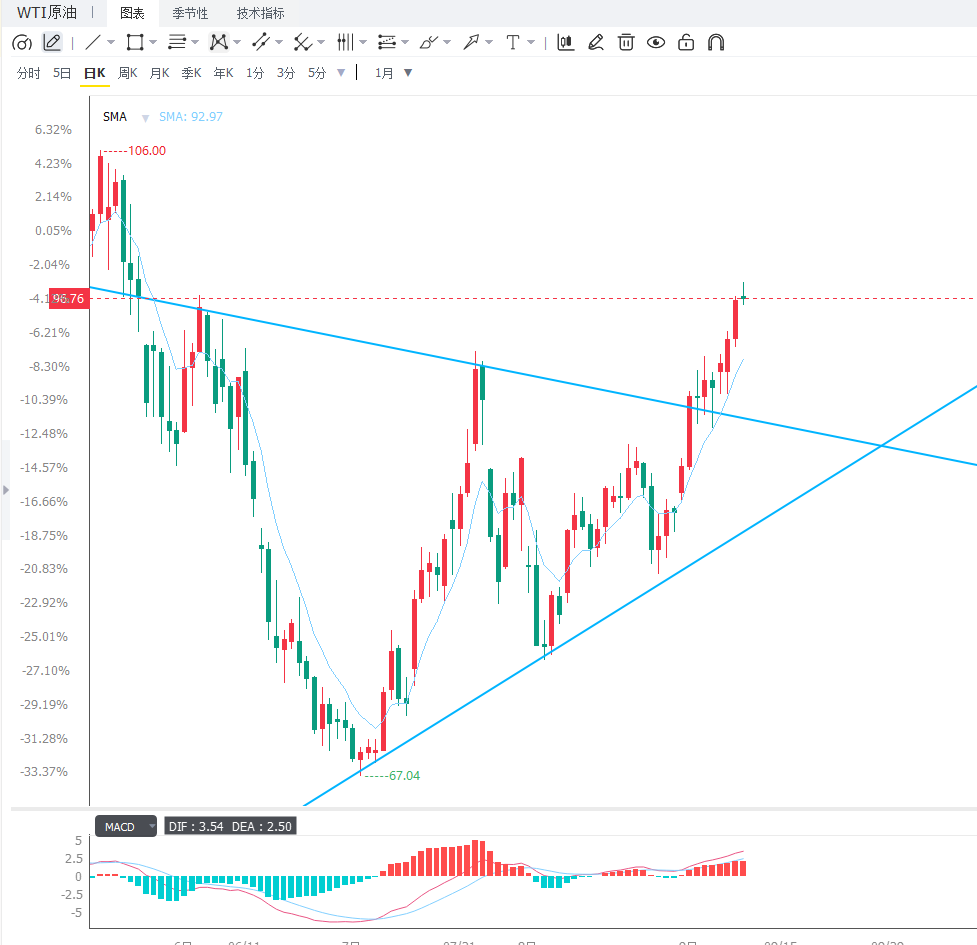 The editor summarizes that WTI crude oil is currently trading around $96.64, and its strength has gradually shifted from purely geopolitical risk trading to a repricing of actual supply tightness. Lower-than-pre-conflict export volumes in the Gulf region, increased shipping risks in the Strait of Hormuz, and attacks on energy infrastructure have collectively reinforced the supply premium in the crude oil market. In the short term, $95 has become a key defensive level for bulls, while $97 is a crucial confirmation area for further upward movement; a decisive break above $97 could see WTI challenge the $98 and even $100 psychological levels. If supply risks continue to escalate, $100 may only be a temporary target; however, if the situation eases and shipping resumes, the rapidly accumulated risk premium could see a significant pullback. Therefore, the current oil market maintains a "bullish fundamentals, high volatility" pattern, and a close watch on the intense battle between bulls and bears around $100 is crucial.
The situation in the Middle East has recently escalated significantly again, with the conflict extending beyond localized military operations to impact energy transportation and infrastructure security. The confrontation between the US and Iran over maritime transport and energy supplies has intensified, reigniting market concerns about the navigability of the Strait of Hormuz. As the region plays a crucial role in global energy transportation, any sustained disruption could rapidly alter the global oil supply and demand balance. The market's primary concern is no longer short-term shutdowns of individual oil fields or facilities, but rather systemic disruptions to the supply chain. Recent industry data indicates that Gulf region crude oil exports remain significantly below pre-conflict levels, with some transport being maintained covertly, but overall flow has not yet returned to normal. The combination of reduced supply and transportation uncertainty has led refineries and traders to lock in supplies in advance, further pushing up risk premiums in the spot market. Meanwhile, attacks on regional energy facilities have further amplified market anxieties. Actions by Iranian forces and regional armed groups have begun to affect the operation of facilities in major energy-producing countries such as Saudi Arabia, significantly increasing market focus on the security of Middle Eastern energy infrastructure. For the crude oil market, any sustained disruption in production, storage, refining, or transportation can be transmitted to the global market through declining inventories and spot premiums. WTI's continued upward movement above $96 after breaking through $95 indicates that the market has begun pricing in longer-term supply tightness. Previously, oil price increases were mainly driven by expectations of escalating conflict, but current transportation constraints, declining regional exports, and attacks on energy facilities have provided stronger fundamental support for risk premiums. Looking at international market performance, Brent crude has broken through $100 again. Latest data shows that Brent closed at $101.21 on September 9th, and WTI closed at $96.05, both benchmarks reaching their highest closing levels since May. This means that $100 has gradually transformed from a psychological resistance level into a key price area that the market is testing. The rapid rise in oil prices is also transmitting to the macroeconomic level. US gasoline and diesel prices have risen significantly recently, and European energy prices have also been impacted. Continued increases in crude oil prices will increase energy costs in transportation, manufacturing, and consumption, and may push up global inflation expectations again. If oil prices remain high for an extended period, major central banks will face a more complex monetary policy environment: on the one hand, economic growth may be suppressed by energy costs, and on the other hand, renewed inflation will limit the scope for interest rate cuts. For the crude oil market, this transmission chain of "rising energy prices—increased inflationary pressures—high interest rate expectations" may gradually become a new market theme. Especially with the upcoming release of US inflation data, the continued rise in oil prices may make the market more focused on the secondary impact of energy prices on overall inflation. However, after the continuous rise in WTI, we also need to be wary of increased short-term profit-taking. Oil prices have risen rapidly from around $90 at the end of August to above $96, a significant increase. If no new supply disruptions occur, some funds may choose to realize profits around $100. Furthermore, if actual traffic in the Strait of Hormuz recovers, or if regional tensions ease temporarily, the risk premium previously accumulated in crude oil may be quickly reversed. Currently, three variables need to be closely monitored. First, the actual traffic volume in the Strait of Hormuz is crucial. If transportation volume continues to decline, upward pressure on oil prices may increase further. Second, the operational status of major oil-producing countries and refining facilities in the Middle East is critical; any new production shutdowns could catalyze a price breakout. Third, US crude oil and refined product inventories are vital. If inventories continue to decline while Middle Eastern supply remains constrained, WTI fundamentals will tighten further. From a daily chart perspective, WTI currently maintains a clear bullish trend, with prices breaking through the important psychological levels of $90 and $95. Short-term moving averages are diverging upwards, indicating significantly increased market momentum. As prices approach $100, the market should first focus on the short-term resistance around $96.50-$97.00. If $97 is effectively broken, the next target will be $98 and the psychological level of $100. $100 is currently the most important medium-term target and resistance area for WTI bulls. On the downside, $95 has gradually transformed from a previous resistance level into a significant short-term support. If the price can stabilize above $95, the daily bullish structure remains intact. In the event of a rapid pullback, the first level to watch is around $93, followed by the psychological level of $90. As long as $90 is not decisively broken, the current uptrend remains intact. Technically, the strong upward momentum indicates continued bullish market energy, but the extended short-term gains also suggest increasing overbought conditions, thus raising the probability of wide-range fluctuations near $100. On the 4-hour chart, WTI continues its stepped upward structure, with prices consistently raising both lows and highs, indicating that short-term bulls still dominate. The area around $96.50 is a crucial area to watch after the current price breakout. If the price can stabilize above this area and break through $97, it may continue testing the $98-$100 range in the short term. Conversely, if significant selling pressure appears around $96 and the price falls below $95, a technical pullback may occur, retesting the support around $93. Given the current market's high dependence on geopolitical news, any new attacks on energy facilities, shipping disruptions, or news of easing tensions could trigger a rapid breakout or reversal on the 4-hour timeframe. The editor summarizes that WTI crude oil is currently trading around $96.64, and its strength has gradually shifted from purely geopolitical risk trading to a repricing of actual supply tightness. Lower-than-pre-conflict export volumes in the Gulf region, increased shipping risks in the Strait of Hormuz, and attacks on energy infrastructure have collectively reinforced the supply premium in the crude oil market. In the short term, $95 has become a key defensive level for bulls, while $97 is a crucial confirmation area for further upward movement; a decisive break above $97 could see WTI challenge the $98 and even $100 psychological levels. If supply risks continue to escalate, $100 may only be a temporary target; however, if the situation eases and shipping resumes, the rapidly accumulated risk premium could see a significant pullback. Therefore, the current oil market maintains a "bullish fundamentals, high volatility" pattern, and a close watch on the intense battle between bulls and bears around $100 is crucial.
- Risk Warning and Disclaimer
- The market involves risk, and trading may not be suitable for all investors. This article is for reference only and does not constitute personal investment advice, nor does it take into account certain users’ specific investment objectives, financial situation, or other needs. Any investment decisions made based on this information are at your own risk.