Gold prices have been fluctuating around $4,400; inflation data may determine the next direction.
2026-09-10 09:30:08
Spot gold halted a three-day losing streak in early Asian trading on Thursday, returning to around $4,400. This rebound was primarily driven by a weaker dollar, but the overall environment in the gold market has not clearly shifted towards a more relaxed stance. On one hand, renewed tensions in the Middle East and rising international oil prices may increase future inflationary pressures; on the other hand, the upcoming release of new US inflation data will directly influence market expectations for the Federal Reserve's next interest rate decision.  The core contradiction in the precious metals market has recently shifted from simple safe-haven demand to a game between "inflationary pressures and monetary policy expectations." Rising oil prices mean that energy costs may continue to be passed on to end-user prices. If US inflation data shows signs of exceeding expectations again, the necessity for the Federal Reserve to maintain a tight policy or even raise interest rates further will increase. Since gold itself does not generate interest, its relative attractiveness is usually suppressed in an environment of rising real interest rates and bond yields. Recently, shipping risks in the Middle East have escalated again, with shipping activities near the Strait of Hormuz experiencing significant disruptions, increasing market concerns about the stability of energy supply. Rising oil prices not only increase the risk premium in the energy market but may also intensify investors' concerns about future inflation. If oil prices remain high, market judgments on the Fed's policy path may become more cautious, which will be a significant constraint on a short-term rebound in gold. The market is currently awaiting the US Producer Price Index (PPI) and Consumer Price Index (CPI). The PPI will be released on Thursday, and the CPI is expected to be released on Friday; both data points could be important catalysts for the next stage of gold's price movement. The market currently prices in a probability of a rate hike at the Fed's meeting next week at about 60%, meaning that investors have already given a high weight to further tightening policies. If inflation data exceeds expectations, the interest rate market may further increase its pricing of interest rate hikes, potentially leading to a simultaneous strengthening of the US dollar and US Treasury yields, while gold may face renewed downward pressure. Conversely, if PPI and CPI do not show a significant rebound in inflation, market concerns about further interest rate hikes may ease, and gold could potentially attract some allocation funds again. Especially after the previous continuous correction in gold prices, if the US dollar weakens in tandem, some previously hesitant funds may re-enter the market. Therefore, gold is not currently lacking upward momentum, but rather the market needs a macroeconomic signal that confirms a shift in monetary policy expectations. From a sentiment perspective, gold has recently reacted significantly faster to employment, inflation, and speeches by Federal Reserve officials. After the release of US employment data, gold prices were initially suppressed, but subsequent dovish policy statements and changes in the exchange rate market mitigated the negative impact. This indicates that the market is not currently forming a one-sided consensus expectation, but rather is in a phase of high sensitivity to macroeconomic data. Market participants are likely to react quickly to any data that could change interest rate expectations, and gold price volatility may therefore remain at a high level. For gold, the key focus going forward will not only be on the year-on-year and month-on-month CPI and PPI data, but also on core inflation performance and the impact of energy prices on overall inflation. If core inflation remains high while energy prices rise further, the Federal Reserve may maintain a restrictive policy stance for an extended period. If inflationary pressures are lower than market concerns, real interest rates and the dollar may come under pressure, increasing the probability of gold retesting recent highs. Technically, the daily chart for gold remains relatively positive. Gold prices have climbed back above the 100-day moving average, indicating that the medium-term bullish structure has not been broken. However, recent consecutive declines have significantly cooled upward momentum. The 14-day RSI is around 50.65, in neutral territory, neither severely overbought nor significantly oversold. This means the market currently lacks strong trend momentum, and future direction will remain highly dependent on macroeconomic data. Looking at the Bollinger Bands, gold prices are currently trading between the lower and middle bands, and the first resistance level to break is the middle Bollinger Band around $4465. If gold can effectively hold this level, the market will further focus on the upper Bollinger Band around $4675, which could become a significant resistance level for the bulls to retest in the next phase. On the downside, the first support level to watch is the 100-day moving average around $4345. A break below this level could lead to further downward pressure and a test of the lower Bollinger Band around $4255. If gold can hold above the 100-day moving average, the overall structure still leans towards a corrective move within a high-level consolidation. On the 4-hour chart, gold has found short-term support and is approaching $4400 again, indicating some easing of previous downward pressure, but this is not yet sufficient to confirm a new upward trend. Short-term momentum is recovering, but the market still needs to break through the previous resistance area to confirm that buying has regained dominance. If gold breaks through $4465 and holds effectively, the short-term rebound potential is expected to open up further; conversely, if the rebound fails to break through the middle Bollinger Band resistance and the price falls back below $4345, a retest of support around $4255 cannot be ruled out. Therefore, gold is more likely to maintain a wide range of fluctuations before the release of US inflation data, and the direction of market breakout will depend on the repricing of the data on expectations for the US dollar and interest rates.
 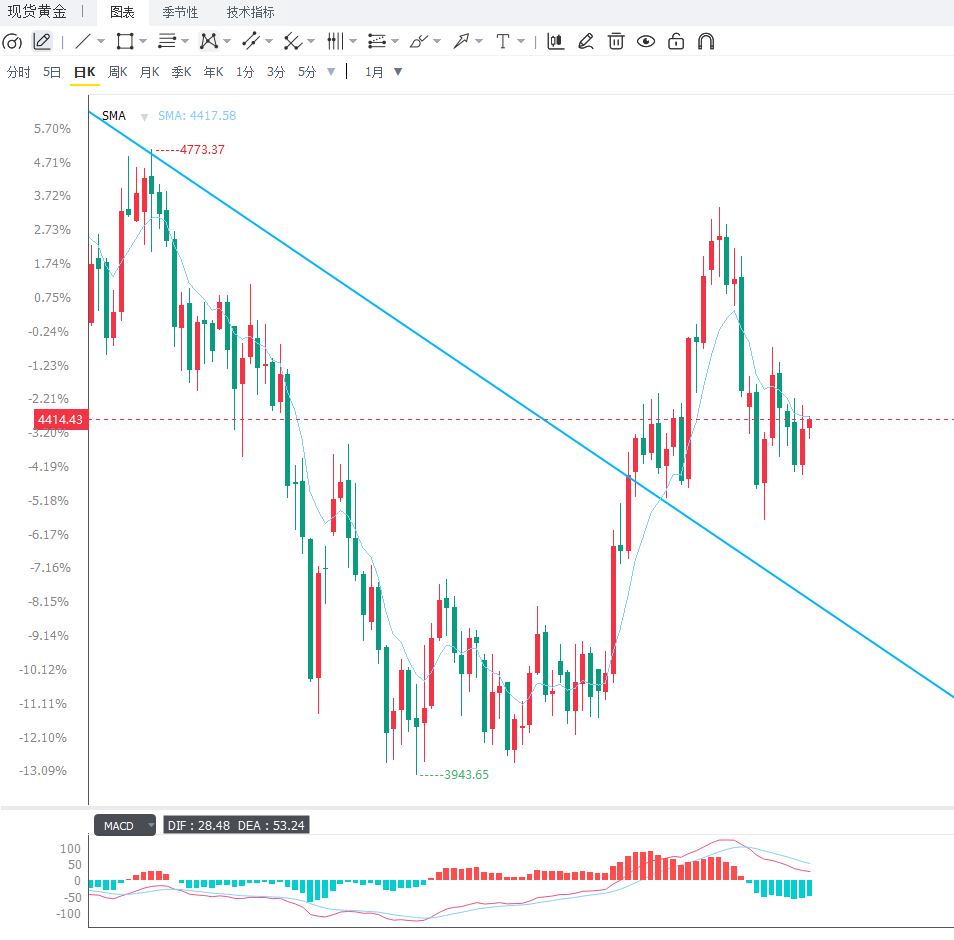 Editor's Summary: Gold ended its three-day losing streak and approached $4,400 again, indicating that a weaker dollar can still provide some support for precious metals. However, Middle East energy risks and inflationary pressures from rising oil prices mean that expectations regarding Federal Reserve policy remain a significant variable suppressing gold prices. The market currently prices in a 60% probability of an interest rate hike next week; therefore, the upcoming PPI and CPI data will directly determine whether the gold rebound can continue. In the short term, $4,465 is a key resistance level that bulls need to break through, while $4,345 is a crucial support level to determine whether the correction will extend further. Before the release of macroeconomic data, gold is likely to maintain a high-level consolidation pattern. Changes in the dollar and US Treasury yields triggered by the data will be the core factors determining the next direction.
The core contradiction in the precious metals market has recently shifted from simple safe-haven demand to a game between "inflationary pressures and monetary policy expectations." Rising oil prices mean that energy costs may continue to be passed on to end-user prices. If US inflation data shows signs of exceeding expectations again, the necessity for the Federal Reserve to maintain a tight policy or even raise interest rates further will increase. Since gold itself does not generate interest, its relative attractiveness is usually suppressed in an environment of rising real interest rates and bond yields. Recently, shipping risks in the Middle East have escalated again, with shipping activities near the Strait of Hormuz experiencing significant disruptions, increasing market concerns about the stability of energy supply. Rising oil prices not only increase the risk premium in the energy market but may also intensify investors' concerns about future inflation. If oil prices remain high, market judgments on the Fed's policy path may become more cautious, which will be a significant constraint on a short-term rebound in gold. The market is currently awaiting the US Producer Price Index (PPI) and Consumer Price Index (CPI). The PPI will be released on Thursday, and the CPI is expected to be released on Friday; both data points could be important catalysts for the next stage of gold's price movement. The market currently prices in a probability of a rate hike at the Fed's meeting next week at about 60%, meaning that investors have already given a high weight to further tightening policies. If inflation data exceeds expectations, the interest rate market may further increase its pricing of interest rate hikes, potentially leading to a simultaneous strengthening of the US dollar and US Treasury yields, while gold may face renewed downward pressure. Conversely, if PPI and CPI do not show a significant rebound in inflation, market concerns about further interest rate hikes may ease, and gold could potentially attract some allocation funds again. Especially after the previous continuous correction in gold prices, if the US dollar weakens in tandem, some previously hesitant funds may re-enter the market. Therefore, gold is not currently lacking upward momentum, but rather the market needs a macroeconomic signal that confirms a shift in monetary policy expectations. From a sentiment perspective, gold has recently reacted significantly faster to employment, inflation, and speeches by Federal Reserve officials. After the release of US employment data, gold prices were initially suppressed, but subsequent dovish policy statements and changes in the exchange rate market mitigated the negative impact. This indicates that the market is not currently forming a one-sided consensus expectation, but rather is in a phase of high sensitivity to macroeconomic data. Market participants are likely to react quickly to any data that could change interest rate expectations, and gold price volatility may therefore remain at a high level. For gold, the key focus going forward will not only be on the year-on-year and month-on-month CPI and PPI data, but also on core inflation performance and the impact of energy prices on overall inflation. If core inflation remains high while energy prices rise further, the Federal Reserve may maintain a restrictive policy stance for an extended period. If inflationary pressures are lower than market concerns, real interest rates and the dollar may come under pressure, increasing the probability of gold retesting recent highs. Technically, the daily chart for gold remains relatively positive. Gold prices have climbed back above the 100-day moving average, indicating that the medium-term bullish structure has not been broken. However, recent consecutive declines have significantly cooled upward momentum. The 14-day RSI is around 50.65, in neutral territory, neither severely overbought nor significantly oversold. This means the market currently lacks strong trend momentum, and future direction will remain highly dependent on macroeconomic data. Looking at the Bollinger Bands, gold prices are currently trading between the lower and middle bands, and the first resistance level to break is the middle Bollinger Band around $4465. If gold can effectively hold this level, the market will further focus on the upper Bollinger Band around $4675, which could become a significant resistance level for the bulls to retest in the next phase. On the downside, the first support level to watch is the 100-day moving average around $4345. A break below this level could lead to further downward pressure and a test of the lower Bollinger Band around $4255. If gold can hold above the 100-day moving average, the overall structure still leans towards a corrective move within a high-level consolidation. On the 4-hour chart, gold has found short-term support and is approaching $4400 again, indicating some easing of previous downward pressure, but this is not yet sufficient to confirm a new upward trend. Short-term momentum is recovering, but the market still needs to break through the previous resistance area to confirm that buying has regained dominance. If gold breaks through $4465 and holds effectively, the short-term rebound potential is expected to open up further; conversely, if the rebound fails to break through the middle Bollinger Band resistance and the price falls back below $4345, a retest of support around $4255 cannot be ruled out. Therefore, gold is more likely to maintain a wide range of fluctuations before the release of US inflation data, and the direction of market breakout will depend on the repricing of the data on expectations for the US dollar and interest rates. Editor's Summary: Gold ended its three-day losing streak and approached $4,400 again, indicating that a weaker dollar can still provide some support for precious metals. However, Middle East energy risks and inflationary pressures from rising oil prices mean that expectations regarding Federal Reserve policy remain a significant variable suppressing gold prices. The market currently prices in a 60% probability of an interest rate hike next week; therefore, the upcoming PPI and CPI data will directly determine whether the gold rebound can continue. In the short term, $4,465 is a key resistance level that bulls need to break through, while $4,345 is a crucial support level to determine whether the correction will extend further. Before the release of macroeconomic data, gold is likely to maintain a high-level consolidation pattern. Changes in the dollar and US Treasury yields triggered by the data will be the core factors determining the next direction.
- Risk Warning and Disclaimer
- The market involves risk, and trading may not be suitable for all investors. This article is for reference only and does not constitute personal investment advice, nor does it take into account certain users’ specific investment objectives, financial situation, or other needs. Any investment decisions made based on this information are at your own risk.