The Strait of Hormuz is ablaze again, signaling a protracted conflict! Brent crude oil breaks $100, hitting a six-week high.
2026-09-10 09:50:07
When Brent crude oil broke through $100 a barrel for the first time since July, and U.S. diesel prices hit record highs, the fighting in the Strait of Hormuz has escalated from a regional conflict into a global energy crisis. With the escalation of tensions between the U.S. and Iran, and the Houthi rebels opening a second front, the Middle East is sliding into a protracted and costly standoff. 
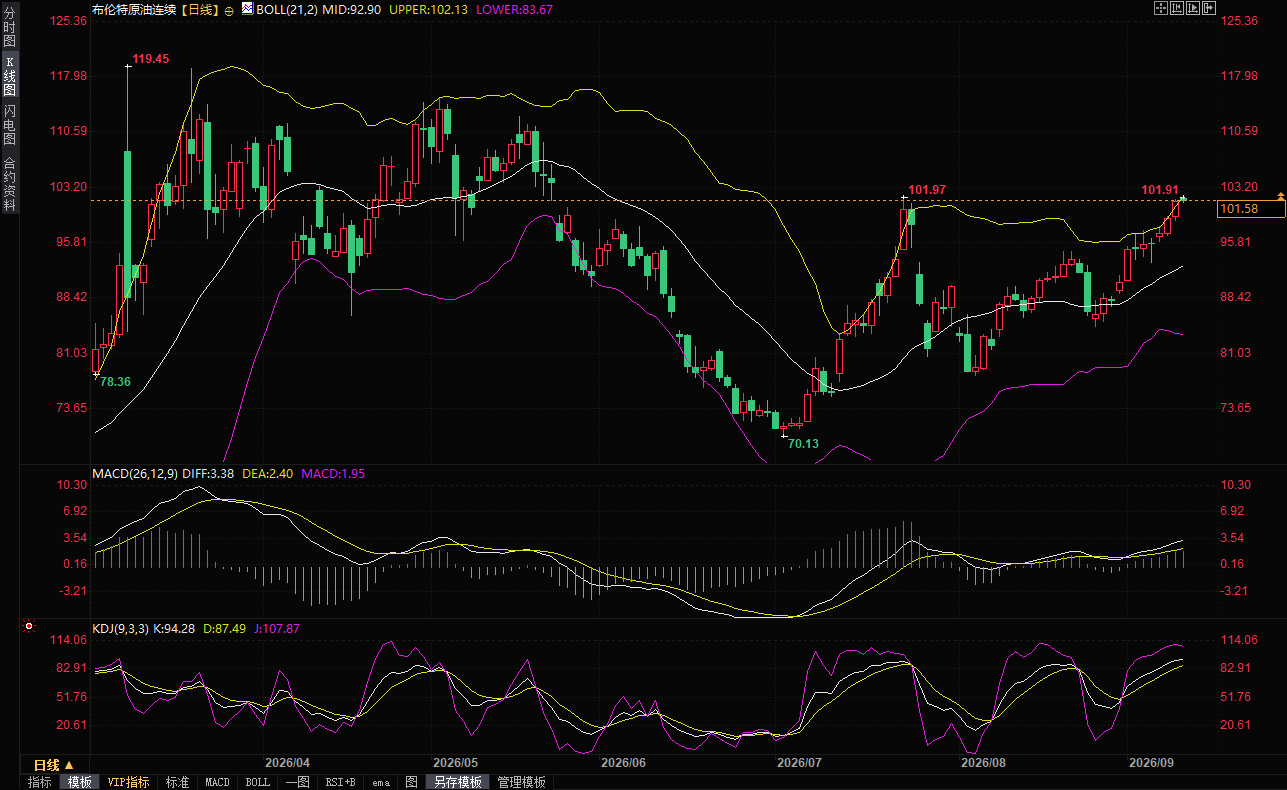 (Brent crude oil daily chart, source: EasyForex)
Conflict Escalates: Largest Maritime Clashes in Six Months
On September 9, the largest naval exchange since the start of the war erupted between the US and Iran in the Strait of Hormuz and surrounding waters. Iran's Islamic Revolutionary Guard Corps claimed responsibility for attacking 10 vessels near the Strait of Hormuz, including two US ships and eight oil tankers. The US military stated that it had destroyed five Iranian oil tankers, four in the Gulf of Oman and one near Kharg Island, Iran's main oil export hub. US Central Command confirmed that the strikes were a response to the Iranian Revolutionary Guard Corps' ballistic missile attack on a US Navy warship and announced a new policy: destroy any Iranian oil tanker attacked. This exchange was not an isolated incident. Since September 5, the US military has destroyed at least eight Iranian oil tankers in the area, and two large-scale strikes within a week indicate that the US is expanding its reach from military targets to Iran's oil transportation network. Iran, in turn, announced a ballistic missile attack on the US military base in Azraq, Jordan. Jordanian air defenses intercepted 18 missiles, with the remaining two landing in uninhabited areas without causing any casualties.Oil prices fluctuated wildly: Brent crude briefly broke through the $101 mark.
The escalating conflict quickly spilled over into the international energy market. On September 9, Brent crude futures broke through $100 a barrel for the first time since July, settling at $101.21 a barrel. It reached a high of $101.91 a barrel in early Asian trading on Thursday (the previous high since May 22 was $101.97, reached on July 23). WTI crude futures also strengthened, breaking through $95 a barrel, reaching a new high since early June, and hitting a new high of $97.79 a barrel in Asian trading on Thursday. Year-to-date, Brent crude has risen by more than 60%, marking the third time this year that it has surpassed the $100 a barrel mark. The surge in refined product prices was even more dramatic. The average retail price of diesel in the United States reached a record high of $5.94 per gallon on September 9, surpassing the previous record set in June 2022. Data from the American Automobile Association shows that the national average price of regular unleaded gasoline is $4.22 per gallon, up approximately 5.2% from $4.01 a month ago and 32% from $3.19 a year ago. Daan Struyven, co-head of global commodities research at Goldman Sachs, warned that Brent crude oil prices could climb above $120 per barrel if attacks on shipping continue to escalate. The bank has raised its year-end 2026 oil price forecast from $80 to $90 per barrel and its 2027 average price forecast from $75 to $80 per barrel. HSBC's global research team also raised its 2026 Brent crude oil average price forecast to $95 per barrel, and warned that even if the US and Iran reach a swift agreement, the impact of the supply shock on global inflation is difficult to reverse, and more central banks will be forced to raise interest rates.Lifeline for transportation disrupted: Strait of Hormuz traffic drops by over 70%
The changes in oil shipments through the Strait of Hormuz directly reflect the impact of the conflict on the global energy supply chain. Data from Claudio Galimberti, chief economist at Rystad Energy, shows that in the week before the renewed fighting on August 30, daily crude oil shipments through the Strait of Hormuz were approximately 8 to 9 million barrels; however, the latest data shows that this figure has plummeted to less than 2 million barrels per day. Jorge León, head of geopolitical analysis at Rystad Energy, further points out that during the escalation of hostilities, shipments through the strait dropped to an average of about 1 million barrels per day. Data from the U.S. Energy Information Administration (EIA) shows that approximately 4.9 million barrels of crude oil and energy products passed through the Strait of Hormuz daily in the second quarter of this year, a significant decrease of about 77% compared to the average of 21.6 million barrels per day in the fourth quarter of 2025. The International Energy Agency previously projected that global oil supply would decrease by 4.3 million barrels per day this year, a drop of approximately 4%. Iranian Revolutionary Guard spokesman Hossein Mohbi announced on the 9th that Iran will establish a new maritime "sanctions zone" extending from the port of Chabahar to parts of the Gulf of Oman and the Arabian Sea. Any enemy ships or merchant vessels entering the zone without coordination will be subject to sanctions—Iran will cease providing any maritime, insurance, and support services to such vessels.Signals of a protracted war emerge: US military extends deployment to 2027
In stark contrast to Trump's public declaration that "the war will end immediately after the midterm elections," senior White House advisors have privately suggested that the war with Iran could continue until the end of his presidency. Vice President JD Vance and Secretary of State Marco Rubio, among others, have discussed in the Oval Office and Situation Room that Tehran might continue to withstand US pressure under blockade and other military tactics, potentially extending the conflict beyond the presidential inauguration in January 2029. Signals regarding military deployments are even clearer. US Defense Secretary Peter Hegses has extended the deployment of some troops in the Middle East to 2027. The Pentagon plans to extend the deployment of some Middle East air defense forces without setting a specific end date. Currently, the US has approximately 50,000 troops deployed in the Middle East, and the deployment period for air defense forces has been extended from nine months to 12 months, with some troops deployed from Europe and the Pacific already deployed for over a year. According to the Wall Street Journal, the Pentagon is also rotating air force fighter squadrons in the region, with Air National Guard F-16 fighters replacing aircraft returning to Aviano Air Base in Italy. A third Marine Expeditionary Unit is preparing to deploy to the region this fall. The 31st Marine Expeditionary Unit arrived in March and was replaced by the 11th Marine Expeditionary Unit in June, demonstrating the ongoing rotation of amphibious forces operating with naval formations. U.S. casualties continue to rise. As of September 8, since the U.S. military action against Iran on February 28, the total number of U.S. casualties has reached 838, including 18 deaths and 820 injuries. The latest data from the Defense Casualty Analysis System (DSAS), part of the U.S. Department of Defense, shows that 30 more casualties were added in the most recent round alone. Susanna Maloney, an Iran expert and vice president of foreign policy at the Brookings Institution, pointed out: "A U.S. maritime blockade is unlikely to produce decisive results in the short or even medium term; therefore, the only realistic approach to using this tool must be based on a long-term encirclement plan." She also warned that energy and economic targets in the Gulf states could be attacked, with unforeseen consequences. Ali Vaez, an Iran expert at the International Crisis Group, commented: "Everyone is paying a price, but the price borne by the leadership of both sides is not high enough to force them to accept the other side's conditions."The proxy front expands: The struggle between the Houthis and Pakistan escalates.
A second front in the Middle East conflict is rapidly forming. The Houthi rebels in Yemen have recently intensified their attacks on Saudi Arabia, with the Saudi Ministry of Energy confirming attacks on multiple energy and utility facilities, resulting in temporary disruptions to some operations. Houthi spokesman Yahya Sarreya announced an impending "extensive military operation deep within Saudi territory." Faced with this escalation, Pakistan, representing Saudi Arabia, warned Iran to restrain the Houthis. Pakistani Defense Minister Asif stated that "aggression against one country will be considered an aggression against all three," hinting at the potential activation of the Saudi-Turkish-Pakistani trilateral defense agreement. The Mecca Mutual Defense Agreement, signed by the three countries in Mecca on August 7, stipulates that any armed attack against any one of the three countries is considered an attack against all three, a treaty dubbed "the Islamic version of NATO" by the media. However, Iran responded that "Iran cannot control the Houthis." Two Iranian sources revealed that Iran instructed the Houthis to launch attacks on Saudi Arabia last week, promising additional funding and weapons, and that several commanders of the Islamic Revolutionary Guard Corps have traveled to Yemen to assist in coordinating the attacks. A senior Middle Eastern diplomat believes that Iran's attack on Gulf security to pressure Washington may actually prompt Saudi Arabia, Pakistan, Turkey, and other pro-American countries to strengthen security coordination rather than undermine their relationships.Editor's Summary
The US-Iran conflict is evolving from a military operation initially anticipated as a "quick victory" into a protracted standoff impacting global energy markets and reshaping the Middle East's security landscape. From a data perspective, Brent crude oil breaking through $100 per barrel, US diesel retail prices hitting record highs, and oil shipments through the Strait of Hormuz plummeting by over 70% form a clear transmission chain: military conflict → transportation disruptions → supply contraction → soaring prices → rising inflationary pressures → narrowing central bank policy space. Goldman Sachs and HSBC's forecast adjustments reflect the market's repricing of the sustainability of the supply shock. Meanwhile, signals such as the US military extending its deployment to 2027, the Pentagon not setting an end date, and the imminent deployment of a third Marine Expeditionary Force indicate that Washington is preparing for a military presence that spans election cycles. This discrepancy between Trump's public declaration that "the war will end immediately after the midterm elections" warrants continued attention. Driven by the power struggle between Saudi Arabia, Pakistan, and the Houthi rebels, the Middle East is forming a complex security landscape centered on the US-Iran standoff and interwoven with multiple proxy forces. The course of the conflict depends not only on the outcome of military maneuvering, but also on the assessment of each party's economic capacity. (Brent crude oil daily chart, source: EasyForex)Frequently Asked Questions
Question 1: What does Brent crude oil breaking through $100 mean for global inflation? Brent crude oil prices breaking through $100 per barrel signifies a significant increase in the global energy cost center. Crude oil is the raw material for gasoline, diesel, jet fuel, and many chemical products. The price increase will be passed on to end-consumer prices through transportation costs and manufacturing input costs. HSBC's global research team warns that even if the US and Iran reach an agreement quickly and the Strait of Hormuz reopens, the impact of the supply shock on global inflation will be difficult to reverse, and more central banks will be forced to raise interest rates. The average retail price of diesel in the US has reached a record high of $5.94 per gallon. Diesel is a core fuel for trucking and agriculture; its high price will directly push up logistics costs for food and goods, creating broader inflationary pressure. Question 2: What are the casualties of the US military in the Middle East? As of September 8, 2026, the cumulative number of US military casualties in the war in Iran has reached 838, including 18 deaths and 820 injuries. Since the US military action against Iran on February 28, the war has lasted for more than six months and has resulted in the deaths of 18 US military personnel. The latest update to the Defense Casualty Analysis System (DSAS), under the Department of Defense, shows that 30 U.S. soldiers were injured in the most recent round alone. The Pentagon's disclosure of casualty information has been slow, with the official explanation being "safety needs." Question 3: How much impact will the decline in oil shipments through the Strait of Hormuz have on global supply? The Strait of Hormuz is the world's most important oil shipping route. Before the war, the strait saw approximately 8 to 9 million barrels of crude oil transported daily; currently, Rystad Energy data shows this has dropped to less than 2 million barrels per day. Data from the U.S. Energy Information Administration shows that approximately 4.9 million barrels of crude oil and energy products passed through the strait daily in the second quarter, a decrease of about 77% compared to the average of 21.6 million barrels per day in the fourth quarter of 2025. The International Energy Agency predicts that global oil supply will decrease by 4.3 million barrels per day this year, a drop of about 4%. Although this gap has been partially offset by increased production from non-OPEC oil-producing countries, it is difficult to completely fill the gap. Question 4: What is the Mecca Mutual Defense Agreement? Why has it attracted attention in the current situation? The Mecca Mutual Defense Agreement, signed in Mecca on August 7, 2026, by Saudi Arabia, Turkey, and Pakistan, stipulates that any armed attack against any of the three countries is considered an attack against all three, and has been dubbed the "Islamic version of NATO" by the media. The three countries collectively possess approximately 1.4 million active-duty military personnel, 3,400 military aircraft, and a combined defense budget of approximately $124.4 billion. Against the backdrop of escalating Houthi attacks on Saudi Arabia, Pakistan, representing Saudi Arabia, warned Iran to restrain the Houthis and hinted that the defense agreement might be activated, risking the proxy conflict escalating into a broader Middle East security crisis. Question 5: Why do White House advisors believe a war with Iran could continue until the end of the president's term? In closed-door discussions, senior White House advisors suggested to Trump that Tehran might continue to withstand US pressure under a maritime blockade and sanctions strategy. Brookings Institution experts pointed out that a maritime blockade is unlikely to produce decisive results in the short or even medium term; the only realistic approach is based on a long-term siege plan. Experts from the International Crisis Group analyzed that the costs borne by both leaderships have not yet been high enough to force them to accept the other's conditions. While Trump publicly assured a swift victory, he also supported a long-term economic containment strategy, describing "operational economic isolation" as an alternative to large-scale military operations. At 09:44 Beijing time, Brent crude oil was trading at $151.58 per barrel.- Risk Warning and Disclaimer
- The market involves risk, and trading may not be suitable for all investors. This article is for reference only and does not constitute personal investment advice, nor does it take into account certain users’ specific investment objectives, financial situation, or other needs. Any investment decisions made based on this information are at your own risk.