Spot gold regained the $4,400 level after initially falling below it, with two major investment banks marking it as "midway through a bull market."
2026-09-10 14:58:06
On Thursday (September 10) during Asian trading hours, spot gold briefly fell below $4,400 per ounce to around $4,390 before regaining its upward momentum, moving further away from the one-week low reached the previous day. However, gold prices still failed to break through the key resistance level of $4,450, with bulls appearing hesitant ahead of the release of US inflation data. 
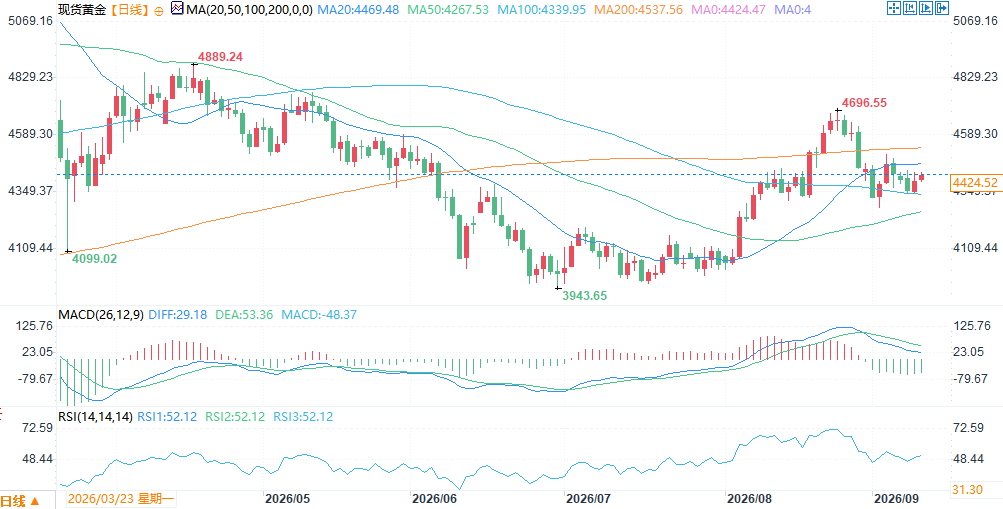 (Spot gold daily chart, source: EasyTrade) At 14:56 Beijing time, spot gold was trading at $4424.79 per ounce.
The dollar's trajectory depends on CPI; the Fed decision is approaching.
Strategists at prominent institutions emphasized that Friday's US August CPI data is "the main market driver determining the Fed's September 16th interest rate decision." They believe that "if the CPI data is strong, it will almost certainly lock in a September rate hike and support a stronger dollar; if the data is moderate, it will strengthen the case for holding rates steady, putting pressure on the dollar to be repriced in a dovish stance." Currently, the market is pricing in a roughly 60% probability of a Fed rate hike at its September 15-16 meeting. This bet was boosted by last Friday's stronger-than-expected non-farm payroll report. Furthermore, the inflationary risks posed by persistently high energy prices have also solidified expectations of an immediate Fed tightening. Oil prices and geopolitical risks are reinforcing this logic. Crude oil prices earlier in the day hit a three-month high as tensions between the US and Iran escalated further—Iran attacked 10 ships near the Strait of Hormuz after the US announced the sinking of five Iranian oil tankers in the Gulf of Oman and near Kharg Island. This exacerbated market concerns about a prolonged disruption to Middle Eastern oil supplies and supported oil prices, further reinforcing the case for other major central banks to adopt a more hawkish stance. In fact, traders have already fully priced in a 25-basis-point rate hike by the European Central Bank later today, as well as a rate hike by the Bank of Japan at its September 17-18 meeting. Furthermore, the Reserve Bank of Australia is also considering a possible rate hike later this month.High US Treasury yields and a stronger yen put pressure on the US dollar.
U.S. Treasury yields remained high after the Treasury's buyback announcement disappointed the market. The Treasury announced it would increase the size of its 10- to 20-year Treasury buyback program from $2 billion to $6 billion, although media reports indicated the market expected at least $10 billion. However, the strengthening of the yen, triggered by hawkish expectations from the Bank of Japan, put dollar bulls on the defensive, becoming a key factor supporting gold prices. The broad-based weakness of the dollar provided a floor for gold, but hawkish expectations from global central banks, driven by rising inflation risks, limited its upside potential.Institutional Views
Goldman Sachs' research team maintained its year-end 2026 target price for spot gold at $4,900 per ounce in a recent report. Analysts Lina Thomas and Daan Struyven pointed out that despite a recent pullback in gold prices, the upward trend is expected to continue in the second half of the year. The core support comes from continued gold purchases by global central banks to diversify their foreign exchange reserves; central banks are expected to buy an average of about 50 tons of gold per month in 2026, significantly higher than levels before 2022. Market downward revisions to expectations of Fed rate hikes will also reduce headwinds for gold prices. Meanwhile, investors' hedging activities through gold derivatives may amplify short-term volatility, bringing two-way risks, but also increasing upside potential. Goldman Sachs believes the current correction is a mid-bull market pause, not the end of the trend, and that there is strong support around $4,000, suggesting buying on dips during periods of volatility. JPMorgan Chase adjusted its average gold price forecast for Q3 2026 to approximately $4,300, rising to $4,500 in Q4, with downside risks skewed. The bank points out that a temporary weakening in key demand areas (including some investor interest) and a renewed sensitivity of gold prices to changes in real interest rates may limit short-term gains. If the Federal Reserve raises interest rates earlier than expected due to overly positive data, there could be further downward pressure. However, a constructive view is maintained in the medium to long term, believing that the current correction is merely a temporary pause in a multi-year bull market, and that continued central bank gold purchases, a recovery in physical demand, and structural allocation needs will drive gold prices higher in 2027. JPMorgan emphasizes that once macroeconomic uncertainties become clearer, demand is expected to accelerate again, and the central level of gold prices still has the potential to move upward.Summarize
Spot gold is currently trading above $4,400, but the key resistance level of $4,450 has yet to be broken, with bulls remaining cautious ahead of inflation data. The US dollar is under pressure due to a stronger yen, providing a floor for gold; however, rising inflation risks and hawkish expectations from global central banks—with the ECB, the Bank of Japan, and the Reserve Bank of Australia all facing pressure to raise interest rates—are limiting the upside potential for gold prices. Friday's US CPI data will be a key variable in determining the Fed's September interest rate decision. Strong data will support the dollar and suppress gold, while moderate data could push gold prices above $4,450. (Spot gold daily chart, source: EasyTrade) At 14:56 Beijing time, spot gold was trading at $4424.79 per ounce.
- Risk Warning and Disclaimer
- The market involves risk, and trading may not be suitable for all investors. This article is for reference only and does not constitute personal investment advice, nor does it take into account certain users’ specific investment objectives, financial situation, or other needs. Any investment decisions made based on this information are at your own risk.