Oil prices have broken through the $100 mark, reigniting concerns about inflation and recession.
2026-09-14 10:56:09
International oil prices have recently surged, with both Brent and WTI crude oil prices surpassing the $100 per barrel mark. Rising oil prices have increased inflation expectations, pushed up US Treasury yields, and significantly increased the probability of a rate hike at this week's Federal Reserve meeting. Since the initial outbreak of the Iranian conflict, the market has again begun discussing the possibility of an economic recession. Global reserves previously used to buffer energy shocks are being rapidly depleted, and institutions such as Goldman Sachs are reassessing the downward pressure on the US economy. The ripple effects of energy price increases are spreading along the supply chain. Most of these buffer measures have now become ineffective. For example, the United States' strategic oil reserves have fallen to their lowest level since the early 1980s. Meanwhile, major Asian powers have eased fuel export restrictions, leading to a rebound in crude oil purchases and a recovery in imports from a ten-year low in June. Oil shipments through the Strait of Hormuz have recovered somewhat, to about half to two-thirds of pre-war levels, but fuel supply remains severely insufficient. The supply gap in refined oil products in the Middle East and Russia is difficult to fill by refining capacity in other regions, putting far greater pressure on the refined oil market than on crude oil itself. In late summer, US gasoline and diesel prices continued to rise. While seasonal demand declines usually lower prices, this year US gasoline prices reached a record high for the same period.
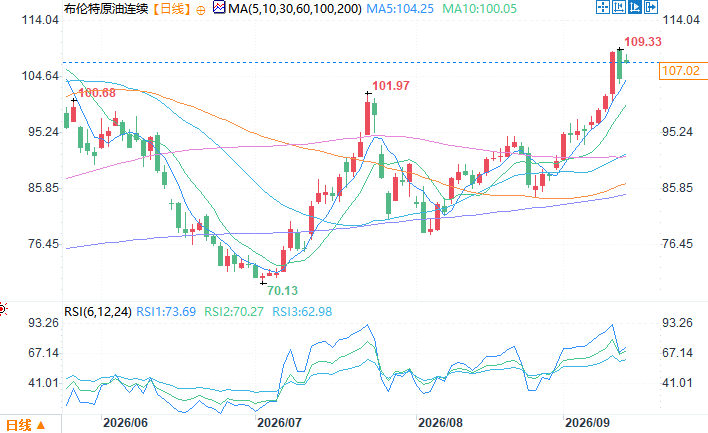 Brent crude oil daily chart source: EasyTrade. At 10:54 AM Beijing time on September 14th, Brent crude oil was trading at $107.48 per barrel.
Geopolitical factors are driving up oil prices, and existing buffer mechanisms are largely exhausted.
As tensions between the US and Iran escalate again, with neither side signaling any intention to negotiate, Brent crude oil prices broke through $100 per barrel last week for the first time since July, while the US benchmark WTI crude also surpassed the $100 mark. During the six months of ongoing conflict in Iran, shipping capacity in the Strait of Hormuz has been disrupted, causing unprecedented disruption to the global energy market. However, the global and US economies have shown resilience. Many countries have released strategic oil reserves to fill supply gaps in the Middle East, major Asian countries have reduced crude oil imports and restricted fuel exports, and high prices have suppressed demand. Since March, the crude oil market has remained largely stable, experiencing only brief spikes during periods of heightened tensions in the Persian Gulf. Most of these buffer measures have now become ineffective. For example, the United States' strategic oil reserves have fallen to their lowest level since the early 1980s. Meanwhile, major Asian powers have eased fuel export restrictions, leading to a rebound in crude oil purchases and a recovery in imports from a ten-year low in June. Oil shipments through the Strait of Hormuz have recovered somewhat, to about half to two-thirds of pre-war levels, but fuel supply remains severely insufficient. The supply gap in refined oil products in the Middle East and Russia is difficult to fill by refining capacity in other regions, putting far greater pressure on the refined oil market than on crude oil itself. In late summer, US gasoline and diesel prices continued to rise. While seasonal demand declines usually lower prices, this year US gasoline prices reached a record high for the same period.Diesel prices hit record highs, bringing inflationary pressures across the entire industry chain.
As a core fuel for the real economy, diesel prices have been particularly impacted. Following last week's record high of $5.85 per gallon, the national average price of diesel in the United States has reached $6 per gallon for the first time. While gasoline prices directly squeeze disposable income, diesel prices will increase freight and logistics costs, push up prices for various goods, and accelerate inflation. Patrick De Haan, head of oil analysis at GasBuddy, stated, "Historically high oil prices are rare, and the economic impact of this round of diesel price increases has a lag. Diesel prices will affect every shipment, potentially reigniting inflation throughout the supply chain. The current seasonal price increase in diesel further exacerbates the pressure. Given the ongoing geopolitical conflicts, diesel prices still have room to rise, and the public needs to prepare for increased costs during holidays."Interest rate hike expectations jump, recession risk assessment changes.
Soaring crude oil and refined product prices have pushed up US Treasury yields and long-term financing costs. Markets anticipate the Federal Reserve may address the inflation shock ahead of schedule by raising policy rates at this week's meeting, bringing recession back into the spotlight. Goldman Sachs Chief Economist Jan Hatzius stated, "We have lowered our 12-month recession probability. When the Middle East conflict first broke out in March, we estimated a recession probability of about 30%, which has now dropped to 15%. However, if there is another energy shock, the recession probability will be revised upwards again." Goldman Sachs predicts US GDP growth of approximately 1.5% in the second half of this year, a forecast that does not factor in a new major energy shock. Hatzius added, "If gasoline prices rise sharply, we will lower our economic growth forecast, as gasoline prices directly affect real income." The latest data from the CME FedWatch Tool shows that traders expect an 86.5% probability of a 25 basis point rate hike at this week's meeting.Conclusion
While a recession is not the most pressing risk, interest rate hikes have become a key pricing scenario in the market. Persistently high refined oil prices will exert pressure on the US economy from both the consumption and supply sides. If geopolitical conflicts continue to drive up energy prices, inflationary pressures will force the Federal Reserve to maintain its tight monetary policy, further pressuring the US economic growth outlook. Global capital markets will also continue to face volatility driven by both policy and commodity prices. Brent crude oil daily chart source: EasyTrade. At 10:54 AM Beijing time on September 14th, Brent crude oil was trading at $107.48 per barrel.
- Risk Warning and Disclaimer
- The market involves risk, and trading may not be suitable for all investors. This article is for reference only and does not constitute personal investment advice, nor does it take into account certain users’ specific investment objectives, financial situation, or other needs. Any investment decisions made based on this information are at your own risk.