Gold prices plunge nearly 2% as oil prices soar and US Treasury yields approach 5%, reinforcing expectations of a Fed rate hike.
2026-09-14 21:56:09
On Monday (September 14) in early US trading, spot gold and spot silver faced significant selling pressure. Rising US Treasury yields and soaring energy prices further fueled market expectations of a Federal Reserve rate hike this week, overshadowing safe-haven buying driven by escalating geopolitical conflicts in the Middle East. Spot gold was last quoted at $4276.52 per ounce, down 1.65% on the day. Silver also came under pressure, with spot silver last quoted at $62.982 per ounce, down 2.28% on the day.  The market is digesting Friday's inflation data, which exceeded expectations, putting continued pressure on precious metals. Meanwhile, the core Consumer Price Index (CPI) rose 0.3% month-on-month, slightly higher than economists' expectations of 0.2%. The latest inflation data, coupled with persistently high energy prices, has led the market to significantly raise its expectations for monetary tightening. Current market pricing indicates an approximately 87% probability of a 25 basis point rate hike by the Federal Reserve on Wednesday; simultaneously, the market expects cumulative rate hikes exceeding 90 basis points over the next year. These rate hike expectations have pushed US Treasury yields to multi-year highs, creating significant downward pressure on gold, which offers no interest income. Simultaneously with the latest inflation data, the US consumer environment is also weakening. The University of Michigan's preliminary consumer sentiment index fell to 47.8. One-year inflation expectations jumped from 4.0% to 4.6%, and long-term inflation expectations rose from 3.3% to 3.4%. On the one hand, economic uncertainty benefits safe-haven assets; on the other hand, persistently high inflation is forcing interest rates to rise. These two factors intertwine, making the market environment complex. GivTrade technical analyst Walid Saeed stated that gold is currently being pulled by two conflicting forces. Deteriorating geopolitical tensions in the Middle East and concerns about energy supply security are driving safe-haven buying, supporting gold prices; however, rising oil and diesel prices will push up transportation, production, and consumer costs, providing justification for the Federal Reserve to implement tighter monetary policy. The Middle East geopolitical situation is rapidly changing, with a new round of conflict threatening key energy infrastructure and shipping lanes. The Gulf states' plan to open a temporary shipping route through the Strait of Hormuz has been postponed; attacks on commercial shipping have continued to escalate global energy supply risks. Furthermore, Saudi Arabia's important east-west oil pipeline has been shut down after a drone attack, temporarily disabling this crucial shipping route that bypasses the Strait of Hormuz. Escalating conflict has driven oil prices sharply higher, further increasing inflationary uncertainty ahead of the Federal Reserve's monetary policy decision. On Monday, Brent crude broke through $108 per barrel, and West Texas Intermediate (WTI) crude held above $100. The surge in oil prices is a double-edged sword for gold: geopolitical risks create safe-haven demand, but high oil prices also reinforce the justification for interest rate hikes. Said believes that the situation in Iran, oil shipping routes, and continued tight global diesel supply may provide medium- to long-term support for gold prices. However, he also warns that if US Treasury yields or the US dollar index continue to rise, increasing returns for investors holding interest-bearing assets, gold will face a new round of volatility and correction. The bond market is the main short-term negative factor suppressing gold prices. The 10-year US Treasury yield once touched 4.992%, a near three-year high, and is currently trading at 4.97%, just a step away from the key psychological level of 5%. The impact of rising long-term US Treasury yields extends beyond gold. The US sovereign debt has exceeded $40 trillion; if borrowing costs remain high, the burden of government debt interest payments will increase dramatically. Once the 10-year US Treasury yield stabilizes above 5%, financing costs across society will rise, and federal fiscal pressure will further increase. The situation is quite contradictory for gold: rising short-term yields increase the opportunity cost of holding non-interest-bearing gold; however, the deteriorating US fiscal situation is a crucial foundation supporting the long-term investment logic of gold. (Technical Analysis )
 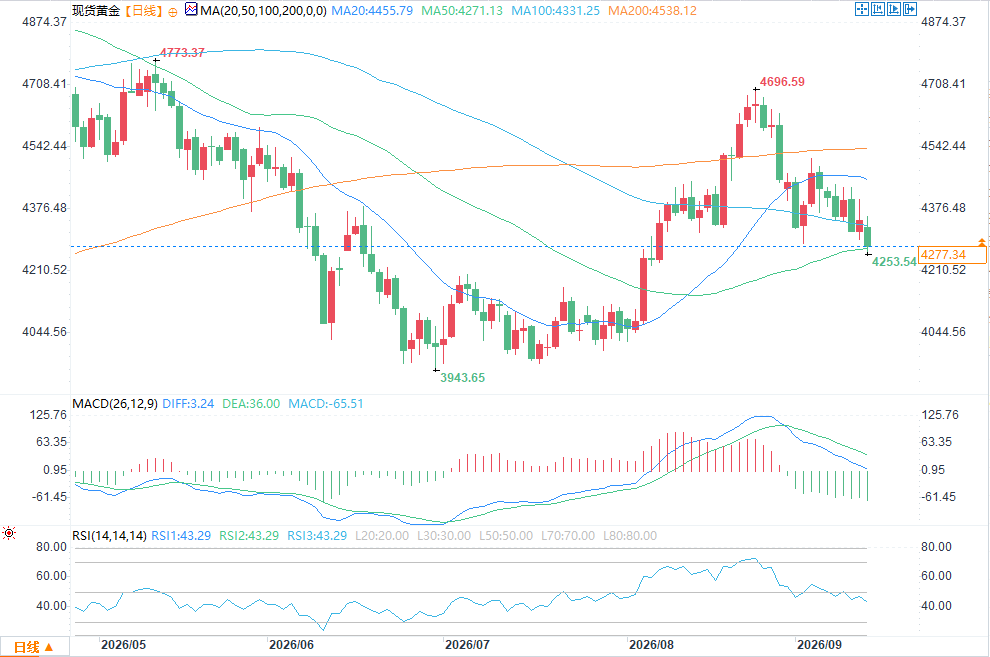 (Spot Gold Daily Chart Source: FX678) Gold's short-term momentum has weakened significantly, breaking through several key support levels. Latest analysis shows that resistance levels for gold are at $4319.60, followed by $4353.92 and $4396.78. Currently, gold is fluctuating around $4275, with market focus shifting to the support level near the 50-day moving average at $4266.76. If this level is effectively broken, bearish momentum will be further released, and gold will test deeper support levels. On the upside, gold needs to regain a foothold above $4319.60 for bulls to have a chance to challenge the strong resistance zone of $4353.92-$4396.78. Silver's technical trend is also under pressure. The key support zone is $62.98-$61.04, with the 50-day moving average at $62.58 falling within this range, making it a key level for traders to watch. If silver effectively breaks below this support, it will further test $60.835. Initial resistance is at $65.59, followed by $67.01; only a sustained move above $68.33 will significantly improve the short-term technical outlook for silver. Monday's US economic calendar is relatively light; ahead of Wednesday's Fed rate decision, geopolitical tensions, oil prices, and US Treasury yields will dominate market movements. The market has largely priced in the rate hike expectation; the real catalyst for gold prices may come from Fed Chairman Kevin Warsh's comments on the future path of monetary policy, and how policymakers view the current energy-driven inflation shock and whether further tightening of monetary policy is necessary.
The market is digesting Friday's inflation data, which exceeded expectations, putting continued pressure on precious metals. Meanwhile, the core Consumer Price Index (CPI) rose 0.3% month-on-month, slightly higher than economists' expectations of 0.2%. The latest inflation data, coupled with persistently high energy prices, has led the market to significantly raise its expectations for monetary tightening. Current market pricing indicates an approximately 87% probability of a 25 basis point rate hike by the Federal Reserve on Wednesday; simultaneously, the market expects cumulative rate hikes exceeding 90 basis points over the next year. These rate hike expectations have pushed US Treasury yields to multi-year highs, creating significant downward pressure on gold, which offers no interest income. Simultaneously with the latest inflation data, the US consumer environment is also weakening. The University of Michigan's preliminary consumer sentiment index fell to 47.8. One-year inflation expectations jumped from 4.0% to 4.6%, and long-term inflation expectations rose from 3.3% to 3.4%. On the one hand, economic uncertainty benefits safe-haven assets; on the other hand, persistently high inflation is forcing interest rates to rise. These two factors intertwine, making the market environment complex. GivTrade technical analyst Walid Saeed stated that gold is currently being pulled by two conflicting forces. Deteriorating geopolitical tensions in the Middle East and concerns about energy supply security are driving safe-haven buying, supporting gold prices; however, rising oil and diesel prices will push up transportation, production, and consumer costs, providing justification for the Federal Reserve to implement tighter monetary policy. The Middle East geopolitical situation is rapidly changing, with a new round of conflict threatening key energy infrastructure and shipping lanes. The Gulf states' plan to open a temporary shipping route through the Strait of Hormuz has been postponed; attacks on commercial shipping have continued to escalate global energy supply risks. Furthermore, Saudi Arabia's important east-west oil pipeline has been shut down after a drone attack, temporarily disabling this crucial shipping route that bypasses the Strait of Hormuz. Escalating conflict has driven oil prices sharply higher, further increasing inflationary uncertainty ahead of the Federal Reserve's monetary policy decision. On Monday, Brent crude broke through $108 per barrel, and West Texas Intermediate (WTI) crude held above $100. The surge in oil prices is a double-edged sword for gold: geopolitical risks create safe-haven demand, but high oil prices also reinforce the justification for interest rate hikes. Said believes that the situation in Iran, oil shipping routes, and continued tight global diesel supply may provide medium- to long-term support for gold prices. However, he also warns that if US Treasury yields or the US dollar index continue to rise, increasing returns for investors holding interest-bearing assets, gold will face a new round of volatility and correction. The bond market is the main short-term negative factor suppressing gold prices. The 10-year US Treasury yield once touched 4.992%, a near three-year high, and is currently trading at 4.97%, just a step away from the key psychological level of 5%. The impact of rising long-term US Treasury yields extends beyond gold. The US sovereign debt has exceeded $40 trillion; if borrowing costs remain high, the burden of government debt interest payments will increase dramatically. Once the 10-year US Treasury yield stabilizes above 5%, financing costs across society will rise, and federal fiscal pressure will further increase. The situation is quite contradictory for gold: rising short-term yields increase the opportunity cost of holding non-interest-bearing gold; however, the deteriorating US fiscal situation is a crucial foundation supporting the long-term investment logic of gold. (Technical Analysis ) (Spot Gold Daily Chart Source: FX678) Gold's short-term momentum has weakened significantly, breaking through several key support levels. Latest analysis shows that resistance levels for gold are at $4319.60, followed by $4353.92 and $4396.78. Currently, gold is fluctuating around $4275, with market focus shifting to the support level near the 50-day moving average at $4266.76. If this level is effectively broken, bearish momentum will be further released, and gold will test deeper support levels. On the upside, gold needs to regain a foothold above $4319.60 for bulls to have a chance to challenge the strong resistance zone of $4353.92-$4396.78. Silver's technical trend is also under pressure. The key support zone is $62.98-$61.04, with the 50-day moving average at $62.58 falling within this range, making it a key level for traders to watch. If silver effectively breaks below this support, it will further test $60.835. Initial resistance is at $65.59, followed by $67.01; only a sustained move above $68.33 will significantly improve the short-term technical outlook for silver. Monday's US economic calendar is relatively light; ahead of Wednesday's Fed rate decision, geopolitical tensions, oil prices, and US Treasury yields will dominate market movements. The market has largely priced in the rate hike expectation; the real catalyst for gold prices may come from Fed Chairman Kevin Warsh's comments on the future path of monetary policy, and how policymakers view the current energy-driven inflation shock and whether further tightening of monetary policy is necessary.
- Risk Warning and Disclaimer
- The market involves risk, and trading may not be suitable for all investors. This article is for reference only and does not constitute personal investment advice, nor does it take into account certain users’ specific investment objectives, financial situation, or other needs. Any investment decisions made based on this information are at your own risk.