The euro's drop below 1.153 is not a case of priced in the negative news; DBS says the real advantage is just beginning to be priced in.
2026-09-14 21:58:09
On Monday, September 14th, the euro was trading around 1.153 against the dollar, down about 0.5% from the previous trading day, and down about 0.7% to 0.8% over the past week. After retreating from its late August highs, the euro continued to digest the difference between the European Central Bank's (ECB) expected rate hike on September 10th and the anticipated Fed meeting this week. Brent crude oil remained above $100 per barrel, with Eurozone harmonized inflation rising to 3.3% in August, while the US consumer price index remained stable at 3.4% year-on-year in August. The market's focus has shifted from "who is more hawkish" to "whose institutional framework is clearer and whose reaction function is more verifiable." DBS Group believes that the euro has a subtle but logically more stable advantage over the dollar this week. The key is not the number of rate hikes themselves, but the credibility of the ECB's strategy to bring inflation back to its target, and the pricing friction left by the changes in the Fed's communication framework. 
 Cross-market comparisons offer even more information. After the ECB's rate hike, the euro did not experience a one-sided acceleration of "policy fulfillment leading to exhaustion of buying interest," indicating that pricing had already partially priced it in. The dollar index and short-term US Treasury bonds, on the other hand, are using this week's meeting as a window to test the Warsh reaction function. The higher the degree to which interest rate futures price in the rate hike, the lower the exchange rate's elasticity to whether or not a rate hike will occur on the day of the meeting, and the higher its elasticity to how the rate hike or non-hike will be interpreted.
The institutional credibility behind the European Central Bank's continuous interest rate hikes
On September 10, the European Central Bank (ECB) raised its three key interest rates by 25 basis points. The deposit facility rate rose to 2.50% effective September 16, the main refinancing rate to 2.65%, and the marginal lending rate to 2.90%. This was the second rate hike this year, following the one in June. The latest forecasts from the ECB administration show that overall inflation in the Eurozone will average 3.0% in 2026, 2.5% in 2027, and 2.1% in 2028; excluding energy and food, the figures are 2.5%, 2.6%, and 2.3%, respectively. Growth forecasts were revised upwards to 0.9% in 2026, 1.4% in 2027, and 1.5% in 2028. The upward revisions to both the inflation path and growth forecasts indicate that the Governing Council views the energy shock as a price stability issue, rather than simply using slower growth as a countermeasure. ECB President Christine Lagarde stated after the meeting: "The Middle East conflict continues to exert inflationary pressures, and inflation will be significantly above the target for an extended period." She also emphasized that the Governing Council does not pre-commit to a specific interest rate path, and decisions are made on a case-by-case basis, according to data. Eurozone inflation rose to 3.3% in August from 2.9% in July, with the energy component climbing to 14.3% year-on-year, while core inflation fell to 2.4%. Structurally, the shock was primarily driven by an energy-led supply shock. While core inflation is not yet fully out of control, the secondary transmission from energy to food, goods, and services is still included in the risk scenario. Lagarde further stated that, according to current forecasts, inflation will rise first and then slow, "it will get worse first, and then it will get better." This statement anchors the policy target at 2% in the medium term, publicly acknowledging the short-term pain and reducing market speculation about "prematurely easing policies for the sake of growth."Changes in the Federal Reserve's Communication Framework and Market Pricing Friction
The Federal Reserve's target range for the federal funds rate remains at 3.50% to 3.75%, with a key policy meeting scheduled for September 15-16 under Warsh's leadership. The market has largely priced in a 25 basis point increase to 3.75% to 4.00%. The US Consumer Price Index (CPI) for August was 3.4% year-on-year and 0.4% month-on-month, with core inflation at 2.4% year-on-year and 0.3% month-on-month; energy inflation was approximately 16.3% year-on-year, with gasoline showing a rise. The Personal Consumption Expenditures (PCE) price index, which the Fed focuses on more closely, was approximately 3.7% year-on-year in July. Warsh stated at Jackson Hole on August 28th, "We must be confident that underlying inflation is clearly moving toward our target at a sufficiently high pace, or there is still work to be done." He also emphasized that the overnight rate is the primary tool for fulfilling the dual mandate and rejected the previous approach of clearly outlining the path of forward guidance. It is necessary to consider the policy stance and the institutional environment separately. Warsh attributed the responsibility for inflation consistently exceeding target over the past 65 months to the central bank itself, reiterating its role in ensuring price stability. However, with reduced communication, bond, exchange rate, and interest rate options are all speculating about "what the next trigger condition will be." For the euro against the dollar, the sensitivity lies not in whether the Fed verbally tightens, but in whether the meeting statement, the dot plot (if still released), and the press conference can fill in the gaps in the information about the path that has been deliberately removed. Without this information, the dollar's interest rate advantage cannot automatically translate into a currency advantage.Energy shocks, fiscal divergence, and exchange rate transmission mechanisms
The exogenous variable in this round of Eurozone interest rate hikes is energy. Brent crude oil has recently been trading above $100 per barrel, and European natural gas prices have risen significantly since before the escalation of the conflict. The ECB has specifically mentioned the contribution of refining margins to liquid fuel inflation. While the energy shock has raised inflation, it has also increased nominal growth and fiscal interest payments. France's fiscal deficit remains near 5%, and its consolidation path is slower than previously targeted; Italy, on the other hand, has lowered its 2026 deficit target to below 3% and emphasized a primary surplus. The yields on the two countries' government bonds were once almost equal, indicating that the market is re-ranking sovereign premiums rather than simply repackaging Southern Europe into the same risk basket. DBS Group believes that fiscal concerns remain in France and Italy, but believes that the ECB is relatively less constrained by domestic politics. The implication of this comparison is that interest rate differentials and credit premiums can be separated: the Eurozone's common monetary policy response to inflation does not equate to a simultaneous convergence of fiscal premiums in individual countries. The euro exchange rate reflects the credibility of the entire region's policy and external interest rate differentials, while member states' interest rate differentials reflect their respective fiscal paths. Interpreting these two factors together can easily lead to mistaking fiscal noise for a loosening of the monetary system. On the dollar side, short-term interest rates have already priced in the possibility of rate hikes, while long-term rates simultaneously trade on inflation stickiness, the duration of supply shocks, and the scale of fiscal financing. When oil prices remain high, short-term inflation expectations are easily pushed up, and whether long-term expectations follow suit depends on whether the market believes the shock is one-off. If the narrative shifts from "inflation" to "sustainable financing," the interpreter of the dollar's interest rate advantage will shift from monetary policy to fiscal policy.Exchange rate structure and the repricing logic of cross-market signals
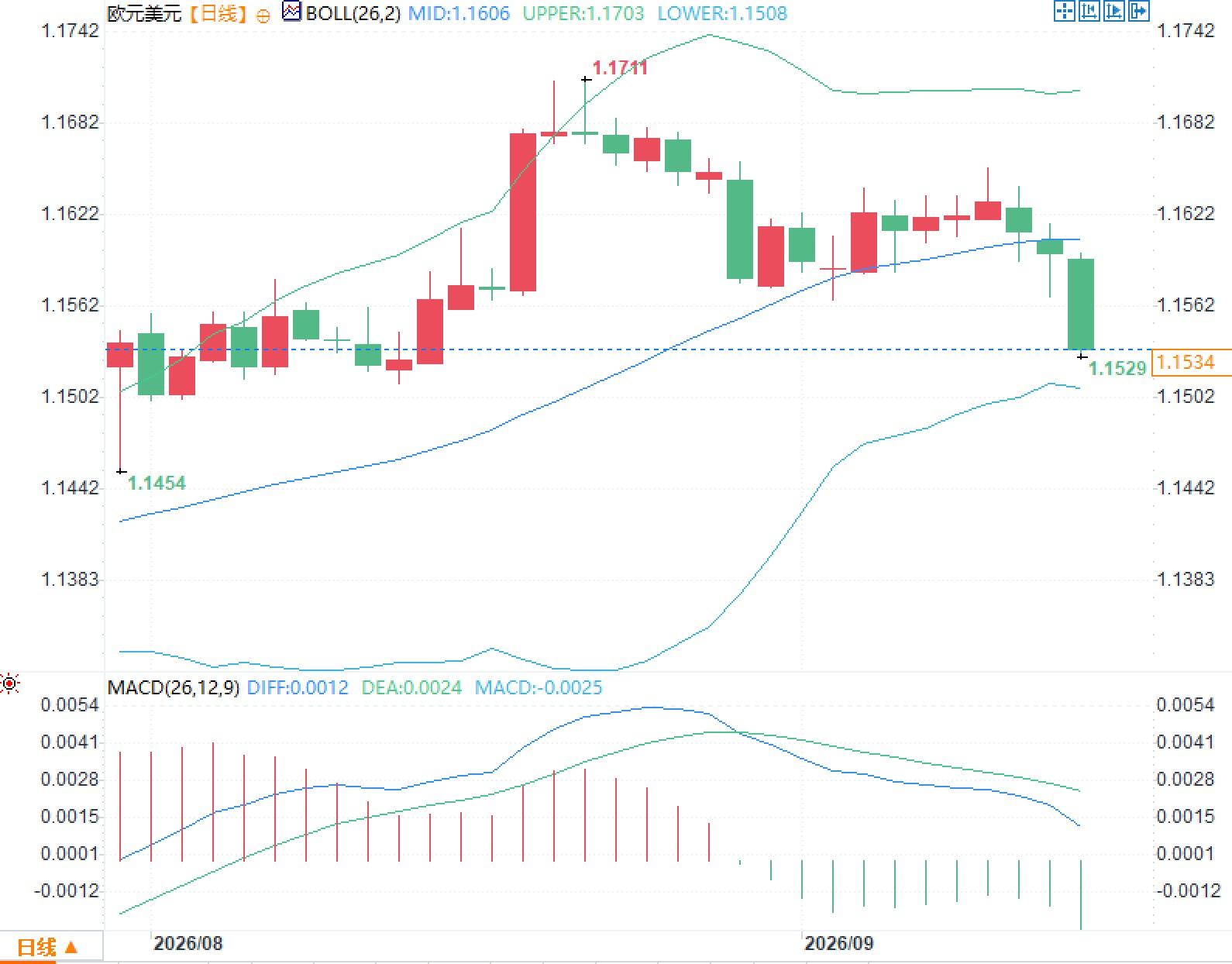
On the daily chart, the euro/dollar pair rose from a relative low in August, reaching a high of around 1.171 in late August, before entering a period of retracement and consolidation in September. The Bollinger Bands have the middle band around 1.161, the upper band around 1.170, and the lower band around 1.151; the price is currently trading close to the lower band. The MACD shows the DIFF at approximately 0.0012 and the DEA at approximately 0.0024, with the histogram turning negative and the fast line below the slow line, indicating that momentum has shifted from expansion in August to contraction in September. Cross-market comparisons offer even more information. After the ECB's rate hike, the euro did not experience a one-sided acceleration of "policy fulfillment leading to exhaustion of buying interest," indicating that pricing had already partially priced it in. The dollar index and short-term US Treasury bonds, on the other hand, are using this week's meeting as a window to test the Warsh reaction function. The higher the degree to which interest rate futures price in the rate hike, the lower the exchange rate's elasticity to whether or not a rate hike will occur on the day of the meeting, and the higher its elasticity to how the rate hike or non-hike will be interpreted.
- Risk Warning and Disclaimer
- The market involves risk, and trading may not be suitable for all investors. This article is for reference only and does not constitute personal investment advice, nor does it take into account certain users’ specific investment objectives, financial situation, or other needs. Any investment decisions made based on this information are at your own risk.