The Baltic Dry Index fell for the third consecutive day, hitting a near two-week low, with freight rates for large vessels continuing to weaken.
2026-09-14 22:54:09
On September 14, 2026, the international dry bulk shipping market experienced a significant correction. The Baltic Dry Index (BDI) declined for the third consecutive trading day, closing at 3445 points, a drop of 62 points on the day, representing an overall decline of 1.8%, and marking its lowest level in nearly two weeks since September 2. This round of index decline was not a general market downturn, but rather exhibited significant structural differentiation. Freight rates for large, mainstream vessel types weakened sharply, while small and medium-sized vessels showed resilience and rose slightly against the trend. The core drag stemmed from cooling demand for upstream commodities, coupled with a short-term mismatch between shipping supply and demand, putting renewed pressure on the previously recovering dry bulk market. 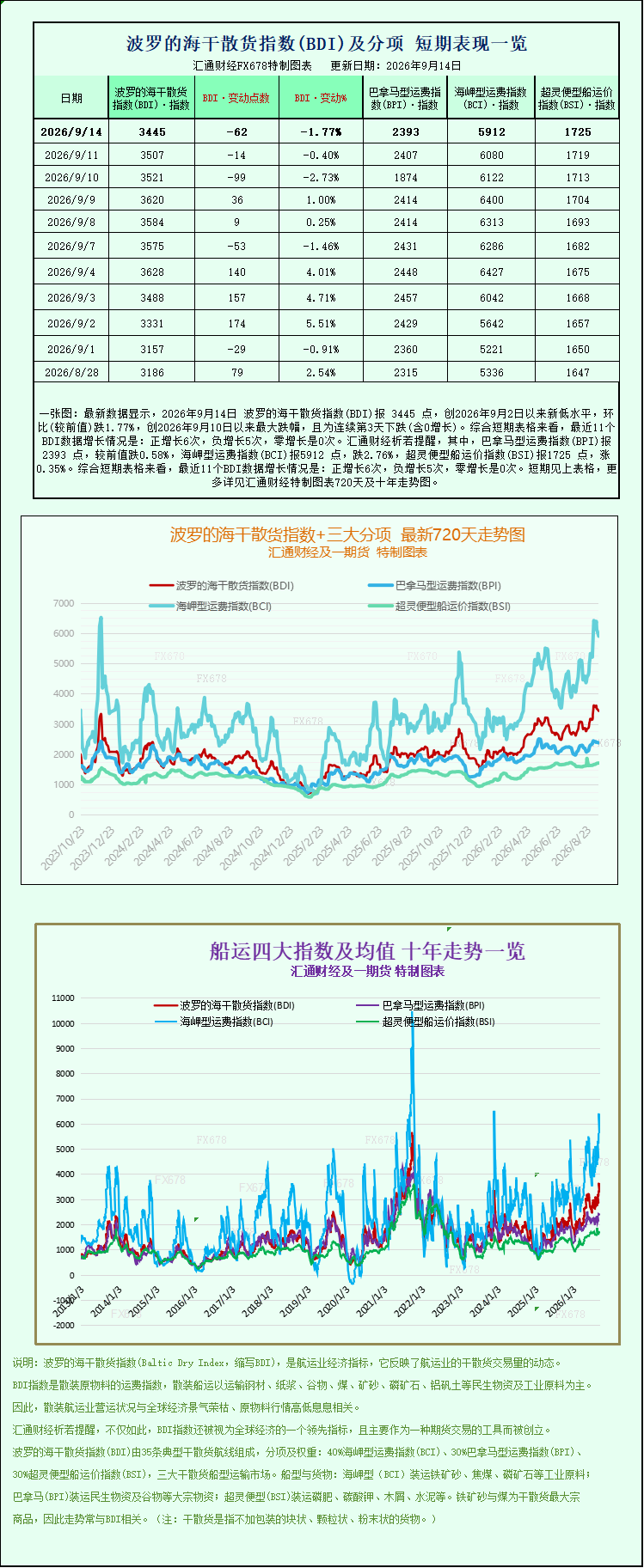 Looking at the data by ship type, large vessels carrying bulk industrial raw materials were the core drag on the index decline, with Capesize vessels experiencing the most significant drop. Data shows that the Capesize vessel index fell sharply by 168 points in a single day, a decrease of 2.8%, closing at 5912 points. Correspondingly, the mainstream 150,000-ton Capesize bulk carriers, mainly carrying core industrial raw materials such as iron ore and coal, saw their average daily operating revenue decrease by $1517 to $50119, indicating a continued contraction in profit margins for large ocean-going dry bulk shipping. As a bellwether for the dry bulk market, the sharp decline in Capesize freight rates directly reflects the rapid cooling of global demand for ocean shipping of industrial raw materials. Panamax vessels followed suit, also continuing their weak trend, with insufficient momentum for market recovery. This period, the Panamax vessel index fell slightly by 14 points, a decrease of 0.6%, closing at 2393 points, with freight rates showing a relatively stable but persistently under pressure. The mainstream deadweight tonnage of this vessel type is 60,000 to 70,000 tons, mainly responsible for the transoceanic transportation of bulk commodities such as coal and grains globally. Its average daily revenue decreased by $122, ultimately settling at $21,540. The simultaneous weakening of the two main large vessel types, coupled with the full digestion of previous market positive sentiment, directly dragged down the overall dry bulk index trend, ending the short-term recovery at the beginning of the month. In stark contrast to the general decline of large vessels, small and medium-sized vessels in the market showed strong resilience, achieving a counter-trend increase. The Supramax vessel index rose slightly by 6 points, an increase of 0.4%, closing at 1725 points, becoming the only vessel type to rise in the current market. Industry analysts pointed out that this structural differentiation stems from the differences in the operating characteristics of different vessel types. Supramax vessels are smaller in tonnage, have more flexible routes, and are suitable for a wider range of cargo types. They can undertake small industrial raw material transportation orders and also cover regional agricultural products, building materials, and other short-distance and feeder transportation needs, and are less affected by the cyclical fluctuations of heavy industry. Against the backdrop of weak demand for large-scale ocean shipping, small-volume, regional shipping orders have supported the steady upward trend in freight rates for smaller vessels. The recent sharp drop in freight rates for large vessels and the continued decline in the Baltic Dry Index (BDI) are primarily driven by a significant contraction in global iron ore demand, with a pronounced ripple effect across the industry chain. Global iron ore futures prices have recently continued to decline, reaching a low point since August 21st, reflecting persistently pessimistic market expectations for demand. As a core global iron ore consumer market, China's steel industry is facing increasing operational pressure, with steel mill profitability falling to historical lows and production enthusiasm significantly limited. To control costs and mitigate the risks of further market downturns, downstream steel mills have proactively reduced capacity and decreased raw material restocking, directly leading to a cooling of iron ore import demand. Since iron ore is a core cargo carried by Capesize vessels, the precipitous drop in demand has directly resulted in a sharp decline in charter orders for large bulk carriers and a rapid correction in freight rates. In addition to weak demand for commodities, shipping geopolitical data also signals market caution. Preliminary vessel tracking data shows a sharp decline in the number of cargo ships passing through the Strait of Hormuz over the past weekend, with daily traffic dropping to single digits, far below the average of 14 ships per day over the past 10 days. As a crucial choke point for global energy and commodity shipping, the significant drop in vessel traffic through the Strait of Hormuz reflects both increased caution among traders regarding short-term market conditions, leading to a proactive slowdown in shipments and transportation; and exacerbates the pressure on the global dry bulk shipping market, further suppressing the recovery momentum of freight rates. Looking back at the market trend in early September, this round of index correction is a phase of adjustment. At the beginning of the month, the Baltic Dry Index (BDI) experienced a brief three-day rise, mainly driven by rising pre-holiday restocking expectations and a concentrated release of ocean shipping orders, leading to a short-term recovery in market sentiment. However, as the concentrated restocking demand gradually materialized, the short-term chartering benefits were fully absorbed, coupled with a relatively ample supply of large vessels in the short term, reversing the supply-demand balance and ultimately triggering a systemic decline in freight rates. Currently, the market as a whole presents a pattern of "large vessels under pressure, small vessels resilient, weak demand, and cautious sentiment." Looking ahead to the dry bulk shipping market, the pace of recovery will continue to depend on the recovery in demand for upstream commodities. In the short term, the steel industry's profit recovery has not yet materialized, and demand for transporting industrial raw materials such as iron ore and coal is unlikely to rebound significantly. Large vessel freight rates are likely to continue their weak and volatile trend, with the Baltic Dry Index (BDI) likely to remain low. Meanwhile, smaller vessels such as Supramax, leveraging their flexible transport advantages, are expected to continue to benefit from regional trade and less-than-truckload (LTL) cargo transport demand, maintaining a relatively independent and resilient trend. In the medium to long term, the pace of global industrial production recovery, commodity restocking cycles, and the efficiency of international shipping geopolitical flows will be the core factors driving future dry bulk freight rate trends.
Looking at the data by ship type, large vessels carrying bulk industrial raw materials were the core drag on the index decline, with Capesize vessels experiencing the most significant drop. Data shows that the Capesize vessel index fell sharply by 168 points in a single day, a decrease of 2.8%, closing at 5912 points. Correspondingly, the mainstream 150,000-ton Capesize bulk carriers, mainly carrying core industrial raw materials such as iron ore and coal, saw their average daily operating revenue decrease by $1517 to $50119, indicating a continued contraction in profit margins for large ocean-going dry bulk shipping. As a bellwether for the dry bulk market, the sharp decline in Capesize freight rates directly reflects the rapid cooling of global demand for ocean shipping of industrial raw materials. Panamax vessels followed suit, also continuing their weak trend, with insufficient momentum for market recovery. This period, the Panamax vessel index fell slightly by 14 points, a decrease of 0.6%, closing at 2393 points, with freight rates showing a relatively stable but persistently under pressure. The mainstream deadweight tonnage of this vessel type is 60,000 to 70,000 tons, mainly responsible for the transoceanic transportation of bulk commodities such as coal and grains globally. Its average daily revenue decreased by $122, ultimately settling at $21,540. The simultaneous weakening of the two main large vessel types, coupled with the full digestion of previous market positive sentiment, directly dragged down the overall dry bulk index trend, ending the short-term recovery at the beginning of the month. In stark contrast to the general decline of large vessels, small and medium-sized vessels in the market showed strong resilience, achieving a counter-trend increase. The Supramax vessel index rose slightly by 6 points, an increase of 0.4%, closing at 1725 points, becoming the only vessel type to rise in the current market. Industry analysts pointed out that this structural differentiation stems from the differences in the operating characteristics of different vessel types. Supramax vessels are smaller in tonnage, have more flexible routes, and are suitable for a wider range of cargo types. They can undertake small industrial raw material transportation orders and also cover regional agricultural products, building materials, and other short-distance and feeder transportation needs, and are less affected by the cyclical fluctuations of heavy industry. Against the backdrop of weak demand for large-scale ocean shipping, small-volume, regional shipping orders have supported the steady upward trend in freight rates for smaller vessels. The recent sharp drop in freight rates for large vessels and the continued decline in the Baltic Dry Index (BDI) are primarily driven by a significant contraction in global iron ore demand, with a pronounced ripple effect across the industry chain. Global iron ore futures prices have recently continued to decline, reaching a low point since August 21st, reflecting persistently pessimistic market expectations for demand. As a core global iron ore consumer market, China's steel industry is facing increasing operational pressure, with steel mill profitability falling to historical lows and production enthusiasm significantly limited. To control costs and mitigate the risks of further market downturns, downstream steel mills have proactively reduced capacity and decreased raw material restocking, directly leading to a cooling of iron ore import demand. Since iron ore is a core cargo carried by Capesize vessels, the precipitous drop in demand has directly resulted in a sharp decline in charter orders for large bulk carriers and a rapid correction in freight rates. In addition to weak demand for commodities, shipping geopolitical data also signals market caution. Preliminary vessel tracking data shows a sharp decline in the number of cargo ships passing through the Strait of Hormuz over the past weekend, with daily traffic dropping to single digits, far below the average of 14 ships per day over the past 10 days. As a crucial choke point for global energy and commodity shipping, the significant drop in vessel traffic through the Strait of Hormuz reflects both increased caution among traders regarding short-term market conditions, leading to a proactive slowdown in shipments and transportation; and exacerbates the pressure on the global dry bulk shipping market, further suppressing the recovery momentum of freight rates. Looking back at the market trend in early September, this round of index correction is a phase of adjustment. At the beginning of the month, the Baltic Dry Index (BDI) experienced a brief three-day rise, mainly driven by rising pre-holiday restocking expectations and a concentrated release of ocean shipping orders, leading to a short-term recovery in market sentiment. However, as the concentrated restocking demand gradually materialized, the short-term chartering benefits were fully absorbed, coupled with a relatively ample supply of large vessels in the short term, reversing the supply-demand balance and ultimately triggering a systemic decline in freight rates. Currently, the market as a whole presents a pattern of "large vessels under pressure, small vessels resilient, weak demand, and cautious sentiment." Looking ahead to the dry bulk shipping market, the pace of recovery will continue to depend on the recovery in demand for upstream commodities. In the short term, the steel industry's profit recovery has not yet materialized, and demand for transporting industrial raw materials such as iron ore and coal is unlikely to rebound significantly. Large vessel freight rates are likely to continue their weak and volatile trend, with the Baltic Dry Index (BDI) likely to remain low. Meanwhile, smaller vessels such as Supramax, leveraging their flexible transport advantages, are expected to continue to benefit from regional trade and less-than-truckload (LTL) cargo transport demand, maintaining a relatively independent and resilient trend. In the medium to long term, the pace of global industrial production recovery, commodity restocking cycles, and the efficiency of international shipping geopolitical flows will be the core factors driving future dry bulk freight rate trends.- Risk Warning and Disclaimer
- The market involves risk, and trading may not be suitable for all investors. This article is for reference only and does not constitute personal investment advice, nor does it take into account certain users’ specific investment objectives, financial situation, or other needs. Any investment decisions made based on this information are at your own risk.