Gold Trading Alert: Continued interest rate hike expectations weigh on gold prices, pushing them to a more than one-month low. How long can the bulls hold on?
2026-09-15 07:40:09
Gold prices weakened on Monday (September 14), with spot gold falling as low as $4,253.54 per ounce, its lowest level since August 7, before closing down 1.1% at $4,298.63. U.S. gold futures also fell 1.3% to $4,351.90. Multiple factors, including escalating conflict in the Middle East, a jump in oil prices, better-than-expected inflation data, and a surge in the probability of a Federal Reserve rate hike, put downward pressure on gold prices. On Tuesday (September 15) in early Asian trading, spot gold hovered at lower levels, currently trading around $4,290 per ounce. 
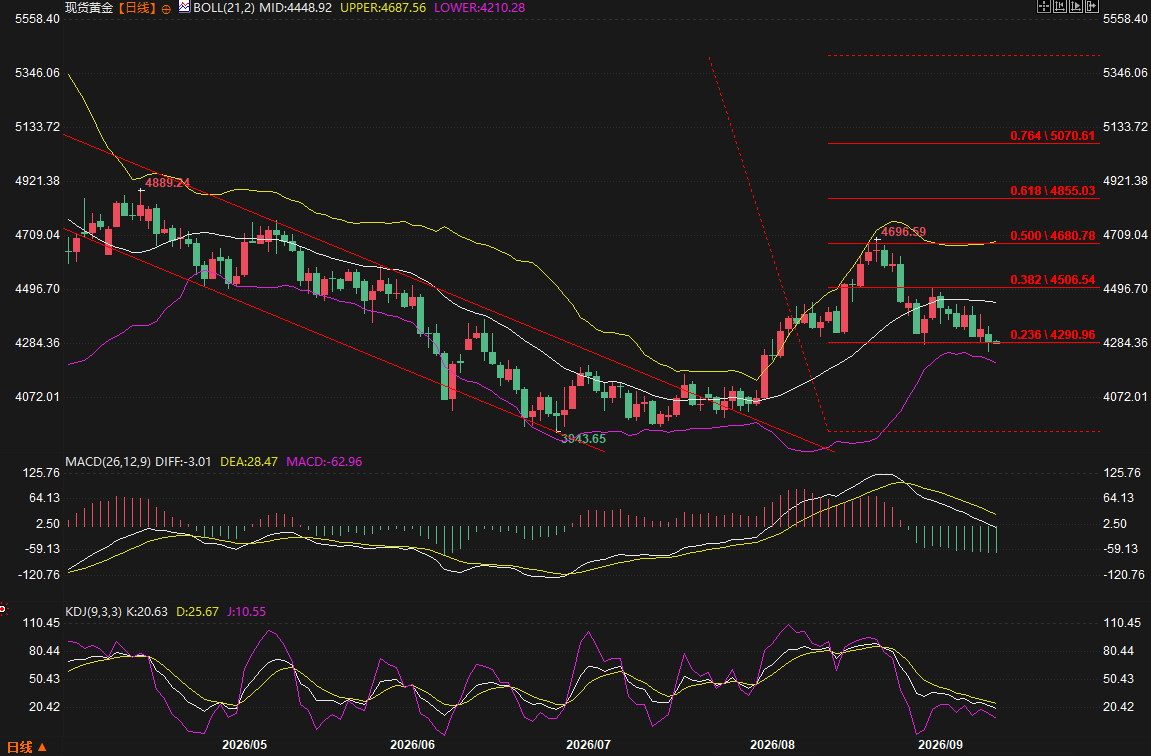 (Spot gold daily chart, source: EasyTrade) At 07:35 Beijing time, spot gold is currently trading at $4290.21 per ounce.
Inflation data supports expectations of a Fed rate hike this week.
Monday's gold market movements clearly reflected investors' reassessment. Spot gold not only broke through key support but also hit a more than one-month low, indicating a concentrated release of selling pressure. Jim Wyckoff, market analyst at the Gold Exchange, pointed out that the sharp rise in oil prices directly pushed up inflation expectations, meaning that major central banks around the world will have to take more stringent monetary tightening measures to curb price increases, which is a significant negative factor for gold, a non-interest-bearing asset. This logic is not unfounded. The stronger-than-expected US inflation data for August released last Friday has broken the previous fragile consensus in the market that the Federal Reserve would keep interest rates unchanged. Surveys show that most economists now expect the Fed to raise interest rates at its policy meeting on Wednesday and may raise rates at least once more before the end of March next year. The CME Group's FedWatch tool has even pushed the probability of a rate hike this week to about 93%. At the same time, rising energy prices and little sign of easing tensions in the Middle East, along with market expectations that the Bank of Japan will raise interest rates on Friday, have significantly increased the opportunity cost of holding gold, leading investors to naturally choose to sell to avoid the pressure of a higher interest rate environment. The simultaneous strengthening of the US dollar further amplified the downward pressure on gold prices. The dollar index rose to a two-week high, making dollar-denominated gold more expensive for holders of other currencies, thus suppressing international buying. It can be said that Monday's gold price decline was essentially a result of asset reallocation driven by interest rate expectations, rather than a simple waning of safe-haven demand.Middle East conflict exacerbates inflation concerns
The real trigger for market sentiment was the sharp deterioration in Middle Eastern geopolitics. On Monday, Yemen's pro-Iranian Houthi rebels again attacked the Khamis Mushait airbase in southern Saudi Arabia, launching dozens of missiles and drones targeting aircraft hangars, radar systems, runways, and ammunition depots. Meanwhile, a key Saudi oil pipeline was paralyzed by Friday's attack; this pipeline is a crucial export route for Gulf oil bypassing the blocked Strait of Hormuz. Satellite images show that sections of the pipeline have been damaged by fire, and a prolonged shutdown could reduce global oil supplies by up to 4%. Even more worrying is the continued blockade of the Strait of Hormuz. Iran's Revolutionary Guard claimed that a Panamanian-flagged oil tanker struck a mine and exploded in the "restricted area" south of the strait, but the US Central Command immediately denied this, stating that the vessel had been hit by an Iranian missile last month and rendered inoperable. Regardless of the truth, this incident once again highlights the vulnerability of the strait as the world's most important oil shipping route. Since the outbreak of the war with Iran on February 28, the Strait of Hormuz has been largely closed, with the International Maritime Organization recording 79 related incidents resulting in the deaths of 22 sailors. The planned talks between Oman and Iran and Gulf states to reopen the Strait, scheduled for Monday, were postponed at Saudi Arabia's request, further diminishing diplomatic hopes. Oil prices reacted swiftly. Earlier on Monday, crude oil prices jumped by about 4% to 5%, with Brent crude reaching a high of $109.8 per barrel before giving back some gains to close at $106.15. The average retail price of diesel in the United States hit a record high, exceeding $6.23 per gallon. The surge in oil prices directly boosted inflation expectations, especially given that core inflation in August had already exceeded expectations, significantly strengthening market confidence that the Federal Reserve would have to raise interest rates to curb inflation. Gold was thus caught in a dilemma: on the one hand, the Middle East conflict should have supported its safe-haven status; on the other hand, the oil price increase triggered by the conflict reinforced tightening expectations, ultimately giving the bearish forces the upper hand.The combined effects of the bond and foreign exchange markets amplified the pressure on gold prices.
The decline in gold prices is not an isolated phenomenon, but rather shows a clear correlation with the US bond market and global currency markets. On Monday, the benchmark 10-year US Treasury yield briefly rose above the key psychological level of 5%, reaching 5.0142%, the first time since October 2023. Although it subsequently fell back to 4.957%, this milestone level has sent a strong signal. Analysts pointed out that persistent inflation, rising expectations of interest rate hikes, a massive supply of corporate and government debt, a strong economic growth outlook, and concerns about the long-term fiscal trajectory of the United States have all contributed to the continued rise in yields over the past month. If the 10-year yield breaks through the 2023 peak of 5.021%, it will be the highest level since 2007, potentially threatening the stock market bull run by weakening the relative attractiveness of US stocks. The two-year US Treasury yield also briefly touched 4.679%, the highest since July 2024, before slightly retreating. The break-even yield of the 10-year Treasury Inflation-Protected Securities (TIPS), which reflects inflation expectations, rose to 2.622%, a new high since 2008. These data clearly indicate that the market is pricing in a higher interest rate path. Federal funds futures show that traders believe there is a 93% probability of a Fed rate hike on Wednesday, far higher than the approximately 60% a week ago. The Fed's upcoming "dot plot" may also show that some policymakers expect one more rate hike this year. The dollar strengthened across the board in this environment, with the dollar index rising 0.3% to 99.41 in late New York trading, having touched a two-week high of 99.735 earlier in the session. Safe-haven inflows, a surge in oil prices, and market concerns about the potential risks of AI all supported the dollar. Francesco Pesole, a foreign exchange strategist at ING, pointed out that developments in the Gulf region remain worrying, and AI-related news is also weighing on the stock market, thus continuing to support the dollar. Analysts at MUFG emphasized that increasing market expectations that the Fed will begin tightening monetary policy are driving a slight strengthening of the dollar. However, this strength also carries risks: if the Fed ultimately chooses to keep interest rates unchanged, or adopts a "dovish" rate hike without clearly committing to further action, the dollar could quickly come under pressure. Globally, bets on rate hikes are also heating up. A Bank of Japan rate hike on Friday is virtually a certainty, with speculators turning net long on the yen for the first time since February. The European Central Bank raised rates last week, and traders now expect the Bank of England to raise rates later this year and take further action in 2027. While the simultaneous rise in government bond yields to multi-year and even multi-decade highs has had a relatively limited impact on the foreign exchange market, it has significantly suppressed non-interest-bearing assets like gold.Gold Market Outlook: Will There Be a Breather After the Interest Rate Hike?
Looking ahead, gold's fate largely hinges on the actual outcome of this week's Federal Reserve decision. If the Fed raises interest rates as expected and signals further tightening, gold prices may continue to be under pressure, especially given that oil prices remain high due to the Middle East conflict. Conversely, if the decision is dovish, or the dot plot shows a less favorable rate hike path than anticipated, gold prices may experience a technical rebound. Any signs of easing tensions in the Middle East—such as the resumption of negotiations in the Strait of Hormuz or the reopening of Saudi pipelines—will indirectly benefit gold through a decline in oil prices. Meanwhile, investors should also pay attention to the US Treasury's bond issuance plans this week. $13 billion in 20-year Treasury bonds will be issued on Tuesday, and $19 billion in 10-year Treasury Inflation-Protected Securities will be auctioned on Thursday. These supplies will test the market's tolerance for long-term interest rates. If weak demand leads to further yield increases, the pressure on gold could intensify. Overall, in the current environment, the forces of inflation and interest rate expectations have temporarily outweighed the safe-haven demand driven by geopolitics. Gold is no longer simply a "crisis asset," but a financial instrument deeply embedded in global monetary policy expectations. In the coming weeks, the gold market may experience another round of significant volatility as the Federal Reserve's decision, the Bank of Japan's actions, and Middle East diplomatic developments unfold. For investors, closely monitoring the triangular relationship between oil prices, US Treasury yields, and the US dollar's performance will be key to seizing opportunities in the gold market. (Spot gold daily chart, source: EasyTrade) At 07:35 Beijing time, spot gold is currently trading at $4290.21 per ounce.
- Risk Warning and Disclaimer
- The market involves risk, and trading may not be suitable for all investors. This article is for reference only and does not constitute personal investment advice, nor does it take into account certain users’ specific investment objectives, financial situation, or other needs. Any investment decisions made based on this information are at your own risk.