Gold Trading Alert: Gold Prices Under Pressure, Barely Holding Above 50-Day Moving Average; Fed Decision Looms! Watch for Impact from "Terrifying Data"
2026-09-16 07:30:08
On Tuesday (September 15), spot gold fell slightly by 0.12%, hitting a low of $4261.24 per ounce during the session, and closed at $4293.52, barely holding above the 50-day moving average; US gold futures closed down 0.4%, settling at $4332.80. A combination of factors, including a stronger dollar, soaring US Treasury yields, a sharp rise in oil prices, and strengthened expectations of a Federal Reserve rate hike, continued to put pressure on gold prices. The market is closely watching the Federal Reserve's policy decision to be announced on Wednesday, which could further reshape the short-term trajectory of gold. In early Asian trading on Wednesday (September 16), spot gold traded in a narrow range, currently hovering around $4285 per ounce. 
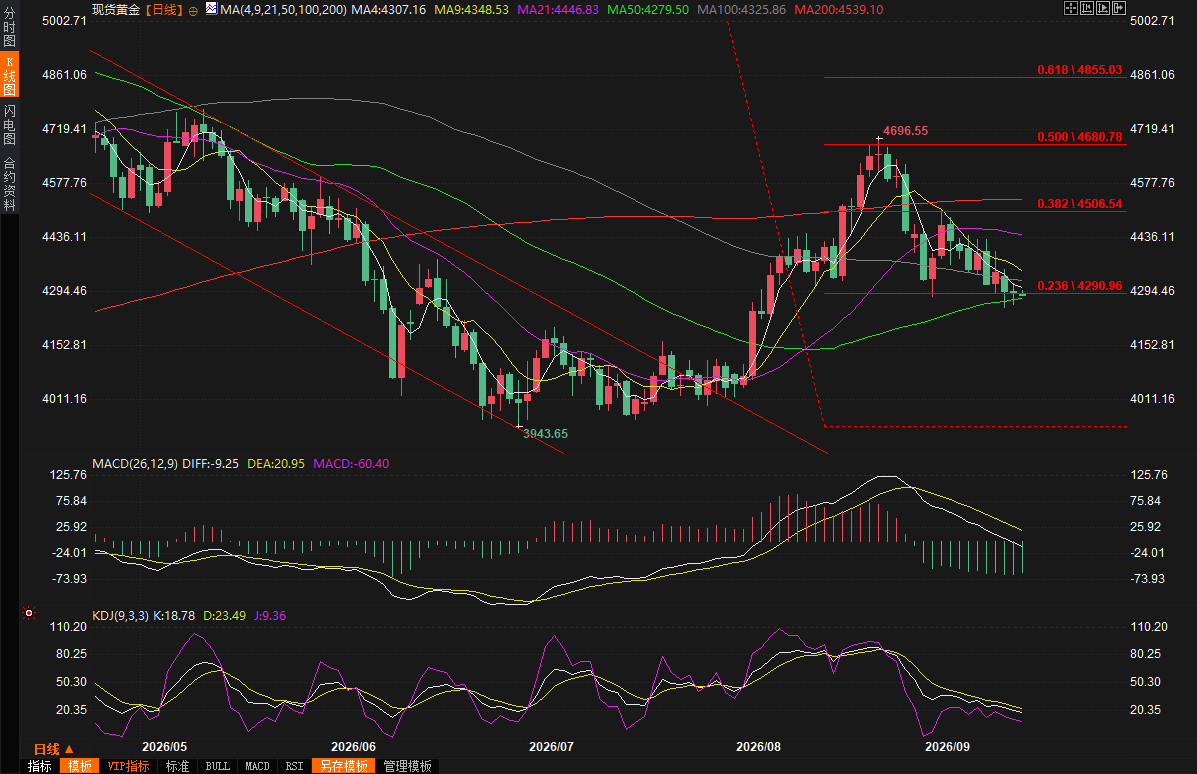 (Spot gold daily chart, source: FX678) At 07:27 Beijing time, spot gold is currently trading at $4284.62 per ounce.
A strong dollar and historically high US Treasury yields
Gold is priced in US dollars, and every strengthening of the dollar directly increases the holding costs for buyers of non-US currencies, thus suppressing demand. On Tuesday, the dollar index rose slightly to around 99.62, near a two-week high, as weakening risk appetite in the stock market further strengthened the dollar's safe-haven appeal. Meanwhile, the yield on the 10-year US Treasury note rose to 5.041%, its highest level since July 2007, while the 30-year yield touched 5.401%, also approaching a nearly 19-year high. The rapid rise in risk-free yields significantly weakened the relative attractiveness of gold, which yields no interest – investors are more inclined to hold US Treasuries, which offer stable returns, rather than "zero-interest" precious metals. StoneX senior market strategist Daniel Pavilonis stated bluntly that rising energy prices will push up inflation, which in turn will push up interest rates, directly negatively impacting gold. Currently, gold prices are largely trapped in a range-bound trading pattern; if interest rates continue to rise, prices may decline further. Analysts at ING also pointed out that the market has largely priced in the risks of a hawkish stance from the Federal Reserve, but gold will still face downward pressure if policymakers hint that interest rates will remain high for an extended period. This "high-interest-rate environment" is a direct reflection of the recent price weakness in gold.Oil price-driven inflation concerns: Middle East geopolitical conflicts ignite supply risks
What truly exacerbated market tensions was the rapid rise in crude oil prices. Brent crude closed up more than $3 on Tuesday at $108.75 a barrel, while U.S. crude rose even more sharply to $105.83, both reaching new highs since May. The core factor driving this surge was the suspension of crude oil loading operations at Yanbu port, Saudi Arabia's Red Sea export hub, and the cancellation of some late September deliveries to European customers by Riyadh. A deeper reason lies in the Houthi attacks on Saudi Arabia in Yemen, which last Friday even forced the closure of Saudi Arabia's east-west oil pipeline—a crucial 1,200-kilometer-long pipeline that bypasses the Strait of Hormuz for Saudi oil exports; its prolonged shutdown could cut off up to 4% of global oil supply. The suspension of operations at three Libyan oil fields due to protests further amplified concerns about supply disruptions. Goldman Sachs warned that the attacks on oil infrastructure marked a significant escalation of the conflict, increasing the likelihood of Brent crude breaking through $120 a barrel. While U.S. Energy Secretary Wright indicated that the pipeline was expected to be restored within days, the market remained highly vigilant about the risk of a disruption lasting for weeks. Soaring oil prices have directly pushed up inflation expectations, with the break-even yield on the five-year Treasury Inflation-Protected Securities (TIPS) rising to 2.426%, and the market's pricing in an average annual inflation rate of approximately 2.4% over the next decade solidifying. Energy prices have become a "trigger" for inflation, forcing the market to reassess the Federal Reserve's policy path.Strengthening Expectations of a Fed Rate Hike: A Game Between Market Bets and Policy Signals
Financial markets are currently betting heavily that the Federal Reserve will raise its benchmark overnight interest rate range by 25 basis points to 3.75%-4.00% on Wednesday, and may signal further tightening. The CME FedWatch tool shows a rate hike probability of over 92%, far exceeding levels from a week ago. The market expects a cumulative rate hike of nearly 100 basis points over the next 12 months. Stronger-than-expected employment data and faster-than-expected consumer price increases in August have reversed the previous fragile consensus of "no change in interest rates." Pavilonis believes the market has largely priced in rate hike concerns; the real key is the Fed's subsequent rhetoric—will it continue raising rates or shift to a wait-and-see approach? Regardless of the outcome, it's not a good sign for gold. New Chairman Warsh may face pressure from Trump to cut rates, but the current inflation and oil price environment limits his decision-making space. Even if the rate hike occurs, most of the positive impact on the dollar may have already been priced in, and subsequent price movements will depend more on forward-looking signals released at the press conference. This combination of "high interest rates and a strong dollar" is continuously eroding the investment appeal of gold.The paradox of gold's safe-haven status: Geopolitical risks have failed to effectively hedge against interest rate pressures.
Gold has traditionally been seen as a hedge against inflation and geopolitical uncertainty, but the current escalation of conflict in the Middle East has failed to effectively support gold prices. The Houthi rebels have intensified their drone and missile attacks on Saudi Arabia, Mecca has sounded its first alarm, Red Sea ports and oil pipelines face continued threats, Iran's leverage in its conflict with the United States has increased, and global oil supplies are under further pressure. These risks should have boosted safe-haven demand for gold; however, high risk-free yields and expectations of interest rate hikes have taken precedence. Investors are more focused on the impact of rising interest rates on holding costs than on simple geopolitical premiums. In this environment, gold is caught in a "range-bound" dilemma: supported by geopolitical risks on the downside, but suppressed by interest rates and the US dollar on the upside. If the Federal Reserve hints at a "higher and longer" interest rate path, gold prices may fall further; conversely, if the wording is dovish, or if falling oil prices alleviate inflation concerns, gold may experience a phase of rebound.Summary: Short-term pressure is unlikely to change the long-term logic; pay attention to both policy and supply variables.
In summary, the current decline in gold prices is a result of a combination of factors: oil price-driven inflation concerns, strengthened expectations of a Fed rate hike, a strong dollar, and historically high US Treasury yields. While Middle East geopolitical conflicts have increased gold's safe-haven premium, they are insufficient to offset the opportunity cost of rising interest rates. The Fed's decision on Wednesday and subsequent communications will be a key turning point in the short-term direction; the progress of Saudi oil pipeline restoration and the Libyan supply situation will directly impact oil prices and inflation expectations. For investors, gold may remain under pressure in the short term, but its long-term logic as an inflation hedge and safe-haven asset remains intact. If global energy supplies remain tight, inflation stickiness exceeds expectations, or geopolitical conflicts escalate further, gold's allocation value will remain prominent. In the current highly volatile environment, closely monitoring Fed signals and Middle East supply dynamics is more important than blindly chasing highs and lows. Before the Fed's interest rate decision today, the US August retail sales data (commonly known as "the terror data") will also be released, which investors should also pay attention to. (Spot gold daily chart, source: FX678) At 07:27 Beijing time, spot gold is currently trading at $4284.62 per ounce.
- Risk Warning and Disclaimer
- The market involves risk, and trading may not be suitable for all investors. This article is for reference only and does not constitute personal investment advice, nor does it take into account certain users’ specific investment objectives, financial situation, or other needs. Any investment decisions made based on this information are at your own risk.