The ECB's rate hike takes effect on the same day as the Fed's vote, and the direction of the euro is about to be revealed.
2026-09-16 08:16:12
The euro traded in a narrow range against the dollar during Asian trading hours on Wednesday (September 16), currently hovering around 1.1535, virtually unchanged for the day. The euro closed near 1.1540 against the dollar on Tuesday, down 0.1%, marking its fourth consecutive day of decline. The euro fell for three consecutive trading days after the European Central Bank raised its deposit rate to 2.50% last Thursday. The rate hike officially took effect on Wednesday – coinciding with the Federal Reserve's expected first rate hike since July 2023. The ECB has raised rates twice, while the Fed has yet to act, yet the euro continues to weaken; both central banks raised rates due to the price of crude oil exceeding $100 per barrel after Saudi Arabia closed pipelines near the Strait of Hormuz, but the two economies are at opposite ends of that price range – the US is a net oil exporter, while the Eurozone relies almost entirely on imports. 
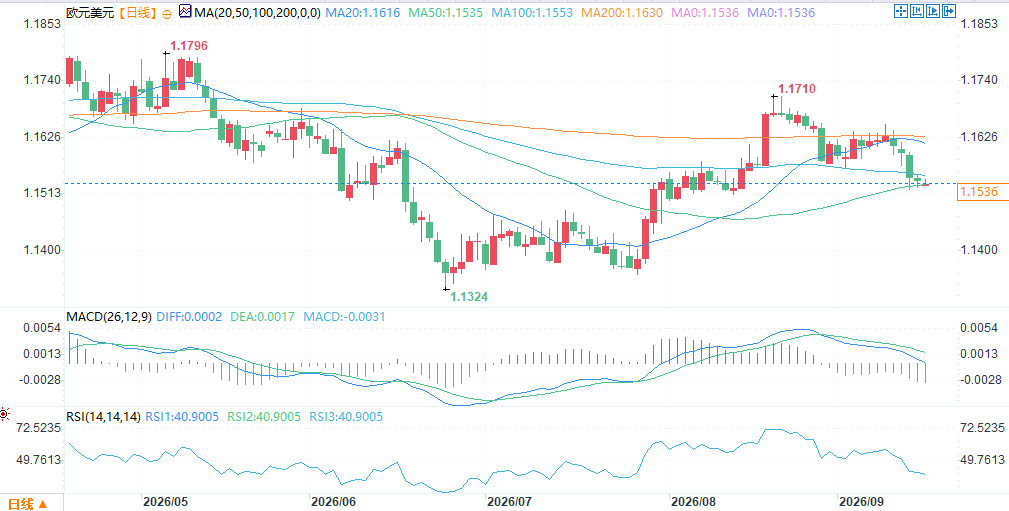 (Euro/USD daily chart, source: FX678) At 7:59 Beijing time, the euro was trading at 1.1536/37 against the US dollar.
Two central banks raised interest rates, but the exchange rate fell.
A currency pair is priced based on the interest rate differential between the two central banks. The European Central Bank (ECB) has raised interest rates twice since June to 2.50%, while the Federal Reserve's (Fed) upper limit remains at 3.75%. Wednesday will push the upper limit to 4.00%, widening the differential to 1.5 percentage points on the day the ECB's 25 basis point cut officially takes effect. Futures subsequently price in a Fed rate of 4.25% or higher in March, and more likely 4.50% or higher in June, while investors expect the ECB to act again no earlier than December. The two central banks are raising rates for the same reason—oil prices broke $100 per barrel after Saudi Arabia closed pipelines around the Strait of Hormuz—but the two economies are at opposite ends of that price range. The US is a net oil exporter, while the Eurozone imports almost all of its crude oil. The same price allows the Fed to raise rates in a growing economy, but the ECB to raise rates on an import bill. The dollar index is slightly below 100. The European Central Bank (ECB) president called last Thursday's decision an "easy decision," as it was unanimously approved. The Governing Council's own forecasts are 3.0% inflation this year and 2.5% next year, with growth revised upwards to 0.9% this year and 1.4% next year. On June 11, the day the ECB raised interest rates for the first time, the euro traded around 1.1600 against the dollar; it closed at 1.1538 on Tuesday, while the Federal Reserve has not yet raised interest rates.ZEW Survey: Expectations Worsen, Only Banking Sector Shows Improvement
The ZEW survey of investor confidence in the eurozone fell to 25.8 in September, below the expected 39.9 and August's 31.4; the German reading was 34.7, below the expected 42.5. Current conditions have improved, with the eurozone reading rising from -21.5 to -13.9 and Germany from -61.1 to -47.1 – the economy looks better than before, but the outlook is worse. The survey authors attributed the improvement to conflict-related energy prices and what they called “hybrid attacks.” The German 10-year yield has been at its highest level since 2011 since the ECB's decision, as the bond market prices in a rate hike that the survey says the economy is not yet ready for. The only sector to improve in the survey was banking, rising 8.2 points to 52.9 – the sector that receives interest payments from others. The automotive sector was at -22.6%, and the steel sector at -16.7%. Such a survey reflects the constraints facing the ECB in fulfilling investors' expectations of a December rate hike, which risks a reduction in the euro's interest rate path, rather than the dollar's.Frankfurt issued a statement an hour before Washington.
Eurozone industrial production for July was released at 17:00 Beijing time on Wednesday, down 0.2% from a flat reading in June, with two Governing Council members speaking at 20:15 and 21:00 respectively. The ECB President spoke at 01:00 Beijing time on Thursday, an hour before the Fed's decision. The Governing Council stated last Thursday it would not commit to a path in advance, and the President said no further steps had been discussed. It has been six days. The Fed's decision was announced at 02:00 Beijing time on Thursday, pricing in a 25 basis point rate hike at 92.5%, a second rate hike in December and a third in March. A press conference was held at 02:30, following the release of US retail sales at 20:30, with an expected increase of 0.8%. The ECB's chief economist spoke at 15:00 Beijing time on Thursday, the final August inflation reading was released at 17:00, with core inflation expectations remaining stable at 2.4%, and the Bank of England's decision was announced at 19:00. Eurozone finance ministers met on Friday.Summarize
The European Central Bank (ECB) raised interest rates to 2.50% last Thursday, which officially took effect on Wednesday, coinciding with the Federal Reserve's (Fed) expected first rate hike since July 2023. The ECB has already raised rates twice, while the Fed has yet to act, yet the euro continues to weaken – the core reason being that the two central banks are at opposite ends of a $100 oil price range: the US is a net exporter, while the Eurozone relies almost entirely on imports. A ZEW survey showed investor confidence falling to 25.8, far below expectations, with the only improvement in the banking sector; the automotive and steel sectors remained weak. Such surveys constrain the ECB's ability to deliver on its December rate hike expectations, risking a reduction in the euro's interest rate path. Wednesday's focus will be on Eurozone industrial production and speeches by the ECB President and the Fed Chair; Thursday's focus will be on the ECB's chief economist, the final Eurozone inflation reading, and the Bank of England's decision. (Euro/USD daily chart, source: FX678) At 7:59 Beijing time, the euro was trading at 1.1536/37 against the US dollar.
- Risk Warning and Disclaimer
- The market involves risk, and trading may not be suitable for all investors. This article is for reference only and does not constitute personal investment advice, nor does it take into account certain users’ specific investment objectives, financial situation, or other needs. Any investment decisions made based on this information are at your own risk.