A Fed rate hike is imminent! The 10-year US Treasury yield has broken through 5%, hitting a nearly 19-year high. Is a global shift in borrowing costs imminent?
2026-09-16 09:26:08
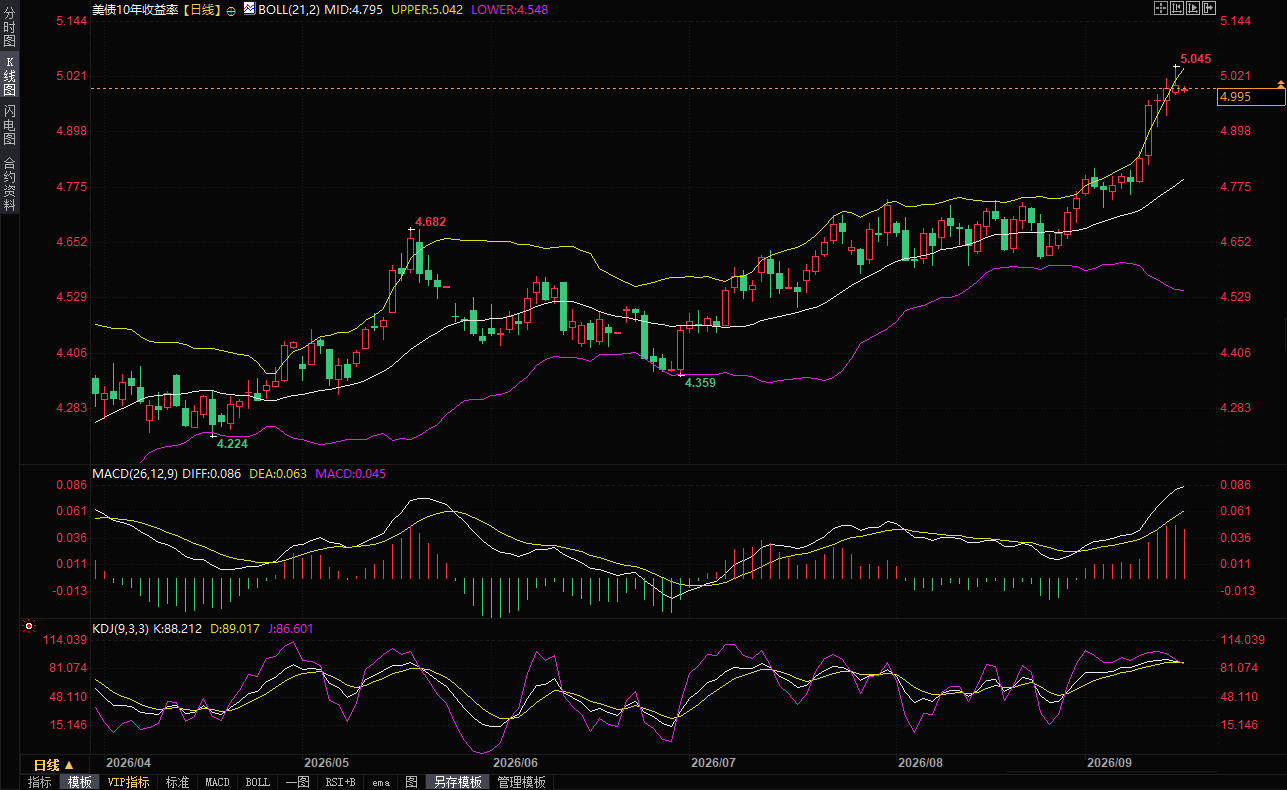
On Tuesday (September 15), the yield on the 10-year U.S. Treasury note touched and broke through the key psychological level of 5%, reaching its highest level since 2007 at 5.045%, marking a significant turning point for the bond market. This rise in the benchmark interest rate directly increased borrowing costs across various categories, from mortgages to business loans, adding further pressure to an already strained economy and stock market. The upcoming Federal Reserve interest rate meeting, the economic growth and inflation outlook, oil prices driven by geopolitical conflicts, and stock market performance will collectively determine the next direction of yields. 
Market Background and Direct Impact of US Treasury Yields Breaking Through 5%
The 10-year US Treasury yield, which moves inversely to bond prices, is a core benchmark for global borrowing costs. This yield touched 5% again on Monday and further reached a near 19-year high on Tuesday, closing in the range of approximately 4.995% to 5.01%, having briefly surged above 5.04% overnight. This level has only been seen briefly in 2023 since the 2008 financial crisis. Michael Antonelli, Managing Director at Beyerdynamic, pointed out that rising yields are clearly dragging down stock market sentiment. Major US stock indices continued to decline, with the Dow Jones Industrial Average falling more than 300 points in a single day, and the S&P 500 and Nasdaq also under pressure. Higher long-term interest rates have increased mortgage and corporate financing costs, dampening consumption and investment.The Fed's policy path becomes a key variable
The current timing comes just before the Federal Reserve's interest rate decision-making committee meeting. Interest rate futures indicate a roughly 90% probability of a 25 basis point rate hike by the Fed on Wednesday (September 16th), which would be the first rate hike in over three years. The current target range for the federal funds rate is 3.50%-3.75%, and a hike would push it to 3.75%-4.00%. Futures pricing also suggests two to three more rate hikes within the next year, with the policy rate potentially peaking near 4.50%-4.60%. Rate hike expectations typically push up long-term yields, but this is not absolute. If the market believes that rate hikes will effectively curb inflation and slow economic overheating, the rise in long-term yields may slow or even decline. Don Ellenberger, head of multi-sector strategy at Federal Reserve, stated that rate hikes reflect the Fed's determination to bring inflation down to its target, which helps to mitigate the upward momentum of 10-year yields. Historical experience provides a reference. Deutsche Bank's review of past rate hike cycles found that the 10-year yield rose by an average of about 114 basis points in the first year after the start of the cycle. Analysis by 3Fourteen Research also shows a similar magnitude. However, the current context is unique: yields have risen by approximately 100 basis points over the past year, and the current 5% level is already attractive to some investors. The real yields on Treasury Inflation-Protected Securities (TIPS) are also at their highest levels since 2008, which may limit further significant upside potential.Growth, inflation, and oil prices collectively support high yields.
Wall Street is currently relatively optimistic about economic growth but pessimistic about inflation, creating conditions for yields to remain high. Several bank CEOs have stated that despite rising lending rates, consumer and business borrowing demand remains strong. Bank of America CEO Brian Moynihan stated that the Fed's rate hikes will not disrupt the pace of the economy. The surge in oil prices caused by the Middle East conflict is a significant source of inflation concerns. International benchmark Brent crude oil prices have recently risen to around $108-110 per barrel, with the closure of a key Saudi oil pipeline exacerbating supply pressures. MFS Investment Management analyst Kish Patak points out that bond investors are not only concerned about the rate of increase in energy prices but also about the duration of these high levels, as sustained increases in energy costs are more likely to be widely passed on to consumer prices.The potential impact of stock market performance and the Treasury's share buyback program
This year, stock and bond yields have mostly risen in tandem. Recently, the stock market has declined while yields have continued to rise. If the stock market experiences a significant correction, investors may flock to safe-haven assets such as bonds, thereby pushing down yields. Patak believes that the wealth effect from the stock market rally has previously outweighed the erosion of real income by energy prices; a stock market crash due to factors such as concerns about artificial intelligence security could be the beginning of a decoupling between oil prices and yields. The U.S. Treasury's expanded long-term bond repurchase program is also a significant factor. The Treasury is attempting to at least double the size of its long-term bond repurchase program to lower yields. In recent operations, the plan was to repurchase up to $6 billion of 10- to 20-year securities, but only about $5.2 billion was actually completed, indicating insufficient selling pressure at current prices. Several more repurchase arrangements are scheduled until early November, each targeting at least $4 billion. Market reactions are mixed: some believe it will curb rising yields, while others worry that raising expectations without delivering on them could backfire.Editor's Summary
The 10-year US Treasury yield breaking through 5% marks a new phase in borrowing costs, and its subsequent trajectory is highly dependent on the implementation of Federal Reserve policies, inflation (especially energy prices), and the balance between economic growth and stock market performance. Historical cycles show that interest rate hikes are often accompanied by further increases in yields, but current real interest rates are already high, and repurchase operations and potential safe-haven demand may provide a buffer. The market is at a critical juncture, observing the Fed's resolve and economic resilience. Whether yields have peaked or entered a higher range will directly impact global asset pricing and the financing environment for the real economy.Frequently Asked Questions
Q: What does the 10-year US Treasury yield exceeding 5% mean for ordinary homebuyers and businesses? A: It directly pushes up mortgage and business loan rates, increasing monthly payments and financing costs, and suppressing some housing and investment demand. Q: Will the 10-year yield continue to rise after the Fed raises interest rates? A: Historically, it has risen by more than 100 basis points in most cycles, but if the rate hike effectively curbs inflation and slows the economy, the rise may slow or even fall. Current real interest rates are already high, limiting room for further increases. Q: How do rising oil prices affect US Treasury yields? A: Sustained high oil prices push up inflation expectations, forcing the market to price a higher interest rate path, thus pushing up long-term yields. If the conflict eases and oil prices fall, the pressure will lessen. Q: Can the Treasury's expanded repurchase operations effectively lower yields? A: Repurchase operations can increase demand and support prices, but if the scale is lower than expected or there are insufficient sellers, the effect will be limited, and it may even push up yields due to unmet expectations. Q: What impact will a sharp stock market decline have on yields? A: Investors may turn to bonds as a safe haven, pushing up bond prices and lowering yields, potentially leading to a decoupling from inflationary factors such as oil prices. At 09:22 Beijing time, the yield on the 10-year US Treasury note was 4.995%.- Risk Warning and Disclaimer
- The market involves risk, and trading may not be suitable for all investors. This article is for reference only and does not constitute personal investment advice, nor does it take into account certain users’ specific investment objectives, financial situation, or other needs. Any investment decisions made based on this information are at your own risk.